
The German-Made “Skynex” Arrives in Ukraine
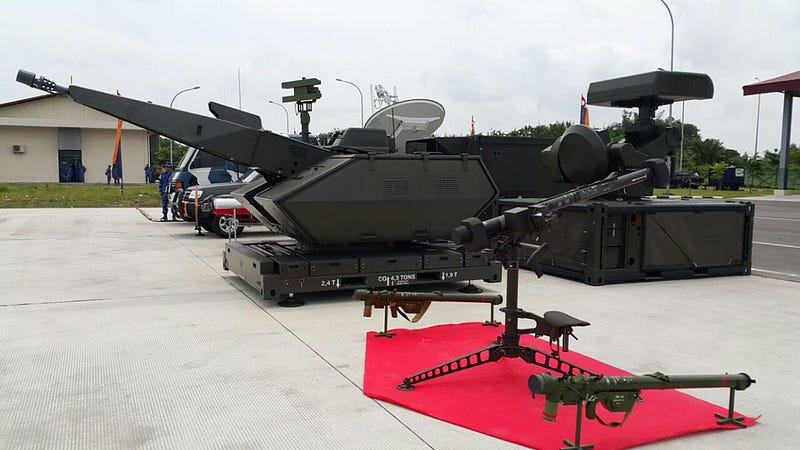
Finally! An air defense weapon system with a cool, futuristic name. “Patriot” is so boring.
Note: Future article idea — How do military leaders come up with the naming conventions of military hardware; Bradley, Patriot, Storm-Shadow, Falcon, Leopard, Skynex? Inquiring minds want to know…
On January 4, the German government announced a substantial military aid package for Ukraine, which, no doubt, made the Americans blush a little at their recent impotence.
Ah, if only there were a little, blue pill that would fix political dysfunction.
Note: Another idea — forget military hardware, what about the bizarre naming conventions of prescription drugs!?
This announcement comes as a direct response to President Zelensky’s repeated requests for enhanced air defense capabilities.
Germany has contributed more to Ukraine than any other nation, besides the U.S., with a current tally of $18 billion in aid so far.
At the start of the war, I envisioned a day in the future when Ukraine would have an “iron dome” of sorts, to protect its citizens from future Russian aerial aggression.
Now, two years later, Ukraine is shooting down on average, nearly 90% of incoming Russian junk.
The German package includes an array of military equipment aimed at significantly boosting Ukraine’s defense capabilities including Marder armored vehicles, tank and artillery ammunition, mine-clearing and bridge-laying tanks, ground surveillance radars, trucks, and assault rifles.
The centerpiece of this aid package is the Skynex air defense system — two actually — and represents a significant investment in short-range air defense.
Manufactured by Rheinmetall, (yep, the same company that makes tank guns for the Abrams and the Leopard), Skynex is a mobile, modular anti-aircraft artillery system, with all components being containerized for easy transport.
The system is operated using the Oerlikon X-TAR-3D situational awareness and detection radar, capable of scanning up to a 50 km (31 mi) radius.
It is controlled via the Oerlikon Skymaster system, which manages up to four 35mm Oerlikon Mk 3 Revolver Gun air defense cannons simultaneously.
In the U.S. military, we call this type of system a SHORAD for “short-range air defense.”
This is different from traditional anti-aircraft missile batteries, like the Patriot, in that the Skynex is a cannon that uses programable, air-bursting ammunition.
And while a gun can still take down aircraft, this particular system will presumably be used in Ukraine to assist with suicide drone defense.
That’s not to say that the Skynex can’t work together with other air defense systems.
In fact, this is one of its biggest selling points: This interoperability allows for seamless integration into Ukraine’s existing defense infrastructure, enhancing overall tactical effectiveness.
The system’s guns are housed in remotely controlled turrets, equipped with advanced fire control systems, enabling automated target acquisition and engagement.
Skynex is armed with a variety of ammunition types, including the innovative Advanced Hit Efficiency and Destruction (AHEAD) munition.
This programmable ammunition is designed to release a cloud of sub-projectiles at an optimum range, determined by an integrated laser rangefinder, to effectively neutralize both large drones and smaller UAV swarms.
While the donation of Skynex bolsters Ukraine’s air defenses, it’s worth noting that the delivery of only two systems, with a total of eight to twelve firing modules, somewhat limits their effectiveness.
Ukraine will need to deploy these two systems strategically to provide critical protection to key infrastructure and military assets.
I’m not saying that Germany’s donation wasn’t significant — each Skynex costs upwards of $200 million and Germany paid Rheinmetall to send them to Ukraine — just that two systems that have such limited range (50 km) aren’t going to provide widespread protection.
But it’s still lethal.
Perhaps the biggest advantage of Skynex, compared to something like the Patriot missile battery, is the speed with which the system can be packed up and moved to a new location. In theory, this should allow Ukraine to experiment with locations that need them the most.
This portability also makes them harder targets for Russian strikes — not that Russia would target them anyway as they seem happy to attack civilians over military targets.
SHORAD systems like this became popular in the asymmetric conflicts of the 2000s. Forward operating bases that were susceptible to incoming rockets, artillery, and mortar rounds used SHORAD to provide a level of assurance to soldiers stationed close to the action.
But the AHEAD ammo is what truly makes Skynex special, and so effective against LSS threats (Low, Slow, and Small) AKA drones.
The 35 mm version produced by Oerlikon Contraves splits each projectile into 152 tungsten submunitions “that form a cone-shaped pattern to destroy a target’s control surfaces and other vital components”.
So, it’s basically an exploding bullet with about 150 angry tungsten fragments moving at the speed of sound and shredding anything in its general vicinity.
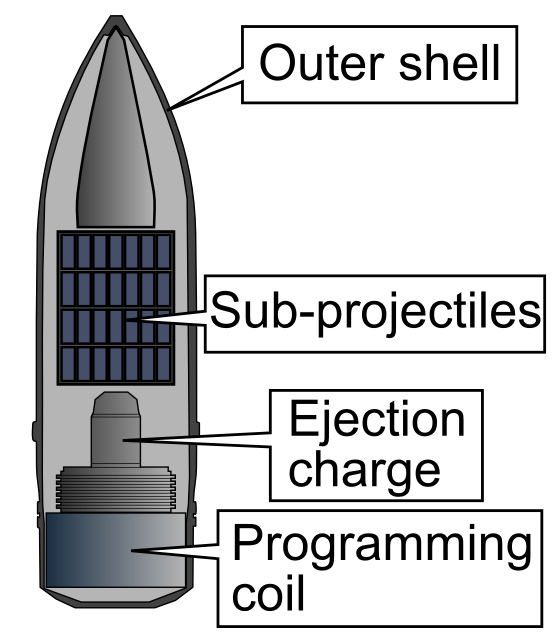
When this system was under development in 2021, Rheinmetall tested its 35 mm Revolver Gun against drone swarms with AHEAD ammunition.
An eight-drone swarm was neutralized with an 18-round burst, most of them being destroyed with the first 6 rounds.
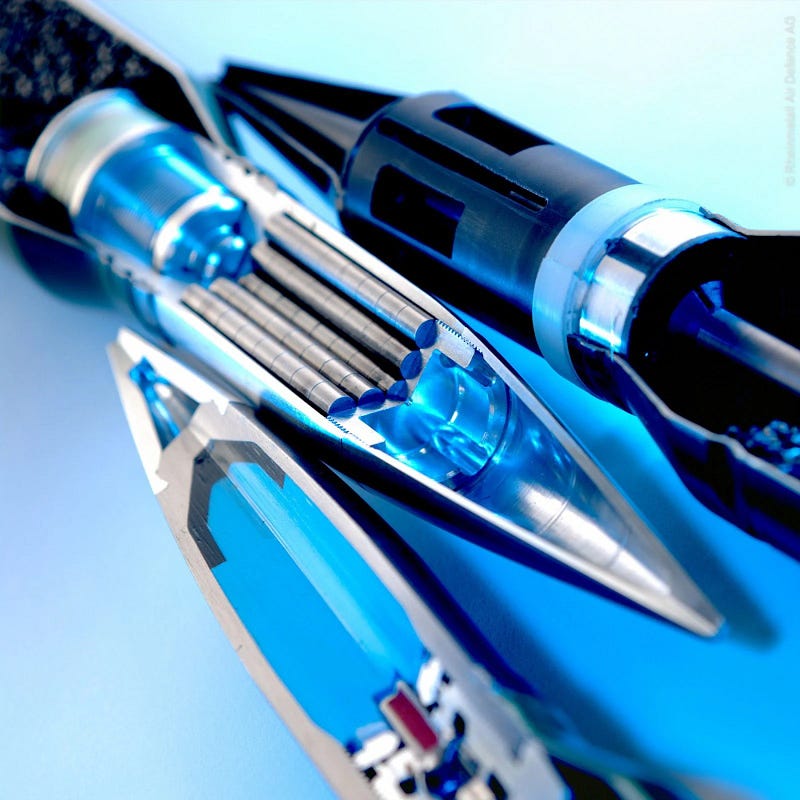
I’m frequently impressed and terrified in equal measure at the innovations coming out of the “blow sh*t up” industry.
In Ukraine, nothing goes to waste.
I do not doubt that they will put these new weapon systems to good use protecting their citizens from Russia’s Iranian-supported suicide drone attacks.
All I ask is that we send more.
Слава Україні