
The Genius of the Little Golden Books
The series has added books on Star Wars and Dolly Parton, and it’s still a terrific value
If you’ve bought books for a young child recently, you could be forgiven for wondering: Is the day coming when I’ll have to borrow against my 401(k) plan to afford these?
High-quality children’s books are expensive — and getting more so.
Last year School Library Journal reported that the average children’s hardcover book costs $18. That’s a steep price for a lot of families in any season. It’s steeper in a pandemic that’s involved a double whammy for some households: Job losses and other hardships have turned new hardcovers into a luxury as school and library closings have put free books out of reach.
The cost of books may give you pause even if you’re a well-off aunt, uncle, or grandparent who can fund vacations or contribute to a college savings plan. What if three of a child’s friends also decide that the perfect birthday gift is that $17.99 Pinkalicious hardcover you’ve wrapped up?
Fortunately, one children’s series has always held prices down: the Little Golden Books that generations of adults have grown up with. Each book cost 25 cents when Simon & Schuster launched the series in 1942. Then — astonishingly by today’s standards — the cost stayed the same for 20 years, or until it went up to a princely 29 cents in 1962. The cost now varies with the title but averages about $5 per book, or roughly the same, adjusted for inflation, as it was nearly 80 years ago.
More than 1200 Little Golden Books titles have appeared and, by Amazon’s count, 467 are in print. These books are now attracting their fifth generation of readers, one that extends from the so-called matures (the parents of boomers) through Gen Z.
Newer releases have involved celebrities like Dolly Parton and Ruth Bader Ginsburg and the Star Wars and Lion King franchises. Like the original batch of 12, the latest books have a nearly square format, patterned golden spines, and lightweight paper that’s easy for small hands to carry.
More than the low cost accounts for the remarkable longevity of the series, which the Smithsonian honored in a 2013 exhibit. The early Little Golden Books attracted — along with their share of long-forgotten contributors — some of the finest picture book creators of the 20th century. They included Margaret Wise Brown, author of Goodnight Moon, and Garth Williams, illustrator of Charlotte’s Web and The Little House on the Prairie books.
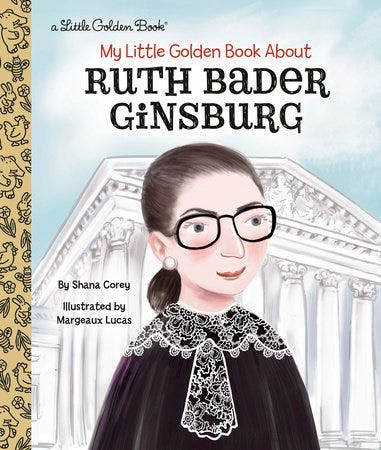
Like the first Golden Books, the latest appeal to ages as young as 2. So they offer the simplified or idealized views that define the series. As the literary scholar Perry Nodelman wrote in Words About Pictures, the books “sacrifice details in order to focus on the typical,” or images or archetypes that speak to a wide range of children. In My Little Golden Book About … Ruth Bader Ginsburg, the Supreme Court justice has the unlined skin of a teenager while wearing one of the lace-collared black robes of her later decades.
Such romanticized visions may have less appeal for older preschoolers used to books by authors like Maurice Sendak and Chris Van Allsburg. But in best Golden Books, the idealism coexists with warm and realistic pictures or text.
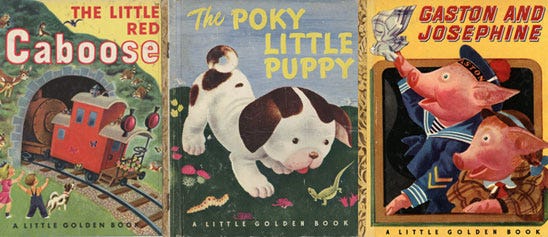
An example is The Poky Little Puppy, a perennial bestseller that was among the first 12 books in the 1942 series. It’s ostensibly about a canine slowpoke who, unlike his more punctual siblings, gets home too late for dinner and must go to bed “without a single bite of [strawberry] shortcake.” On a deeper level, the book is about the joys of the natural world. The puppy dawdles to explore what he sees around him — a “a fuzzy caterpillar,” “a quick green lizard,” and other creatures. Gustave Tenggren’s gentle pictures soften the blow of the loss of the shortcake. The puppy radiates such sweetness that no one could think him intentionally wayward (which is just what many children might want their parents to think when they get home late).
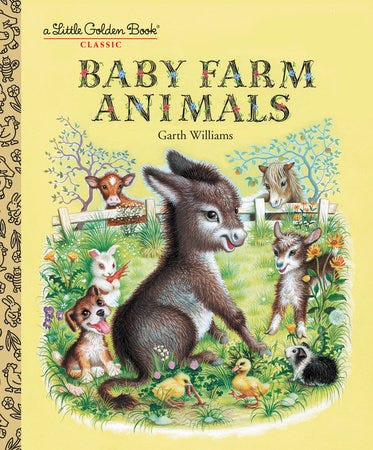
Even better is Garth Williams’ Baby Farm Animals, first published in 1953. This ageless charmer has full-page pictures of 14 animals found on farms: lambs, kittens, calves, foals, chicks, ducklings, piglets, cygnets, goslings, puppies, guinea pigs, and more.
Critics have rightly praised the warm and lush detail of Williams’ drawings. His creatures have some of the most expressive eyes you’ll find in a picture book, and the text shows a sly wit. Williams writes of one of his creatures: “Baby Donkey loves to eat juicy carrots. He is sitting down because he is tired. Somebody is trying to make him stand and follow those carrots tied on the end of a stick. ” The donkey isn’t budging. “I know that trick,” he says.
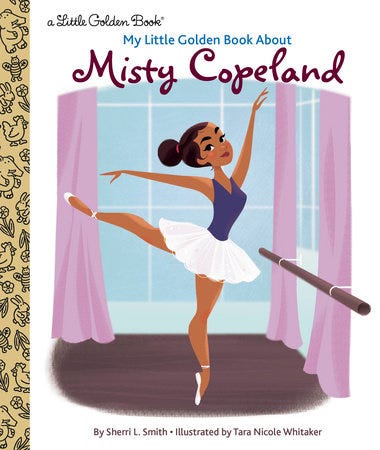
Over the years, the series has expanded to focus on subjects from a broader cross-section of ages, races, and cultures. It has books on Frida Kahlo and Kamala Harris with one on ballerina Misty Copeland due out in January.
The newest entry, published last month, celebrates Betty White, an actor few 2- and 3-year-olds might recognize. So is it intended more for children or for their boomer and Gen X elders? It hardly matters. The book introduces White to preschoolers, in an age-appropriate way, and offers nostalgic pleasures to older generations. That kind of cross-generational appeal helps to explain the staying power of the series. The writer Clare Barnett has said:
“A Little Golden Book as one of their first books is a part of childhood that adult readers of today likely have in common with their grandparents.”
There’s little reason to doubt that the trend will continue. For 79 years, the Little Golden Books have been a literary goldmine that keeps yielding fresh ore to new generations.
@janiceharayda is an award-winning journalist who writes about books for adults and children on Medium and elsewhere.