
The Genius Behind Apple’s Cloud Native & AI Strategy
Apple Vision Pro is gearing up for its debut in February 2024, showcasing Apple’s commitment to shaping the future of spatial computing. In 2023, Apple stood out as the only major tech company to avoid significant layoffs, still achieving impressive financial results with their traditional product line-ups. Despite this success, Apple has acknowledged the need to catch up with the generative AI trend and plans to invest $1 billion annually for this purpose.
What might surprise you is that Apple’s triumphs can be attributed to its robust cloud-native and AI strategy. While Apple has always been a tech giant, its recent strides in AI and cloud-native technologies have taken its success to new heights. The company’s continuous innovation in these areas has played a pivotal role in its ongoing achievements.
But what exactly is this cloud native and AI strategy that is making Apple stand out so much? Let’s find out!
Chapter 1: Apple Founders’ Story and History
The founding of Apple was one of the most interesting tech entrepreneurial stories. On 1 April 1976, Steve Jobs, Steve Wozniak, and Ronald Wayne formed a partnership. Together, they founded the Apple computer company.
Since the trio didn’t have a lot of money to finance their business endeavor, they chose to sell off their stuff to raise funding for the project. Steve Jobs had to sell his car, a Volkswagon, and Wozniak sold his HP-65 calculator. It was a pretty expensive calculator back then, with an opening price of $795.
In total, they both made $1,300 from selling these items.
But not all the founding fathers of Apple stuck around to see it become the industry behemoth it is today. Twelve days after the company was formed, Ronald Wayne left, leaving it all in the hands of the two Steves. Talk about a bad business decision!
The first product Apple launched was the famed Apple 1, made by Wozniak by hand. After the launch, the Apple 1 saw decent success on the market, selling 175 units within ten months. The next key turning point for the company came on January 3, 1977, when the company went from being the Apple computer company to Apple Computer Inc.
During this transition, Jobs and Wozniak had the backing of Mike Markkula, a multimillionaire who had provided $250,000 in funding for Apple.
From here on, Apple grew quickly. The sales went from $775,000 to $118 million between September 1977 and September 1980. Soon, Wozniak was ready with his new invention, the Apple 2.
Chapter 2: Early Success and Progress
Released in 1977, Apple 2 was a major hit.
Not only did people love this model, but it was also the chosen platform for a popular application named VisiCalc. VisiCalc was the first ever spreadsheet computer program made for personal computers. Since it ran on Apple 2, the unit sold like pancakes.
By 1984, the Apple 2 series had already sold over six million machines.
Bolstered by the success of Apple 2, Apple finally went public in December 1980.
The next product Apple launched was the Lisa, a computer named after Steve Jobs’s daughter.
Over $50 million was spent on the development.
However, the product was a huge flop despite being the first mass-marketed computer with a GUI and a graphic user interface. The unit was way too expensive with a price point of $9,995, despite its limited functionality. Jobs had also been pushed off from the Lisa project during its development.
Steve Jobs still believed that GUI computers were the future. So, he chose to continue the concept with the Macintosh. Macintosh was initially supposed to be just a cheaper textual user interface computer.
But Jobs went all in on the GUI, and he wanted to make it cheaper this time around.
The Macintosh was heavily marketed upon launch, and it sold very well. But after three months, the sales came to a near grinding halt due to the bad performance of the computer.
What happened after was a disaster. Jobs left Apple and founded neXT with some other former Apple employees. And then in the coming years, Apple Computer Inc. nearly went bankrupt due to several bad decisions.
But one decision ended up saving the company from bankruptcy. This decision was the acquisition of neXT by Apple for $400 million in 1996.
This was done weeks before Apple would have gone bankrupt. Talk about a close call!
Steve Jobs was once again made a board member but only as an adviser.
What happened next seemed right out of a movie. In a genius move, Steve Jobs staged a coup on July 9, 1997. His scheme was a success as he was able to oust Gil Amelio, the former CEO of Apple. Jobs himself was named the interim CEO.
Jobs was quick to turn around the worsening situation at Apple. He convinced Microsoft to invest $150 million into the company in August 1997. In the same year, he also bought Power Computing, a company that was making clones of Apple products and selling them.
It all paid off, as Apple made over $300 million in profits due to these changes during the first year of Steve’s reign as the CEO.
In the coming years, apple made its most iconic and best-selling products under the leadership of Steve Jobs.
The first was the iMac, released in 1998. It sold 800,000 units in just the first five months of launch. 1999 saw the debut of iBook, which was also pretty successful on the market.
Apple next put out the iPod in 2001, and we all know how popular those were. I mean, in six years, Apple sold 100 million iPods!
Finally, in 2007, Steve Jobs made the big announcement that revolutionised the tech world: the iPhone was being released. Once again, a major success. Two hundred seventy thousand iPhones were sold within the first three hours of launch. And the rest is history.
Apple has since created a loyal customer base around the world, becoming a giant in the Tech industry. After Steve Jobs’s death in 2011, the company reached greater heights with its highly popular product lines, such as iPhones, Apple Watches, and Macs.
Today, very few companies can claim to rival Apple.
Chapter 3: Apple’s Cloud Native Strategy
Apple’s innovation is powered by its thirst for improvement. In recent years, Apple has set its eyes on developing a strong cloud-native environment to further enhance its services and development capabilities.
For five years, the tech giant used Apache Mesos to meet its application development and deployment needs. And why not? The Apache Mesos architecture is great for scaling, perfect for an ever-growing company like Apple.
But there is one downside to Mesos. It presents a huge bottleneck when it comes to responsibility delegation, so much so that Apple was forced to move on.
So, in 2022, Apple announced its move from Apache Mesos to Kubernetes.
Now, what is Kubernetes? Well, it is a container orchestration system maintained by the Cloud Native Computing Foundation.
Kubernetes, or K8s for short, is much better in terms of scaling, privacy, and security than Mesos. It also excels in multitenancy, which is crucial for meeting the application development and deployment demands of Apple.
Kubernetes stands out for its exceptional pluggability and extensibility, enabling Apple to seamlessly adjust its plug-in choices in the future without the need for major system overhauls. The extensive community backing ensures robust support, comprehensive documentation, and a rich ecosystem of plug-ins, extensions, and tools for Apple’s benefit.
However, the migration to Kubernetes hasn’t been without challenges. Apple invested in upskilling its workforce through training programs to adapt to the new cloud-native structure brought about by Kubernetes adoption. Additionally, organizational adjustments were made to guarantee optimal efficiency post-migration.
Aside from all that, apple has also become a platinum end-user member of the Cloud Native Computing Foundation (CNCF). On top of that, the tech giant has contributed to various cloud-native projects, including Kubernetes, gRPC, Prometheus, Envoy Proxy, and Vitess.
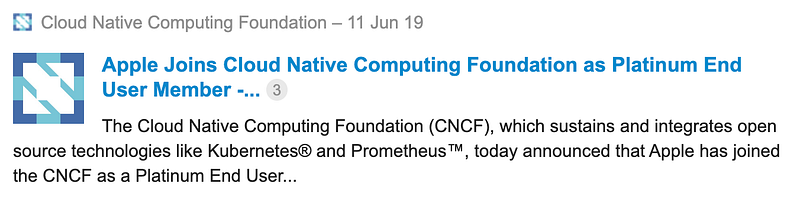
This all clearly indicates that Apple is quickly migrating towards a cloud-native ecosystem for its services, whether it be computing, app development, or intelligence.
Xcode Cloud is a prime example of this, as this project by Apple has allowed developers to develop apps for Apple products while utilizing cloud-native technology.
Apple is working its way towards building a rich cloud-native infrastructure for its products and services. So, we have a lot to look forward to in the future as Apple continues to innovate.
Chapter 4: Apple’s AI strategy
We doubt Apple ever expected AI to take over the way it did. When chatGPT made its debut in 2022, its popularity skyrocketed. And turns out Apple fell behind the curve on this one.
Instead of investing in the new AI technology, Apple chose to just sit and watch as its competitors, such as Google and Microsoft, integrated the new tech into their services.
Apple must catch up to its competitors by developing its own AI technology. This is because AI is the future, and every tech giant in the industry can see it clearly as day. If Apple fails to catch up, it may never be able to compete in the AI market again.
For this, Apple has developed a very strong AI strategy. To make up for the lost time Apple could have spent developing its own AI tools, the company has decided to invest 1 billion dollars every year to advance its AI services.
This includes Apple’s own large language model called Ajax and AppleGPT, a chatbot that is thought to be in development.
There are several ways Apple can utilize AI in its services and products. Siri can be revamped and then decked out with AI features. According to Bloomberg, Apple intends to integrate AI deeply with SIRI to make a smarter version of the voice assistant.
The smart assistant will then be even smarter.
The Apple Music app will likely get AI features as well. For instance, AI could be used to generate playlists for the users.
App developers also have a treat in store for them. Apple is looking into incorporating AI into Xcode. If Apple goes through with this, app development will become much easier and more convenient. The AI could be a great tool for writing and troubleshooting code.
Apple’s strategy is to push AI into as many apps as possible and hopefully catch up to the ever-rising competition.
If Apple is successful in doing this, it could become a leading force in the AI world. While the current AI market is dominated by Google, Microsoft, and Amazon, Apple can become a huge competitor by leveraging AI.
Apple is clearly committed to AI technology, as the company is expected to spend $4 billion on AI servers in 2024.
Apple’s future
From the looks of it, this is only the calm before the storm. Apple has a lot of plans for the future of AI technology, and the company has begun investing heavily to bring those plans to fruition.
And with the cloud-native Kubernetes powering the company on its journey, Apple’s future is exceptionally promising, despite any perceived lag in AI technology. The company’s robust AI strategy is set to bridge any gaps and propel it forward.
Apple likes to bid its time and then come to the limelight with a bang. We are excited to see what Apple will have to offer with its next-generation products, especially with such promising ideas being put out by the development team.
On Apple’s website, they highlighted: Your work is as meaningful to us as it is to you. To them, the most important company assets are creative people and their meaningful contributions to the company.
Looking forward
I hope this blog helps, and if you enjoy this type of content. Feel free to follow me here on Medium , every week I write about entrepreneurial stories in tech industry and share your thoughts and journey about AI with us here’s a video recapping 5 fun facts about AI startup in 2023 on our Youtube channel in case you’d like to learn further. Stay tuned, and see you in the next one!


