
The Gender Wage Gap is Closing
But only for women in this group

If you have been waiting for the wage gap to close, The World Economic Forum has an answer. Our highly evolved civilization will have fully solved this thorny problem in 257 years. In 2017, the wage gap was on target to close in 217 years, but the pandemic has revised that prediction.
Yes, that is right. We are going in the wrong direction.
Currently, American women make 82% of what men earn. But to understand the wage gap, we first must understand how we got that number. The wage gap aggregates ALL men’s and women’s wages to get a median. But that average does not tell the full story.
What is NOT closing the wage gap
Some people deny the wage gap exists, and these arguments further hamstring our ability to close it.
The first wage gap denial argument goes like this; more women work in lower-paying jobs than men, thereby skewing the gap. For example, if more hairdressers are women than neurosurgeons, then that job discrepancy bends the percentages.
But that gap exists within professions too and is larger in some professions. In 2018, the wage gap for accountants was 78%. For nurses, it was 92%. And for lawyers, it was a staggering 58%.
Another argument is the wage gap exists because women are not demanding equal pay for equal work. Jordan Peterson spouts the following syllogism. Agreeable people are less likely to ask for a raise. More women are agreeable than men. Therefore, women make less than men.
Sure. That ties it up in a cute pink bow, but the research doesn’t support his theory. Studies show women ask for a raise just as frequently as men. The difference — they don’t get it.
But there is another reason why women are not getting paid the same as men. And if you have children, you are not going to like this statistic.
What is closing the wage gap
Becoming a mother is one of the most rewarding and life-changing decisions a woman can make. It also comes with a cost — kids are not cheap. And I am not just talking diapers and diplomas. Having children hinders earning potential.
Research shows the wage gap gets larger when you compare working moms to working dads. Working mothers earn 39% less than working fathers. In contrast, a man’s average income increases after he has children.
Economists have called this the motherhood penalty.
Using MBA graduates as a reference point, research from Denmark shows that the gap between childless women in their 20s and childless men in their 20s is small. Female MBA graduates earned an average salary of $115,000 out of graduate school, while men earned $130,000 out of school. That’s not ideal, but it is not as wide as the median wage gap.
But when those same female graduates had their first child, the gap widened. And then the gap closed again during their 50s when they were past reproductive age.
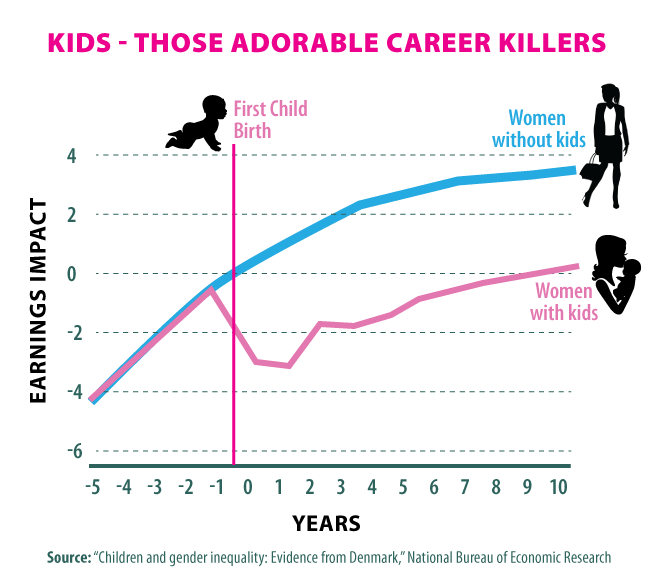
Why is there such a pay discrepancy between working mothers and working women without kids?
To start, “the motherhood penalty” is a somewhat unfair moniker. Many men decide to stay at home and sacrifice their careers for their children. The men who do not make this sacrifice also pay a price — they see their family less.
And men who choose children over their jobs sacrifice the most. Men who reduced their hours for family reasons faced a 15.5% reduction in earnings throughout their careers. Women who reduced their hours for family reasons experienced only a 9.8% reduction in pay.
Let that sink in. Men are penalized more for sacrificing their careers for parenting.
So what we really should call this penalty is a Child Care Penalty.
And with fertility rates dropping, many women have realized the price of motherhood. But what if both sexes shared the cost of parenting?
Research shows the wage gap gets larger when you compare working moms to working dads.
How to close the wage gap
Give national paid leave to BOTH genders
While nearly every other developed country in the world offers paid leave for new mothers and many countries provide paid leave for fathers too, the US has no national paid parental leave system. Private companies decide paid leave, and in 2018, only 17 percent of working mothers received paid leave.
But what if we gave parents EQUAL paid leave for parenting? We are not apes. We are humans capable of thriving as co-parents. Not every woman wants to be the primary care provider. And not every man wants to be the breadwinner. But maternity leave forces the woman to take on the onus of being the primary childcare provider, which inevitably leads to reduced pay.
If we want to close the wage gap, we need to close the parenting responsibility gap. Changing cultural perceptions about parenting will take time. Without national paid leave, companies who genuinely care about closing the gap can offer women AND men equal paid leave for parenting.
If we want to close the wage gap, we need to close the parenting responsibility gap.
Affordable childcare for all
Elizabeth Warren had an even better solution — affordable childcare for all. In 2019, Warren released a plan that offered childcare for children up to 5 years old in which families would pay no more than 7 percent of their income in fees. For families whose joint income was under 50,000, childcare would be free.
The plan would relieve the economic burden for a dying breed — working parents. And Warren was astute to see the need.
According to a 2019 analysis by the Census Bureau and Labor Department data, the number of working mothers with children under the age of six in the labor force has dropped. And it is not just because parents are sitting home changing diapers instead of logging in work hours.
Many are simply not having kids because the cost is too high. It takes an estimated $233,610 dollar to raise a child before the age of 18.
This high cost not only makes women decide not to have children (fertility rates are dropping), but many are also having fewer children or delaying having children until after they have established their careers. Obviously, fertility lowers with age, which turns that wait into a gamble against time.
Flexible work hours
In 2014, Harvard economist Claudia Goldin found the prescription to closing the wage gap in the same place you get your heartburn medicine — pharmacies. Goldin found the wage gap among pharmacists to be small — 95%. So she began to ask why.
Her research showed the size of the pay gap in most occupations was due to a worker’s ability to work longer hours. (This explains why the pay gap is so much larger with lawyers required to work ridiculously long hours.)
In the past decade, many large pharmacies like CVS and RiteAide attracted both women and men to the profession by offering flexible work hours with opportunities for part-time work. This type of pay is “linear pay,” where no one gets rewarded for martyring themselves for a 60-hour workweek.
Unfortunately, pandemic economics may throw a monkey wrench into the linear pay model. Experts predict the pandemic will cause the wage gap to increase because, with kids out of school, more women are spreading valuable resources between childcare and work. And according to recent surveys, women are shouldering the burden of the household more than men. (Feel free to cite that statistic next time you are trying to get your man to do the laundry…It’s for the good of womankind.)
There is no denying a gender wage gap exists, but it does not exist solely because of gender. And parenting is certainly not the only cause. But it might be the head of a roaring dragon.
Either way, if we fail to understand why the gap exists, we will never close it.
About the author:
Carlyn Beccia is an author, illustrator, columnist, and speaker. Beccia's books, including The Raucous Royals, I Feel Better with a Frog in My Throat, They Lost Their Heads, and Monstrous have won numerous awards, including the Golden Kite Honor, The International Reading Association's Young Adult Book Award, and the Cybil Award. For more information: www.CarlynBeccia.com