avatarYury Erofeev

Free AI web copilot to create summaries, insights and extended knowledge, download it at here

1161

Abstract

States simply will not have time to close all coal generation by 2030 — too much capacity and too complicated a regulatory system. Serious domestic political contradictions cannot be discounted either.</p><p id="daca">Japan is the only one of the G7 countries that is still building coal-fired power plants. Three facilities are under construction and another power plant is under design.</p><figure id="9c0d"><img src="https://cdn-images-1.readmedium.com/v2/resize:fit:800/0*arXkGcHWOD3VZ-Bu.jpg"><figcaption></figcaption></figure><p id="b791">As a result, the final communiqué states that countries will prioritize “concrete and timely steps to accelerate the phase-out of domestic coal energy.” But without a specific date. It also reaffirmed “commitment to achieving a fully or predominantly decarbonized energy sector by 2035.”</p><p id="b40a">At the same time, the G7 countries issued a collective commitment to increase offshore wind power to 150 GW and solar power to more than 1,000 GW by 2030. These are impressive figures, but upon closer examination it becomes clear that there is nothing particularly aggressive in them. The “natural course of thi

Options

ngs”, that is, the predicted growth rates of these sectors, could well lead to such installed capacity figures without any special efforts.</p><figure id="8669"><img src="https://cdn-images-1.readmedium.com/v2/resize:fit:800/0*jypKiyBaZ9ppX9x0"><figcaption>Photo by <a href="https://unsplash.com/es/@atulvi?utm_source=medium&amp;utm_medium=referral">Atul Vinayak</a> on <a href="https://unsplash.com?utm_source=medium&amp;utm_medium=referral">Unsplash</a></figcaption></figure><p id="8750"><a href="https://medium.com/areas-producers"><b>Curious About Culture, Intellectual About The World</b></a>. Discover this publication’s content writers explaining scenarios/shifts related to geopolitics, future industrial policies and advanced technologies.</p><p id="4bb0"><a href="https://medium.com/areas-producers/newsletters/the-weekend-brief-twb?source=collection_about-------------------------------------"><b>Sign up for The Weekend Brief (TWB)</b></a> newsletter to stay on top of what’s happening with publicly-traded companies operating in global markets (including stock markets) at the nexus of tech, industrials and global commodities.</p></article></body>

The G7 countries did not agree on the timing of the shutdown of coal generation

Photo by Manuel Cosentino on Unsplash

At a meeting of G7 environment ministers in Sapporo, Japan this month, the UK and Canada proposed setting 2030 as the date for phasing out the use of coal in the electricity industry for all G7 countries.

France, as well as other European members of the group, plan to close their coal-fired power plants before 2030, but they also represent the European Union, and the EU as a whole is not ready to go for it. In particular, Poland plans to phase out coal by 2049.

But the main opponents of establishing a firm commitment at the meeting were the United States and Japan. Although coal-fired power plants are closing at an accelerated pace in the United States, the States simply will not have time to close all coal generation by 2030 — too much capacity and too complicated a regulatory system. Serious domestic political contradictions cannot be discounted either.

Japan is the only one of the G7 countries that is still building coal-fired power plants. Three facilities are under construction and another power plant is under design.
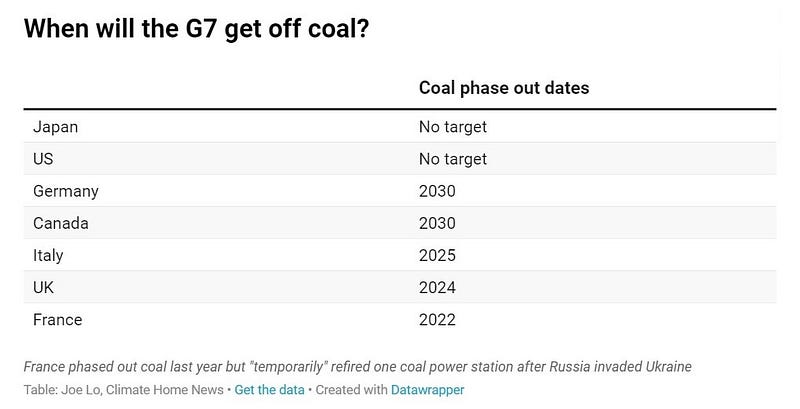
As a result, the final communiqué states that countries will prioritize “concrete and timely steps to accelerate the phase-out of domestic coal energy.” But without a specific date. It also reaffirmed “commitment to achieving a fully or predominantly decarbonized energy sector by 2035.”

At the same time, the G7 countries issued a collective commitment to increase offshore wind power to 150 GW and solar power to more than 1,000 GW by 2030. These are impressive figures, but upon closer examination it becomes clear that there is nothing particularly aggressive in them. The “natural course of things”, that is, the predicted growth rates of these sectors, could well lead to such installed capacity figures without any special efforts.
Photo by Atul Vinayak on Unsplash

Curious About Culture, Intellectual About The World. Discover this publication’s content writers explaining scenarios/shifts related to geopolitics, future industrial policies and advanced technologies.

Sign up for The Weekend Brief (TWB) newsletter to stay on top of what’s happening with publicly-traded companies operating in global markets (including stock markets) at the nexus of tech, industrials and global commodities.


G7
Energy
Coal
Coal Industry
Time
Recommended from ReadMedium
avatarJan Slort
Civilization -the next page.

3 min read