The Future of Organizational Structure and Culture
A discussion on organizational structure and culture to predict what it will look like for the next generation

An organization’s structure provides insights into an organization and the work co-ordination of the business.
Whereas an organization’s culture provides insights into the people and the behavior patterns of the business.
The aim of this article is to enable readers to:
- Understand organizational structure and the purpose of organizing
- Differentiate between the components of organizational structure
- Provide an overview of the new types of organizational design
- Define organizational culture
- Understand the significance of culture and the basic elements
- Understand changing cultural values of organizations
In order to predict what organizational structure and culture will look like for the next generation, let’s first look at it today.
Organizational Structure
Designing a company structure involves the process of organizing and the function of management plays, an important role in the success of the firm.
Structure determines the manner in which a business operates and its overall performance. A defined structure allows the tasks for different processes to be clearly allocated to different departments and employees.
So what is an organization?
An organization is a collection of people who work together to achieve individual and organizational goals.
Also, people will work together more effectively if they know the part they have to play in cooperative activity — how their roles relate to one another.
To design and maintain the system of roles is the fundamental managerial function of organizing.
For an organization to exist and to be meaningful to people, it must have:
- A clear understanding of the major duties or activities involved
- A defined area of discretion or authority so that the person responsible knows what decisions s/he can make to achieve results
When the “structure of roles” is established organizing can function:
The grouping of activities necessary to attain objectives, the assignment of each grouping to a manager/supervisor with the authority required to supervise it.
Why it's important to establish structure?
An organization structure conveys the:
- Clarity of the environment, so that
- Everyone knows who does what and who is responsible for what results
- Removes performance obstacles, caused by confusion and uncertainty
- Establishes a decision-making network of communication
Historical development to structuring organizations
Prior to the industrial revolution, businesses were small, less complicated. The industrial revolution changed that, exploding production and sales en-masse:
- Organizations grew, becoming more complicated, prompting the need for ways to better manage the business
- Early management approaches focused on organizational structure as the key to effective management
Weber’s Bureaucracy theory specified that effective and efficient business management required a division of labor, a hierarchy, and formal rules.
Fayol’s Administrative Management proposed similar points, adding a reference to authority, centralization, unity, and chain of command.
Organizational Structure Defined
According to Hitt (2008), organizational structure can be defined as:
“The formal arrangement of tasks within a firm and is frequently a hierarchical concept.”
Organizational structure determines the manner in which it operates and performs. The wrong structure can hinder the success of the business.
Structure allows the responsibilities of different functions and processes, clearly allocated to different departments and employees.
An effective organizational structure can facilitate working relationships across various business verticals in an organization
Worthington & Britton stated that an organizations’ structure allows it to:
- Achieve effectiveness in the utilization of resources
- Enable the monitoring of organizational performance
- Ensure individual accountability
- Guarantee coordination between the different parts of the enterprise
- Provide an efficient and effective means of organizational communication
- Enhance job satisfaction, with opportunities for progression
- Adapt to changing circumstances caused by internal or external developments
Selecting the most appropriate structure for a business is the responsibility of senior management. Their remit is to implement a structure that:
- Optimizes an organization’s capacity and ability to compete
- Creates value
- Improves service to customers
- Aligns the goals of the organization
Organizational Structure Design
The following factors can influence the structural design of an organization:
- The organization’s size, industry and sector
- The nature and composition of its staff
- Its task(s)
- The environment
- The established style and culture
The Principles of Organization
Some of the principles of an organization, if implemented should aid the organization’s structure and operations are as follows:
- Unity of Objectives | Unity of Command | Scalar Principle
Span of Control
- Delegation | Responsibility | Specialization (a division of labor)
The components of an organization’s structure are twofold:
- Structural configuration
- Structural operation
Let’s look at each one of these components:
№ 1 — Structural Configuration/Division of Labor: is the extent to which the work of the organization is broken down into different tasks.
№ 2— Structural Configuration/Span of Control: no one manager can supervise all employees in an organization, so it's important to decide how many subordinates a superior can manage effectively.
The exact number of subordinates will depend on underlying factors.
Although, the general rule of thumb is usually four to eight subordinates at the upper levels and eight to fifteen at the lower levels of an organization.
Span of Control
The eight factors below can determine the number and frequency of a manager to the subordinate relationship:
- Subordinate Training
- Clarity of Delegation of Authority
- Clarity of Plans
- Rate of Change
- Use of Objective Standards
- Communication Techniques
- Amount of Personal Contact
- Variation by Organization Level
Hierarchy— Centralization and Decentralization
When authority is delegated it is said to be decentralized. Decentralization is dependent on:
- Being capable managers throughout the organization
- Being policies and guidelines to guide their action
- Centralization is the opposite — Senior managers make all the decisions
- Centralization is the only option when an organization is relatively small
Advantages of decentralization
Subordinates and junior managers have the opportunity to participate in decision-making, so feel part of the organization's direction.
- Good training for junior managers
- Encourages junior managers to be responsible for their decisions
- Line managers are not burdened with routine decision-making and free to concentrate on more important issues
- Allows for decisions to be made quickly and closer to the point of impact
Disadvantages of decentralization:
- Control and coordination for top management is more difficult to achieve
- Requires a robust communication system if decentralization is to succeed
- A risk if people focus on their own goals, rather than organizational goals
- Decentralization is difficult to achieve and may do severe damage to the organization where managers are not trained or capable
Approaches to structuring organizations
Types of formal organizational structure/departmentalization are:
- Functional Departmentalization
- Product Departmentalization
- Geographical Departmentalization
- Divisional Departmentalization
- Matrix Departmentalization
So let’s look at each one of these in a little more detail:
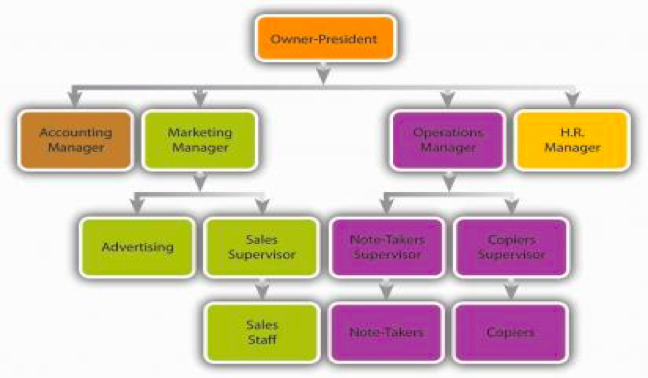
№ 1 — Functional organization: It's common for organizations to structure themselves across functional lines according to major functions e.g. Marketing, Finance, HR and Sales, etc.
Managers must be allowed to make decisions for that function i.e. given functional authority.
№ 2— Functional departmentalization: The main advantage of this type of organization is that it groups people together based on their technical and specialist expertise, facilitating the coordination of the entire enterprise.
The major disadvantage of this method is that it can give rise to the growth of sectional interests which may be detrimental to the organization's needs.
№ 3 — Product Departmentalization: Another form of structure is grouping by product. This is popular in large organizations with diversified products.
The main advantage is that it can better cope with technological change by grouping expertise, specialized technology, into one major unit.
The main disadvantage is that each manager may promote his/her own product group in a way that creates problems with other departments.
№ 4— Geographical Departmentalization: A popular form of is grouped on a geographical basis. A regional manager is in charge of an area. The main advantages are:
- There is knowledge of local circumstances which facilitates decision-making & should lead to better customer service at a local level
- If plants for the manufacture & assembly of products are located within close proximity, this should reduce transport costs
- It can provide a useful training ground for managers before they become involved at the general manager level
- Its major disadvantage is to the extent that management is dealt with at a local level, this may cause additional problems for top-management control
№ 5— Mixed Structures: Due to the increasing complexity and size of organizations, companies are opting for a mixed structure, which combines the benefits of two or more functions, like finance or HR.
The first of such mixed structures is Divisionalised structure, the second being the Matrix structure.
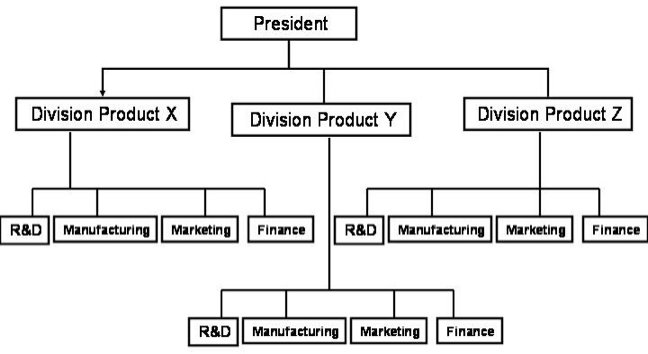
Divisionalised — In this structure, the organization is divided by division on the basis of product and/or geography.
- Each division is operated in a functional form
- Certain key functions remain at company headquarters
- One would generally find this type of organization structure is highly diversified firms operating internationally
Matrix Structure — This is a new type of structure, which has come about as a result of coordination problems in complex industries like aerospace.
A matrix structure usually combines a functional form of structure with a product-based structure.
Advantages of a divisionalized or matrix structure
Attention focuses on the requirements of the project group which helps to clarify who is responsible for the success of a project.
- Encourages functional managers to understand their contributory role in the organization’s productive efforts — offsets individual empire-building that can be found in the functional form of structure
- Leads to customer goodwill as the project manager deals with the customer
- Useful training ground for potential general managers as the position of a project manager involves a wide range of responsibilities
Disadvantages of a divisionalized or matrix structure
Potential conflicts can arise concerning the allocation of resources and the division of authority between project groups and functional specialists.
- Gives rise to the possibility of divided loyalties between members of project teams in relation to their own project manager and their functional superiors
- The functional management may neglect their job and let the project manager/team undertake everything
Organization structure terms
A formal organization exists when two or more people come together to achieve a common objective. The structure of this organization can be examined in the following ways:
№ 1— Line organization: the chain of command that connects each level:
- Line authority with the right to command and give orders
- This structure is at the heart of an organization
№ 2a— Staff organization: As a business grows line managers are not able to cope with the increased workload (staff assistants), finding that the growing organization requires other expertise (staff specialists)
- Staff organization support consists of staff assistants and staff specialists
- Staff assistants support line managers, taking up some of the workload
№ 2b— Staff organization: Staff specialists are hired for their expertise
- Staff organization has staff authority — the right to assist (staff assistants) and the right to advise (staff specialists)
- They don't have the power to make decisions or give orders
№ 3— The networked organization: This type of structure is one that retains a small core of business activities but outsources most of its functions
- There exists a rational philosophy that other organizations can perform activities far better and at less cost due to their specialization in this area
- The core of the organization oversees, controls and coordinates this network to make sure the operation as a whole operates effectively
- Rather than a hierarchy of authority, the network is controlled by a series of contracts specifying performance
While each company has to meet a level of performance, they also have to have complete autonomy in order to do it.
№ 4— The cluster organization: This type of structure groups employees from different parts of the business together in “clusters”:
- No formal hierarchies — employees operate on a self-managing basis, as part of project teams
- The cluster acts as a profit center, so responsible for its own BU performance
- Clusters are supported by functional areas of the organization
№ 5 — The high-performance organization: Seeks to increase the motivation of employees by establishing self-managed teams:
- These teams are empowered to take responsibility and make decisions about the way their work is done
- This results in raising the levels of commitment and involvement
Culture
Organizational Culture is “the sum total of the knowledge, values, beliefs, attitudes of mind & customs to which people are exposed.” (Handy, 2003)
Charles Handy also noted culture as “the way we do things round here.”
Culture helps an organization’s individuals to understand which actions are considered acceptable and those that are not.
The significance of culture
Culture influences the external image of an organization. In this respect, it can impact an organization’s legitimacy — its acceptance by the outside world.
Culture also influences the internal motivation and satisfaction of employees, thereby impacting the strategic ability of an organization.
Basic elements that make up culture
- Visible artifacts — comprises of the outward expression of culture
- Overt statements of belief — part an organization’s mission statement
- Basic underlying assumptions — fundamental values that guide behaviors, reflecting core values and beliefs of individuals in the organization
Factors that affect culture
- Economic conditions
- Leadership style
- The nature of the organization’s tasks
- Structure, Policies, and practices
- Demographic nature
The following four generic types of culture are easy to identify:
- Power culture — centralized power with a loose structure. Internal competition for power is rife
- Role (bureaucracy) culture — job structures and formal relationships are more important than individual personalities. Structures are formal with set rules and procedures so jobs are strictly defined
- Task culture — the focus is on “getting-the-job done”. Flexibility, innovation, creativity and job satisfaction are key due to high participation, communication, and group identity
- Person culture — where the emphasis is on serving the interests of the individuals involved
Culture can also be related to the strategic inclination of a business, here are three types:
The Defenders type
- Appropriate for organizations in low-risk, secured market
- Reflects continuity and consensus where decision making is formalized
- Focus is on efficiency
The Prospectors type
- Applies to organizations that take risks
- Reflects decentralized structures
- Focused on effectiveness
The Analyzers type
- Applies to organizations that aim to balance risk and profit
- Prefers to use the core of a stable business as a source of earning to support simultaneous risky prospecting
- Culture following but not initiating change
The Organizational Paradigm
A paradigm is a “taken-for-granted” frame of reference that affects how a given situation is perceived & how it is responded to.
- Allows the experiences gathered over time to be applied in a given situation so that the organization’s strategies can be formulated in a certain way
- It is the dynamic expression of the organizational entity
The paradigm not only indicates the organization’s dominant culture but also indicates how entrenched that dominant culture is within the organization.
The Stages in the Life Cycle of an Organization
As organizations develop and grow, they follow a life cycle comprising of various stages of their evolution.
Sequential in nature, following a natural progression.
Organizational structure and culture can change to match the characteristics of the organization at each of its respective life stages.
№ 1 — Entrepreneurial phase:
- The organization is small and non-bureaucratic
- The top manager provides structure and control
- Culture is focused on survival and innovation
- Risk of conflict as the organization grows
№ 2 — Formalization phase
- The organization that’s experiencing rapid growth
- The structure tends to be informal; however, key priorities and directions are being prioritized
- Culture is one of excitement and high energy
№ 3 — Establishment phase
- Formal systems and processes start to be introduced
- Risk of becoming overly bureaucratic
№ 4 — Growth phase
An effective balance between the formal structure and processes on the one hand and people and culture on the other hand — the primary characteristics of this the final phase.
Final thoughts
To conclude, below is an insight to what organization of the future might look like and how this will reflect in their cultural values.
The organization of tomorrow
- Small is beautiful — the organization of tomorrow will no longer be big corporations, but small, flexible and adaptable firms.
- Non-permanence — the society of tomorrow will be characterized by change. This implies that organizations may have to change their tasks or nature at least once.
- Customers rule — the organizations of tomorrow will be challenged to have a less internal focus of power while being increasingly controlled by the customer.
- Non-employment — the organizations will be challenged to redefine work not as employees but as transactions.
- Without boundaries (boundaryless) — organizations will be defined by job descriptions, work locations, or work hours.
The changing cultural values of organizations
It is anticipated that organizations of the future will demand managers to:
- Operate without hierarchy, thereby without the benefits of positional power.
- Compete in a way that enhances rather than undercuts co-operation, thus to have a high standard of ethics.
- Have a sense of humility since with the fast pace of change there are always new things to learn.
- Be multifaceted and ambidextrous — completely flexible.
- Shift emphasis from status to contribution — from the attainment of position to attainment of results.
So where is your business structure and culture on the life-cycle spectrum?
References
- Caramela, S., 2018. The Management Theory Of Max Weber — Business.Com. [online] business.com. Available at: https://www.business.com [Accessed 21 March 2020].
- Lipman, V. (2015). People Leave Managers, Not Companies. [online] Forbes.com. Available at: https://www.forbes.com [Access. 21 Feb. 2020].
- Quain, S., 2018. The Advantages Of Fayol’s Principles Of Management. [online] Smallbusiness.chron.com. Available at: https://smallbusiness.chron.com [Accessed 21 March 2020].