
The Future of Online Writing: Why Web3 Will Blow Away Sites Like Medium and Quora
Listen up, writers.
Life doesn’t care how comfortable you are in your current situation. It marches on.
Evolution is inevitable.
Exploring previous versions of the Web
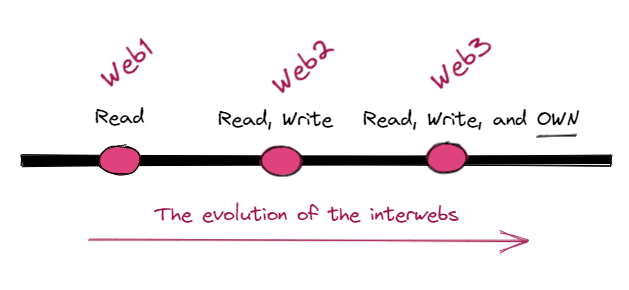
Our parents’ generation found this out as they watched dial-up internet and AOL strangle the newspaper to death in broad daylight. Those who loved the newspaper fought till the bitter end, but that war is over (despite what your grandpa thinks) and ultimately the internet, or “Web1”, won out.
Eventually, though, reading online news grew stale. People weren’t satisfied just consuming content. They wanted to take part — to create. And thus Web2 was born along with company-owned apps like Twitter, Facebook, and Instagram.
There, people could create and upload their own content onto the internet. They could engage with others, build followers, and reap (some) rewards in the process. Over time, Web2 evolved into the present-day creator economy we all know and love, where creators earn money doing pretty much whatever they want.
- Gamers stream on Twitch
- Lewds go on OnlyFans
- Writers publish on Medium
People believe we’re living in the epitome of creatorship, and to date, it’s unarguably the best it’s ever been. I mean, FINALLY, you can learn a living from your bedroom playing video games!
The creator economy has become so appealing that when LEGO did a study two years ago, it showed children were 3x more likely to aspire to be a YouTuber than an astronaut. My girlfriend’s kid is one of them.
Who can blame them? The money can be great. The opportunities are “endless”. And everybody wants a shot at virality and superstardom.
But Web2 is just a toddler’s den compared to Web3
People are becoming privy to the fact that, even now, the companies behind our favorite “creator-first” apps gobble up a much larger slice of the pie than the creators do.
Focusing specifically on the field of writing, sites like Medium, Quora, and NewsBreak are starting to pay their writers more and more in hopes of retaining their high-quality creators, who in turn create high-quality content and thus grow their business.
They’re doing this because they know we writers have more options than ever, with more coming out every day.
Even still, the current state of the creator economy is nothing compared to how Web3 will revolutionize the system. Just like Web1 turned the newspaper into nothing more than a handy cleaning tool around the house, Web3 will make its predecessors look like chumps. It’s the next natural phase of evolution.
What is “Web3”?
Don’t be turned off by the term because you don’t know or don’t care to know what it means. I resisted it for a while out of ignorance, but now that I know, it’s really awesome.
Web3 is essentially the same as Web2, except for two key differences:
- The engine behind Web3 is blockchain technology, like Ethereum. Everything is open-source, transparent, and built on math/algorithms.
- On Web2, you can read and create content then get paid separately in return for your work. On Web3, you can read and create content, but you are also granted ownership of the platform you publish on in exchange for your efforts.
Imagine…what if you, as a creator, were given OWNERSHIP for your contributions to a website like Twitch TV. Say if, for every 100 views, you were given a small share of the company. That would be pretty sick, but also fair because you are contributing to their success as a business. And, it would incentivize you to continue producing on their platform.
Web3 is not some new-age, Bitcoin HODLer bullshit. It’s the real deal.
With Web3:
- You don’t have to worry about your content disappearing or being censored at a company’s discretion. It lives on the blockchain where everything is open and transparent and decentralized. No one entity owns it. It’s owned primarily by its users, a.k.a. YOU.
- You don’t have to worry about company’s like Medium changing their algorithm resulting in hundreds, sometimes thousands, of personal lost income.
- You can finally earn what you deserve instead of greedy corporations profiteering off of your masterpieces, all while paying you in peanuts.
Web3 is every creator-at-heart’s utopia, and that’s what we have to look forward to.
I’ve checked out some of the Web3 companies working on building the writing playground of the future. BitClout was an OK start, but it’s more like decentralized social media, not specific to the craft of writing. Mirror.XYZ appears to be better for writers and perhaps could be the “next big thing”.
But, there’s also still plenty of room for other platforms to rise up and steal our hearts and metaphorical pens. Who knows what it’s going to be, but we know where it’s going to be — Web3.
Web2 served its purpose, but soon Web3 will be here to replace it
I can’t scroll down my Twitter feed without reading about someone who’s left their high-paying tech job to work on Web3. It’s where everyone wants to be. It’s the way of the future.
Once Web3 is widely adopted, we’re all in for some really cool shit.
- You can have ownership in the platform you choose to write on
- Your articles could become NFTs that people bid hundreds, even thousands of dollars to “own”
- YOU could be one of those bidders who owns a piece of your favorite writer’s work
Writing was always meant to be a physically expressive, documented form of free speech. But for too long it’s been censored and controlled by company-owned entities like Google who, at any time for any reason, can change the way it works.
It’s time for us, the writers — the creators — to retake ownership of our words and our expressions, and Web3 will be there for us.


