
The FUSELLM Breakthrough: Blending the Best of Large Language Models

Background and Motivation
- Problem Addressed: 🏋️ Training Large Language Models (LLMs) is resource-intensive, leading to redundancy in capabilities. Knowledge fusion emerges as a solution, merging existing LLMs into a stronger, more efficient model, addressing the challenge of diverse architectures and redundant functionalities.
- Proposed Solution (FUSELLM):🧠 The study introduces FUSELLM, an innovative method that fuses LLMs via probabilistic modeling. This approach harnesses the generative powers of source LLMs to encapsulate and impart their collective intelligence and unique strengths to a target LLM.
Key Concepts and Techniques
- Source LLMs:🌐 Llama-2, MPT, and OpenLLaMA, each bringing unique architectures and functionalities to the table.
- Knowledge Fusion Approach:🔗 FUSELLM specializes in aligning tokenizations from different LLMs and merging the probability distributions they generate.
- Training Objective:🎯 Aims to reduce the divergence between the target LLM’s probabilistic distributions and those of the source LLMs.
- Implementation Details:🛠️ Involves token alignment for accurate mapping of probabilistic distribution matrices and sophisticated fusion strategies for effective knowledge merging.
- Datasets:📊 Utilizes MiniPile, a diverse yet concise dataset, for the continual training of the target LLM.
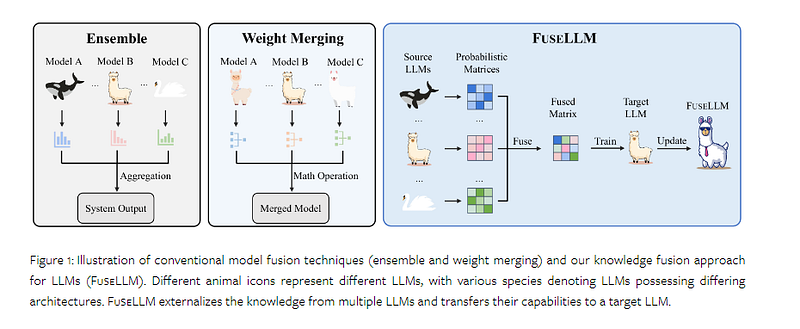
Research paper — https://arxiv.org/html/2401.10491v1
Experimental Results
- Evaluation: 📝 Conducted on benchmarks spanning reasoning, commonsense understanding, and code generation tasks.
Findings:
- 1. Performance Gains:📈 FUSELLM outshines each source LLM and baseline models, demonstrating enhancements in reasoning, commonsense comprehension, and code generation.
- 2. Effective Knowledge Integration:💡 Proves the capability of FUSELLM to merge the expertise of structurally distinct LLMs more efficiently than traditional ensemble and weight merging techniques.
Conclusion and Future Directions
- Summary: ✅ The study showcases FUSELLM as a robust technique for LLM knowledge fusion, outperforming traditional training methodologies and existing model fusion strategies.
- Implications for Future Research:🔍 Emphasizes the potential of LLM fusion as a fertile ground for exploration, especially given the varied structures and substantial sizes of LLMs.
Additional Insights
- Code and Resources:👨💻 Authors have made their code, model weights, and datasets accessible, fostering further research and development in the field.
This paper marks a notable advancement in the strategic use of LLMs, presenting a cost-effective and powerful method for model evolution and knowledge amalgamation.