
The Fragrance of The Night Jasmine Still Lingers in My Mind
DEP Fall contest — What does fall mean to you?
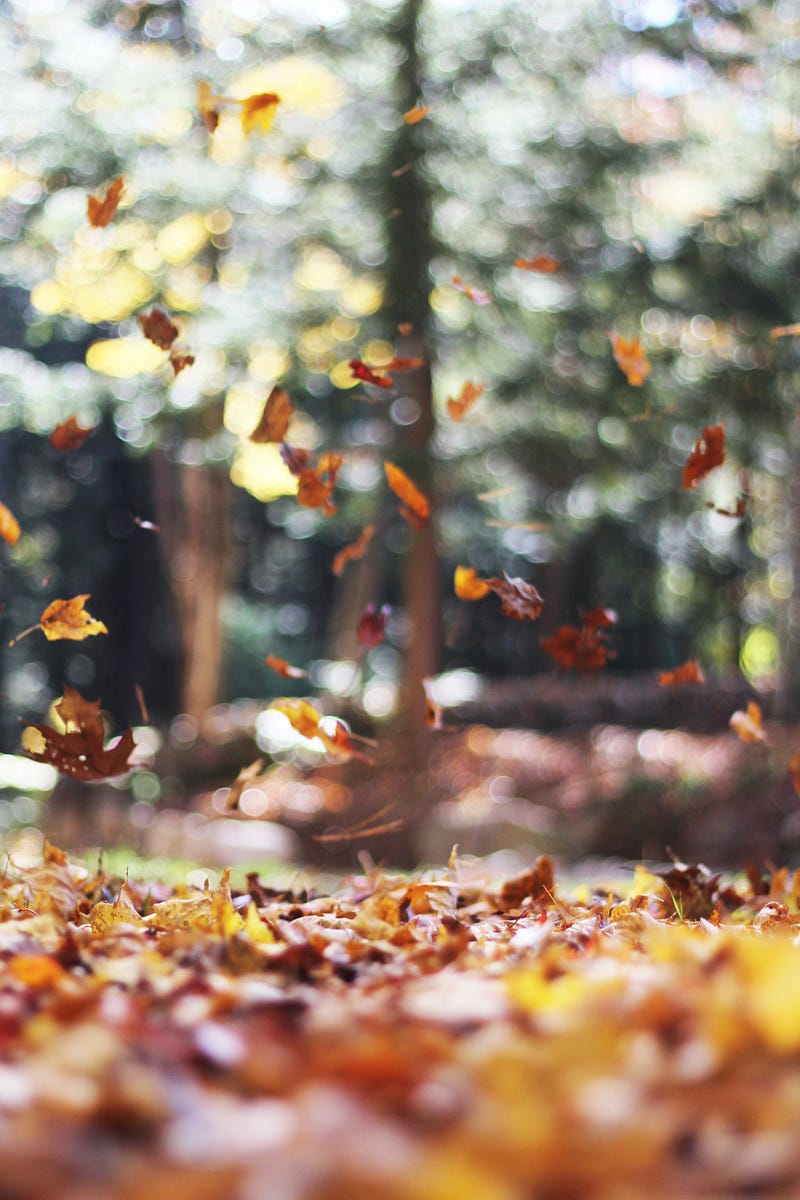
The crisp autumn air
There’s a nip in the air. The Kans grass has started to bloom. The leaves are turning from all shades of yellow, orange, and crimson red, before turning brown. The sugar maple tree in my backyard has now crimson red leaves. The clouds are like balls of cotton floating in the sky.
This takes me back to my childhood days and makes my heart ache — it’s a longing to go back home.
As a child, the word autumn seemed magical. It was only after I grew up and moved to the USA that I came to know the word fall, which is an equally beautiful word.
I grew up in a tropical place — in Kolkata, India, where the monsoon is long and prominent. Autumn brings a pleasant respite to the hot and sultry summer and the constant rain for over four months.
Although it was not just the change in weather that made me look forward to autumn so much, it was also an end to the year-long wait for the festivals — a month-long celebration that starts with Durga Puja and ends with Diwali — the light festival.
Now that I have grown up and live far away in the Netherlands, I marvel at the thought of how our festivals are connected with mother nature and more importantly, how I, as a child paid minute attention to this.
The joy of nature
Growing up in Kolkata, the omnipresence of the Kans grass (called kaash phul in Bengali) in autumn was very symbolic. The first sight of this flower meant Durga puja was approaching.
We follow a lunar calendar and start with our celebrations on the first day of the new moon in the autumn as the beginning of Durga Puja (or Navratri in other regions of India). It’s the celebration of good over evil.
While coming back from school, I would marvel at the Kans grass fields and how beautifully the white long stems swayed in the wind. Nature is resplendent in its abundance.
The new moon gradually changes to a full moon marking other festivities like the Lakshmi puja (the goddess for wealth) or the kite flying festival (this happens a bit earlier though, before the Navratri) during this time.
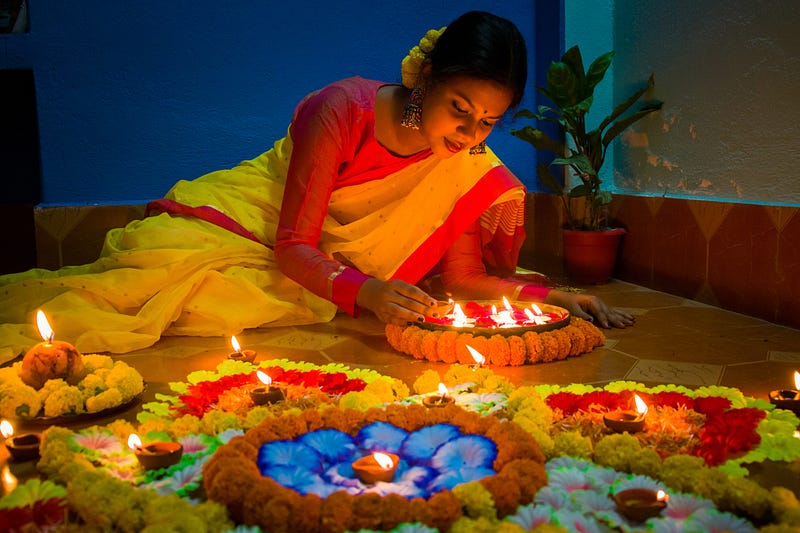
The full moon then changes to the next new moon and this is when we celebrate Diwali — the symbolic victory of light over darkness.
The sound of the distant drums adds to the excitement. The drummers came from far-flung villages. Playing drums during the festival time was their only (in most cases) source of income.
When I think of autumn, I think of the early morning dews on the earth, and the freshly fallen night jasmine, called shiuli in Bengali. This flower is also known as parijata, the lady of the night, the night-blooming jasmine, or simply the queen of the night. According to Hindu mythology, this is regarded as one of the five wish-granting trees in heaven.
Wish-granting or not, it does fill the air with a sweet and mind-blowing fragrance that still lingers in my mind and takes me down memory lane.
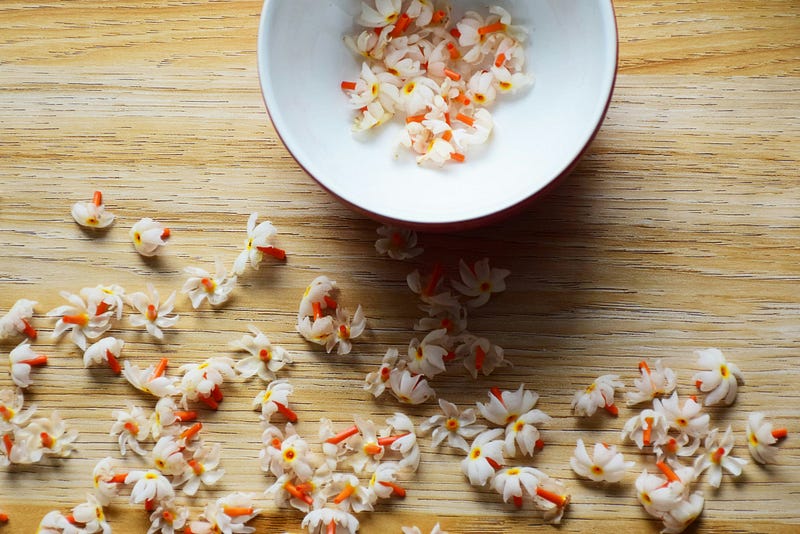
There is a magical transformation in the air and the sweet fragrance of the night-blooming jasmine floating in the air makes my heart miss a beat with unexplained longing and joy and sings a melancholy strain.
Surprisingly though, that’s a happy one, as Victor Hugo put it, “Melancholy is the happiness of being sad.”
A sense of community
Some of you may know the diversity of Indian cultures, places, languages, religions, food, and festivals. But many of you may not know how community plays a big role in all our celebrations.
Unlike many other Western cultures, we thrive on providing a sense of community to each other. None of our celebrations are confined to the walls of our homes. We open our hearts and the doors of our homes to everyone.
All these festivals take place on the streets or in neighborhood parks where all of us would congregate. Every year, painstakingly, we create pandals — a temporary abode for the idols out of cloth and tents. Food stalls are built on the sides of the streets which means there’s no cooking for the next four days.
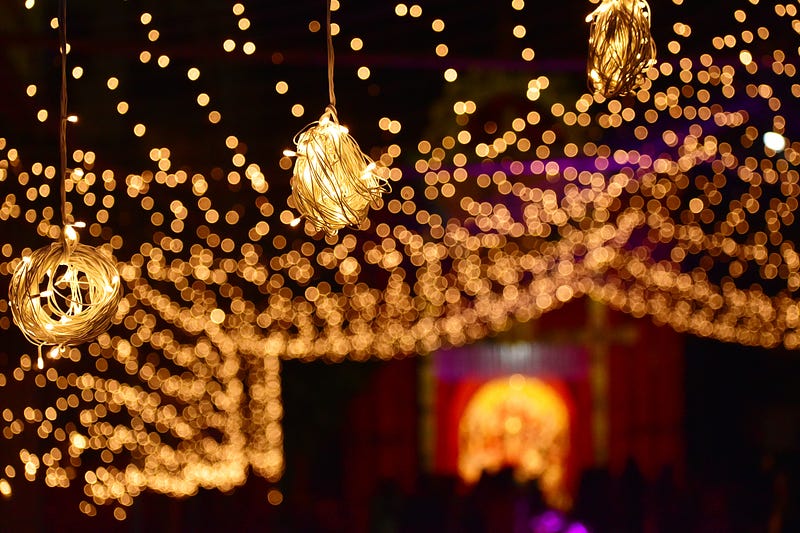
The streets are filled with decorations and lights. People are busy buying gifts for each other. You could feel a sense of busyness but in a good way.
The artists and craftsmen who create the idols in Kumortuli — the place where all the idols are being made and exported worldwide — would be busy applying the finishing touches.
The next few days would be transformed into a fairytale where no one slept at night and hopped from one pandal to another with friends and family — a time for fun and frolic.
We children had the most fun. There was a month-long holiday and we literally had no rules to follow. This was one time in the year when we were allowed to stay up late, hang out with friends, or eat whatever we liked.
Preparing for the festivities
Preparing for the oncoming celebrations also added to the excitement. We would start with cleaning and preparing the house first. It’s like spring cleaning, except it’s in fall.
The women at home (we lived in big joint families) always played a big role in the preparation by making sweets and savory for the festive season that would last us for a long time. We would exchange these sweets as gifts with friends, family, and neighbors for the next month until Diwali.
The house would smell of milk boiling for hours on low heat, coconuts being desiccated, making butter and ghee, or extracting juice from a ripe palm to make palm fritters and other sweets.
I would lend a hand in shaping the laddoos too using gram flour, sugar, jaggery, or coconut, even though I would break some of them. It was hard work and many hands made it easier and more fun.
The touch of the raw coconut, the palm, and the oil in your hand, while you are shaping the sweets, felt comforting and familiar.
We would also make savory snacks that would last long like Nimki — a simple, crispy, crunchy snack made with wheat/flour and cumin seeds. I would impatiently wait for those crunchies to be deep-fried and ready to be eaten so that I could taste a handful.
Now and then
Not much has changed when it comes to celebrating our festivals. Although the women in the house are no longer (and rightfully) confined to the four walls of the house, and hence a month-long sweet and savory-making process can be too tedious or time-consuming.
But we still light up our houses and streets and celebrate as a community. The gifts are still exchanged. The weather has changed, it has become way hotter but the Kans grass still blooms, the morning dews are still there, albeit later in the season, and the night jasmine still blows my mind away.
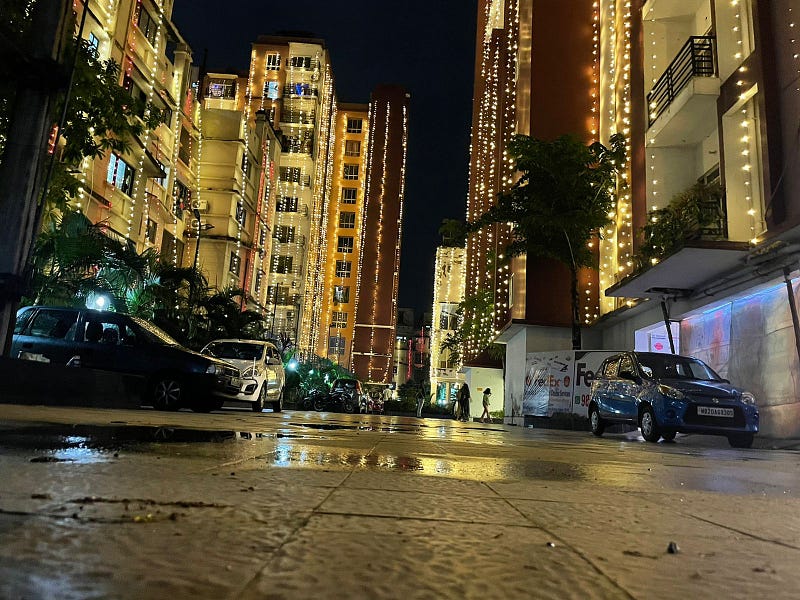
I have not been home in the fall for the past 17 years but the onset of this season still makes me happy. The abundance in nature fills my heart with joy and takes me down memory lane to my childhood days — to the Kans grass and the night jasmine.
The melody of autumn
And to end this nostalgic journey, here’s a poem by my daughter Oishi.
High up in the trees, There are hues of red and green.
Drops of water pellet down, Leaving small dark splashes on the clean, paved ground.
The rustling of leaves and the faint smell of hot chocolate, Slowly fade away.
The couples walk through the pathway, Hand in hand they sway.
As the leaves drift to the ground, the vast sky darkens, There’s a vivid green glow, the result of rain in the gardens.
The wind runs through the leaves, blowing away everything in its path. Guiding the trees to dance to their melody,
The melody of autumn.
- Oishi Chakraborty
Thank you for reading my story.
Many thanks to the DEP editors Dr. Gabriella Korosi, Vidya Sury, Collecting Smiles, Dr. Preeti Singh, Annelise Lords, Libby Shively McAvoy, and the DEP fall contest sponsor DR Rawson - The Possibilist.


