
The Forgotten Girls: Life in White Rural America
What if you take all the good parts of J.D. Vance’s Hillbilly Elegy — the close description of rural life after deindustrialization — and got rid of all the bad parts — the self-aggrandizement and the Horatio Alger myths?
You’d end up with something a lot like The Forgotten Girls, by Monica Potts.
And you’d have a solid story.
Potts delivers in The Forgotten Girls a memoir about growing up in rural Arkansas in the Ozarks. But she puts more focus on those around her than on her own life. She extensively interviews the people of her hometown, even moving back to it while writing the book. And she embeds within her project deeper concerns about ‘deaths of despair’ and the special problems afflicting people who live in regions like this one.
The Forgotten Girls and My Hometown
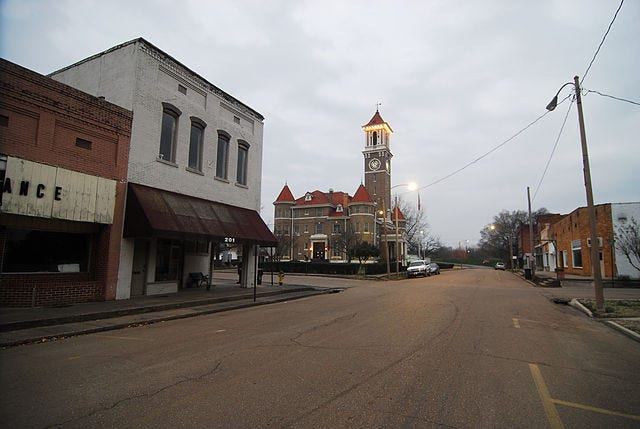
I recognized my rural southern Indiana hometown in her depiction of Clinton, Arkansas. You can call my hometown the ‘lower Midwest’ or the ‘rural Midwest.’ Either way, it’s that part of the Midwest that’s about as Southern as Midwestern.
But, really, the list of similarities isn’t about region. It’s about the collapse of civic institutions and local government. It’s about how churches dominate most aspects of social life. The towns ruthlessly sort kids into the ‘good’ ones who do well in school and might leave someday versus the ‘bad’ ones who party, do drugs, and will probably get (or get someone else) pregnant.
These towns judiciously avoid actually facing any of their problems. They appeal instead to moral panics (once satanism, now child sex trafficking or grooming).
For people who grow up in these towns, leaving is the only sensible solution. Even if they really want to stay.
Getting Out
Let’s talk more about the idea of ‘getting out.’
Most teenagers carry fantasies of leaving their hometown. A few even want to leave their home country. In that sense, there’s nothing special about where Potts (or I) grew up.
But for people like Potts and I, it’s not just a goal. It’s a way of life. I mean, getting out becomes a life project in the tween and teen years. Your life is literally built around doing the things you need to do — and avoiding the things you need to avoid — in order to leave.
And this feels different. It causes a person to make different life choices and set different priorities.
Potts describes quite well what it’s like to live this kind of life as a teenager. She describes how you have to distance yourself from ‘home’ in order to make it happen. You have to alienate some friends and even family. And, even after leaving, you return only carefully and reluctantly. At least until you find your footing.
Potts went through this cycle with her best friend, and I went through it with my closest friends. Like Potts, I had to go out into the world alone, and I held it against my friends for awhile.
People from rural areas lack knowledge of the basics practically all upper middle class kids grok. They usually don’t know that many elite colleges, for instance, offer heavy financial aid. Given my family’s income and my test scores, I probably could’ve gotten a free college education at a great private school.
Of course, it would’ve meant a major life adjustment at age 18. And I struggled enough to adapt to college life even in Bloomington, Indiana. Could I have adjusted to a Dartmouth or a Harvard?
Maybe.
Politics
Let’s return for a moment to The Forgotten Girls versus Hillbilly Elegy. Unlike Vance, who uses rural white poverty as a prop for his own Horatio Alger myth, Potts tries to think about rural white America on its own terms. She shows how broader social forces produce these places and how these places adapt to social forces.
And she does so successfully, for the most part. But her political analysis comes up short in some ways. Potts comes tantalizingly close to getting it right when she admits that her friend Darci — who struggles greatly with the town’s overwhelming expectations, religion, and so on — doesn’t vote and that the ‘successful’ people in the town (the middle class and up, churchgoers, and so on) are the town’s actual voter base.
And then she blows it. At multiple points she repeats tired talking points about how rural white America votes against its own interests. Even after admitting this doesn’t really work as a frame.
That’s how powerful the frame is.
People in towns like Potts’s, for the most part, aren’t voting against their own interests. Especially their wealthier and more religious voters. Trump’s base in these towns is made up of well-off right-wing white Christians. And the GOP serves these people far better than Democrats do. And as for the people who might be interested in voting Democratic — the marginalized, the non-voters, et al. — Democrats are hardly even interested in winning their votes or including them in their party.
That said, Potts does understand the political diversity of rural white America. Even if she doesn’t lay it out explicitly. While voters in towns like Clinton are quite right-wing, and often authoritarian, non-voters carry political sentiment ranging all the way from proto-fascism on the right to socialism, anarchism, or communism on the left.
By contrast, places like Iowa City adopt a kind of hegemonic liberalism or progressivism. You’ll find few Republicans in Iowa City, but also few genuine socialists or communists. Mostly you’ll find the kinds of people who vote for Pete Buttigiegs or Elizabeth Warrens.
Girls
Finally, I’ll say a word about the ‘Girls’ of the title The Forgotten Girls. Potts wants to draw attention to the unique issues girls face in rural white America.
People in these towns sexualize children, but especially girls. That’s the secret of why they’re so worried about ‘grooming’ in liberal areas — because lots of people actually do things like this in their own towns! They just assume liberals do it, too. Readers who didn’t grow up in rural areas miss this component of it.
Teen pregnancy in these towns is rampant. And it has been rampant for decades. It goes even all the way down to 14 or 15 year old girls. And the towns blame girls for it far more than they blame boys. They label girls as ‘boy crazy,’ but not vice-versa.
Potts draws all this out very effectively and in a way that’s highly accessible to outsiders. For that reason alone, The Forgotten Girls is worth a read.
N.B.
This article contains affiliate links.


