
Was this Uneducated Frenchman the Most Ingenious Literary Forger of Modern Times?
He made a fortune selling 27,000 letters From Cleopatra, Aristotle, and Lazarus
“Most ingenious forger of modern times” That’s the description I kept running into online when researching French literary forger Vrain-Denis Lucas (sometimes referred to as Denis Vrain-Lucas).
But was he really ingenious? To find out, I talked with Joseph Rosenblum, professor of English at University of North Carolina and author of several books on literary forgery.
His response wasn’t what I expected.
A day in the life of a literary forger
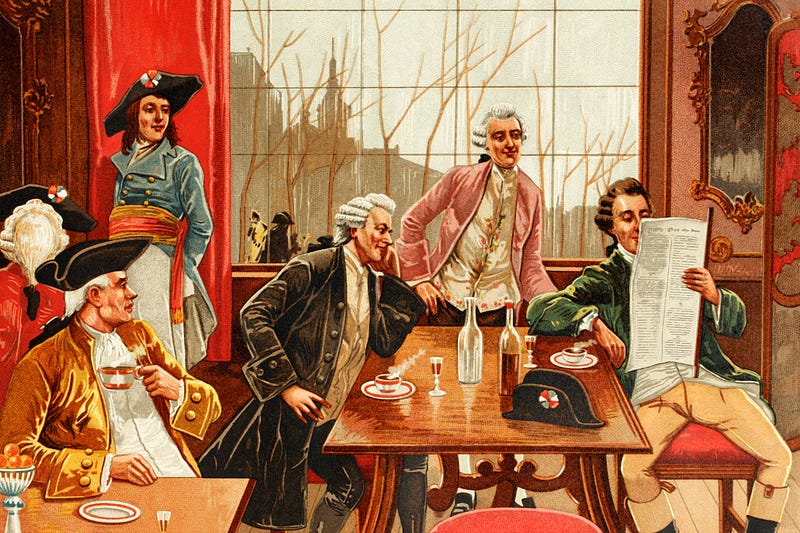
It was just after 11am, mid-1867. Vrain-Denis Lucas sat alone, as usual, with his back against the wall of the small Parisian restaurant and ate his modest lunch.
He would have preferred to be in Cafe Riche — it was the place to be for all the great writers and artists — but finances were tight. (His lover had been enjoying her shopping sprees.)
Everything would be fine, though. He just needed to deliver his next batch of letters and bring in more cash.
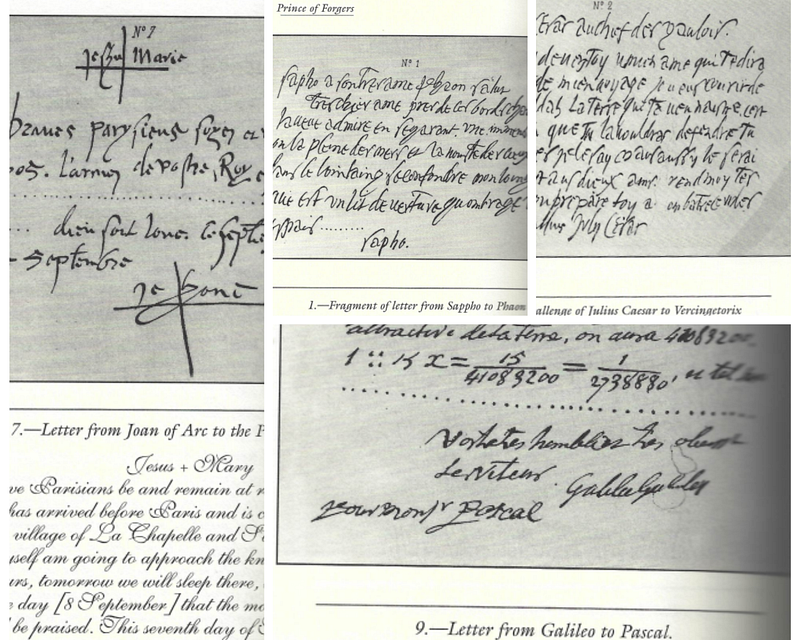
After lunch, he would head to the Imperial Library and start his work for the afternoon. Perhaps today he’d write letters from Pascal to Newton, Cleopatra, Aristotle maybe, and another piece from Galileo.
Lucas’ loyal buyer was a brilliant but naive mathematician named Michel Chasles. Lucas hoped this next selection of letters would thrill Chasles and he’d pay handsomely for them.
He imagined delivering the letters: calmly handing them over to Chasles, playing up the oblivious-agent role that worked so well. “My acquaintance wants me to sell these, but I have no idea if they’re worth anything.” For all his supposed brilliance, Chasles had proven quite an easy target.
Then he’d watch the excitable academic get carried away in his enthusiasm.
Lucas paused, his next bite hovering above the plate in front of him. What if Chasles refused to buy more?
There had been some criticism of his last Galileo letter from the Academie des Sciences: How would Galileo have written a letter after the date he went blind? The criticism could cost him Chasles’ trust.
The forged Pascal letter had particularly excited Chasles. He’d tried to use it to prove Pascal, a French man, had thought of the law of universal gravitation first. Now the letters were facing concerning opposition.
For six years Lucas and his lover had lived off Chasles’ purchases, and comfortably so. He couldn’t lose that now.
Lucas allowed the drone of conversations in the restaurant to wash over him. His mind became more active when surrounded by the background noise of Parisian life.
Yes; he could think his way out of this problem. An argument formed in his mind: “I am not blind but merely pretending to be so.” That would do it.
The draw of money, revenge, and ego
Over a period of 19 years, collectors handed over thousands of dollars for Lucas’s fakes.
Money was clearly a motivation for Lucas, but it’s likely he had other reasons too, according to Rosenblum:
“He’d applied to work at what is now the Bibliotheque nationale (then the Imperial Library) and also for a prominent Parisian bookseller, Auguste Durand. Both turned him down because he had little formal education. So maybe he wanted to get back at the intellectual establishment,” said Rosenblum in our interview.
The forgeries started off in on safe ground. Lucas used quills, inks, papers, and studied the styles of writing used by historical French authors.
But when his forgeries were accepted into significant French collections, he became more confident and his forgeries — from biblical figures to ancient leaders — became less believable.
The people who want to be fooled
Lucas sold most of his forgeries to Michel Chasles: totally around 200,000 francs (approximately $36,000).
Chasles was an intelligent man: a professor of higher geometry and well respected in his field. How was it so easy for an uneducated, terrible forger to fool him?
“Forgers succeed because people want to be fooled,” Rosenblum explains. “Chasles wanted to believe what Lucas’s letters said.”
Forgers rely on human desire and it works again and again.
“The English in the late 18th century wanted a sanitized Shakespeare, and Willam Henry Ireland gave them one. They wanted a 3rd century bard, and James Mcpherson gave them one,” says Rosenblum.
The most ingenious forger? Maybe not
So is it true? The internet seems to think so. Rosenblum has a firm opinion on whether Lucas was ingenious or not:
“Cleopatra writing in French? Aristotle writing in French? On modern paper? He was a terrible forger.”
Lucas was sloppy as far as forgers go. He changed his handwriting style for each character and did limited research, but he used watermarked paper and, whether he was penning letters as Lazarus or Cleopatra, wrote all of his forgeries in French.
Possibly, though, writing in French wasn’t sloppiness but patriotism.
A secret (fake) French history
Rosenblum says Lucas may have had an exalted view of France which motivated him.
Lucas may have wanted “to show that Pascal, not that bloody Englishman Newton, had discovered the law of gravity. Also, Cleopatra wanted her son educated in France. Also, Aristotle was an admirer of France. And French was the original language spoken in Greece, Rome, everywhere,” says Rosenblum.
“That’s why Aristotle, Cleopatra, and Mary Magdalene wrote in French. Makes sense, right?”
Lucas’s victim Michel Chasles was certainly sucked in by the patriotism; it even blinded him, it seems, to the obvious flaws in the forgeries.
“There was a legend that after the crucifixion, Mary Magdalene went to France, and Lucas had letters to prove that she did,” says Rosenblum. “Maybe Lucas was just preying on French nationalism. After all, he didn’t invent the Mary Magdalene story.”
The lover who benefitted most
Forgery isn’t passive income. Lucas’s work involved long hours in the library and eventually time in prison. In the background, Lucas’s mysterious lover was spending up big.
“He worked really hard, and he had a lover who spent most of his money while he forged away,“ says Rosenblum. “When he was caught, he had only a few thousand francs.”
Lucas was eventually tried for forgery in 1869 and sentenced to two years.
Obviously Lucas wasn’t planning on being caught — it’s possible he thought the money would keep coming endlessly — but Rosenblum points out he wasn’t taking a huge risk anyway.
“I don’t think Lucas considered the consequences if he were to be found out. He did get off easily. But literary forgery isn’t a major concern to law enforcement, just as book theft usually isn’t.”
As it says in a 1902 article on literary forgers:
“since his crime is seldom visited with a heavy penalty, he may enjoy all the excitement of the uncaught crime without fearing the boredom of a trial and the pain of a long imprisonment.”
Read more:
O’Connor, JJ. and Robertson, E.F. (April 2003) The Mathematician and The Forger, School of Mathematics and Statistics, University of St Andrews, Scotland.
Rosenblum, Joseph (2000) Practice to Deceive: The Incredible Story of Literary Forgeries Most Notorious Practitioners
Whibley, Charles (1902) Of Literary Forgers, The Cornhill Magazine: Volume 85