The ‘Forgemaster Cycle’ Is a Wonderful Example of Epic Fantasy
Review of ‘The Anvil of Souls’ by Joshua C. Cook
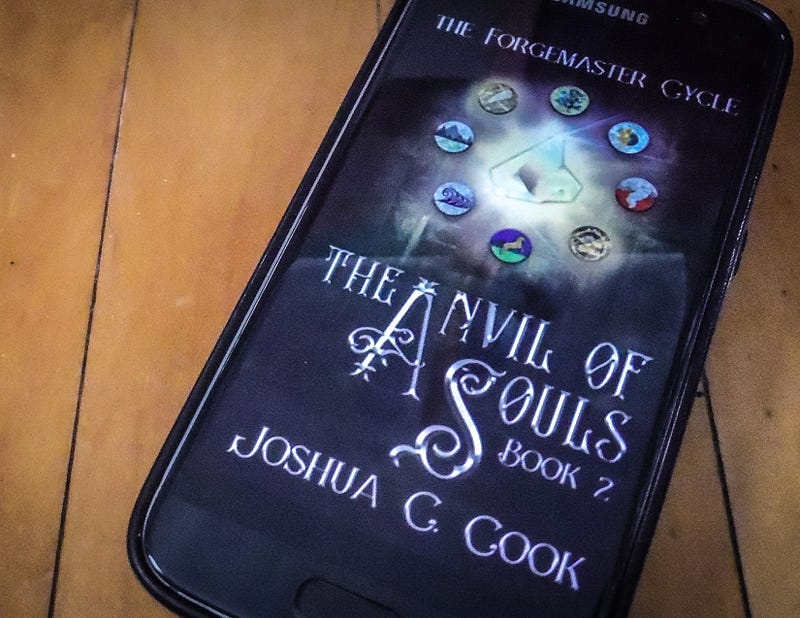
When you review a lot of independent books, every now and then you find one that you get truly excited about. The Forgemaster Cycle by Joshua C. Cook is a series that I’ve really enjoyed.
I’ve always been a sucker for heroic fantasy. I like to listen to a rousing tale of adventure when I go out on runs or bicycle rides. Too much of my day is spent wrestling with ugly historical facts so I can write social justice articles, and a book I can sink my teeth into is a welcome escape.
I thoroughly enjoyed the first book in the series, Blood of a Fallen God, and I’ve been looking forward to the sequel.
For the most part, The Anvil of Souls delivers though there are a couple narrative choices that I mildly disagree with. Sometimes there’s a gap between expectation and reality, and, as a reader, you can’t appreciate a narrative choice until you’ve given it some time to settle.
Fantasy books tend to strike a balance between wilderness and cities. The cities have the human danger of corrupt officials, criminals, and religious zealots. The wilderness has the dangers of predatory animals and other natural dangers. Most fantasy books follow a group of heroes as they navigate urban and rural challenges.
If you ever played the video game Pool of Radiance, you’ll understand how compelling it is when appropriate balance is achieved.
Blood of a Fallen God followed the city/wilderness format perfectly. The Anvil of Souls is set almost exclusively in the wilderness. This gives Cook the opportunity to explore the wilds of the fantasy world he has lovingly crafted and he does so with obvious purpose.
To some extent, the cities in fantasy realms become the equivalent of secondary characters. Gondor, Rivendell, Krondor, are all physical locations with personalities, and through these locations the author of the tale is able to make a comment on the human condition.
Some scholars snort derisively at the idea that fantasy novels comment on the human condition, but that’s just an example of misplaced hubris. This kind of critic is just willfully ignorant as to the function of every element of a fantasy or science fiction universe. Heck, though it’s not a city, the Millennium Falcon is a de facto secondary character of Star Wars. Draw from that the conclusions that you may.
To his credit, Cook deals almost exclusively in new territory in The Anvil of Souls. This is a quest novel that focuses on the dungeons component of Dungeons & Dragons. William Reis and his companions go underground on a quest that goes against the wishes of the creator god that William serves.
As the novel progresses, I came to the conclusion that the creator god was out of his mind to object to William’s ambition because it seems like the resulting quest was a response to the most pressing danger facing the world.
I enjoyed the elements of the story, but my biggest complaint is that I felt the novel was missing a third plot line dealing with the smith guild back in the capital city. This was a powerful force in the first book, and I got the impression that a lot of time was passing without any information on what they were up to.
Now, I’d like to emphasize that my essential criticism is that the book should have been longer which I trust/hope the author will take as a compliment.
I listened to this as an audiobook and the performance by Eric Bryan Moore is absolutely first rate. He does a terrific job providing distinctive voices to every character and it makes the narration come alive.
If you’re a fan of J. R. R. Tolkien, Raymond E. Feist, or David Gemmell, then the work of Joshua C. Cook will be a nice addition to your catalog. Those are the authors that I have populating my audiobook library, and Cook’s work fits in without missing a beat.
The Anvil of Souls is not simply a rehash of the first book in the series. This is a new narrative that ambitiously attempts to widen the scope of Cook’s fascinating fantasy realm. It’s a classic adventure tale that evokes the same sensation of excitement of better known works, but also provides something unique and new. You really can’t ask for more from a book than that.
Check out these other books: