
Music
The Forever Unmatched Five in a Row
No band has ever had a stretch of genius that matches the Stones from 1968 to 1973.
The debate has raged for decades, but I’m just going to come right out and say it. The Rolling Stones were and are a better band than the Beatles ever were.
That ought to finally put an end to it.
I could probably stop right there and just sit back and let the comments come in. There will be those who are right on board with and those who vehemently disagree. Maybe even call me names.
But it wouldn’t do to suggest that the Beatles didn’t have their moments or don’t deserve their place in the pantheon of rock greatness. On the contrary. Their existence and their legendary output pushed Mick n’ Keef n’ Charlie n’ Bill n’ Brian (for a while) n’ Ronnie (eventually) forward in every way possible. The Beatles forced the Stones to be a better band by forcing them to be a very different band, embracing a late 60s / early 70s darkness that John, Paul, George and Ringo never would.
Let’s face facts, though: This argument will likely never be settled, nor should it be.
There have been many artists who have had good runs that stretched decades, and who have been able to string several stunning albums together and have amassed a catalogue that has few rivals. Most bands have a magnum opus that they are best known for. Some have more than one.
U2, REM, Bruce Springsteen, New Order, the Smiths, Radiohead — massive acts, whether you love or hate any of them — each have made at least 3–4 albums that would be considered the high water mark for any band that was able to do it once.
But no one, and I mean no one, has ever been able to match the Rolling Stones run of five stratospheric records in a row like they put out between 1968 and 1973.
It was in these years that the Stones hit their unstoppable stride and became more of an American band than a British one. Mick, louche and lean prancing and prowling on stage. Keith behind him, laying down licks in a haze of cigarette smoke and heroin addiction. Charlie always nattily dressed, holding it down in the back with a trademark drum sound. And Bill off to the side, completely disinterested and with no emotion on his face. But it was Mick Taylor who, after the death of Brian Jones, produced most of the guitar chords and melodies we associate with this period. He never got enough credit for that.
Thus constituted, the Rolling Stones didn’t mirror the sound of the tumultuous times. They were the sound of it.
They soldiered on and muscled their way through the 70s, we can give them that. But there the fawning praise can end and we can freely say what we like about the Stones after approximately 1981 and Tattoo You. They are responsible for some shockingly bad albums since then and their work has been more “Harlem Shuffle” than “Can’t You Hear Me Knockin’”.
It’s a long time ago now, getting on half a century, but this run is unmatched in rock and roll history. All of it greasy, all of it influenced by the times, all of it representative of the times, all of it recorded in a drug addled haze, all of it with a firm basis in American (read: black) rhythm and blues.
Beggars Banquet, 1968
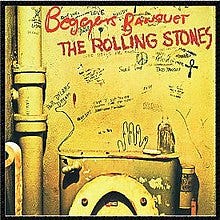
Standout tracks: Sympathy for the Devil / Street Fighting Man / Salt of the Earth
The switch from psychedelia to blues / roots rock begins here. African rhythms and instruments, Lucifer evoking lyrics, daliances with the public student riots in Europe and America in 1968 all put the Stones forth as underground subversives. “This sleepy London town is just no place for a street fighting man”. The confidence that they always had in themselves is now bubbling forth in their musical ability and in their determination to say something about the times they were living in.
Let it Bleed, 1969
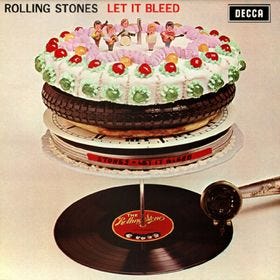
Standout tracks: Gimme Shelter / Monkey Man / Midnight Rambler / You Can’t Always Get What You Want
It was shortly after the release of this album that the Stones played a free festival in Altamont, CA and the Hell’s Angels that had been hired as security went wild on the hippies assembled. The album’s dark undertones rose to the surface, especially in Gimme Shelter “Ooooh, the storm is threatening, louder and louder today”. That lyric could have been about the event itself or about the world in general at the time. It could be about our world today as well and this particular song, cranked up today, will still make your hair stand on end. For me, it is especially after the introduction when the drums and bass full kick in at :32 on the video that does it.
A rock album for sure, but with increasing country, gospel and blues influences. Brian Jones is a big part of this, but he mysteriously dies during the recording of the album after being fired by the band for his unreliability due to drug use, which only adds to the darkness flowing through this album, “You Can’t Always Get What You Want”, aside. Mick Taylor makes his first appearance on this album.
Sticky Fingers, 1971
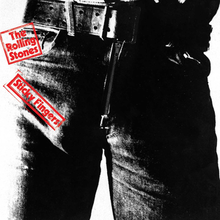
Standout tracks: Brown Sugar / Sway / Wild Horses / Can’t You Hear Me Knockin’ / Bitch / Sister Morphine / Dead Flowers / Moonlight Mile
It’s basically the whole album that is listed here and I would make the argument that this the greatest album in the history of rock and roll as a result. There are several classic rock radio staples here on which Mick Taylor’s imprint is instantly noticeable. A bit more jazz, a bit more country, some piano added but also a horn section. Far from dropping off at this point, Sticky Fingers shows the Stones at their most muscular, most powerful, riff laden rock creations. “Can’t You Hear Me Knockin” and one of my all time favourites for it’s blow your head off power, “Bitch”, are the best examples of where they were at the time. Uninhibited and driving. The energy of Mick in the linked video is incomparable. And then the horns come in at 1:27…
“Yeah, when you call my name, I salivate like a Pavlov dog.”
Exile on Main Street, 1972
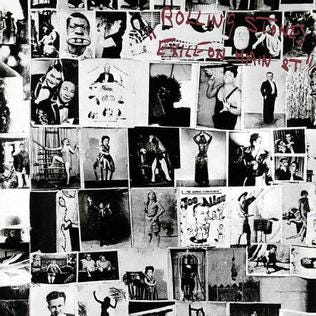
Standout Tracks: Rocks Off / Tumbling Dice / Torn and Frayed / Happy / All Down the Line
Now the Stones are on the run. Now the powers that be begin to see them as a threat and they are exiled to the south of France for tax reasons. Now they are part of the counter culture. Now it’s them against the world.
More blues rock with horns and keys. Sex and drugs still but with a bit less overt swagger than on the previous album. Still crazy, still raw but a little bit less in your face. Looking at it now, they are settling into their roles and now that the Beatles have broken up, they are getting comfortable with their position as the standard bearers for rock and roll and youth culture. They are runaway outlaws, daring anyone to try and stop them.
Keith even thinks he can sing. “Happy” is a sloppy, shambling first try and that’s what makes it so good. “Well I never kept a dollar past sunset, it always burned a hole in my pants”. You can just imagine Keith having that problem daily. Great guitar lick on this one.
Goats Head Soup, 1973
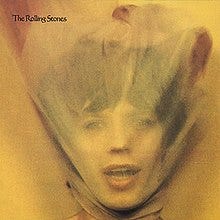
Standout tracks: Doo Doo Doo Doo (Heartbreaker) / Angie / Starfucker
Things had to start to come down somewhere and it’s clear that their status as tax dodging exiles is starting to take its toll. This one is recorded in Kingston, Jamaica and while there are minimal hints of reggae and the album’s name is taken from a popular Jamaican dish, what is more clear is the effect that spending time in a developing country, one with its own version of social upheaval, has on the music.
Instead of the giving of the middle finger to the establishment, one senses a disillusionment, perhaps even a sadness with the whole thing. Though they seem to be trying to be less shambolic and more careful, perhaps and this is out of character at that point. Maybe they knew by then that it couldn’t last forever — the drugs, the alcohol, the women, the relationships with each other, their on the run status. It was time to slow things down a bit. “Angie” is the best example of this, “with no loving in our souls and no money in our coats, you can’t say we’re satisfied”.
No band could keep such a hot streak of raw, unbridled energy and madness fueled creativity going forever and things began to decline for the Stones after that. They still put out some solid work- Some Girls in 1978 was arguably as good as it would ever get again. But like Hemingway describing the way he went bankrupt, the Rolling Stones’ decline was “slow at first and then suddenly…all at once”.
It’s probably a bit uncharitable to say that it continues to this day. But it does. And yet somehow they are still going. They won’t live forever, we know that. But these albums certainly will.


