
“The First Wives Club”: A Comedy Classic Turns 25
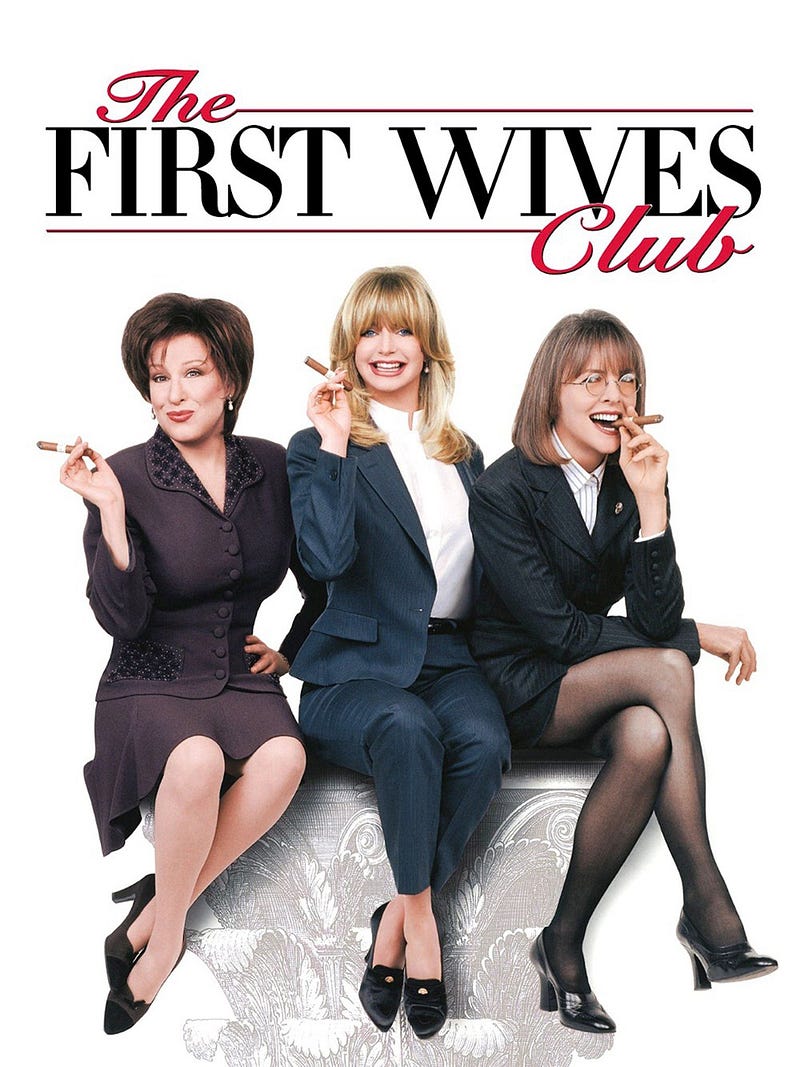
25 years ago last week, an all-star comedy centered on three middle-aged women was released and became a surprise blockbuster. The impact of the film is still being felt today and a contemporary re-evaluation led me to realize that it was even better than I remembered.
The Background
Twenty-five years ago last week, a comedy classic was released in theaters. The First Wives Club told the story of three women in their forties — Elise (Goldie Hawn), an alcoholic movie star whose career was declining rapidly; Annie (Diane Keaton), an insecure and passive housewife; and Brenda (Bette Midler), a plucky Jewish mother. Their common bond is that they were best friends at Middlebury College in the late 1960s. After decades of estrangement, they are reunited under the grimmest of circumstances — the suicide of Cynthia (Stockard Channing), the fourth member of their undergraduate quartet. The reunited women discover that despite their disparate life journeys and markedly different personalities they have something very important in common — they have all been brutally discarded by their husbands for younger women. They team up to exact revenge but find much, much more.
Similarly to the characters they play in The First Wives Club, stars Goldie Hawn, Diane Keaton, and Bette Midler all had quite a bit in common when they were cast. They were all bona fide Hollywood legends whose popularity and career opportunities were dwindling as they approached middle age. And, in a very curious tidbit, they were all exactly 50 years old at the time of the film’s release (making them all 75 now).
Bette Midler had already released 12 albums by the time the film was released, including classics like The Divine Miss M, the Beaches soundtrack, and Some People’s Lives. She had been nominated for 11 Grammys, winning 3 (Best New Artist in 1974, Best Female Pop Vocal Performance for “The Rose” in 1981, and Record of the Year for “The Wind Beneath My Wings” in 1991). She had also earned 4 Golden Globe Awards, 2 Emmy Awards, and a special Tony Award. She had also had enormous success in films, scoring 2 Oscar nominations for Best Actress (one for her 1979 film debut The Rose and one for 1991’s For the Boys) and starring in a slew of commercially lucrative comedies in the 1980s.
Goldie Hawn exploded onto the scene in a big way in 1968, with her star-making turn on the variety series Rowan & Martin’s Laugh-In. The following year she co-starred with Walter Matthau and Ingrid Bergman in Cactus Flower, for which she scored the Oscar for Best Supporting Actress. She then went on to star in a number of critically and commercial successes films over the next couple of decades, including Steven Spielberg’s feature directorial debut The Sugarland Express, the Oscar-winning Butterflies are Free and Shampoo, and comedy hits Foul Play (opposite Chevy Chase), Seems Like Old Times (also opposite Chevy Chase), Bird on a Wire (opposite Mel Gibson), Death Becomes Her (opposite Meryl Streep and Bruce Willis), and Private Benjamin (which scored her a 2nd Oscar nomination).
Diane Keaton was perhaps the most respected actress of the trio at the time of the film’s release. After making a big splash on Broadway with a role in the original cast of Hair and a Tony-nominated turn in Play It Again, Sam, she moved into film where she had enormous success with the Godfather trilogy, Warren Beatty’s epic Reds, and multiple collaborations with Woody Allen. The latter included, but were not limited to, Annie Hall (which won her the Best Actress Oscar), Manhattan, Interiors, and Sleeper. She had also recently starred opposite Steve Martin in the enormously successful remake of Father of the Bride and its sequel.
Despite their absolutely enormous successes, by the early 1990s each of these three women had moved into a period of their career where they were no longer able to get the same high-profile roles they once were. They had fallen out of favor in Hollywood, which had moved on to starlets like Julia Roberts, Meg Ryan, Sandra Bullock, and Cameron Diaz. As a result, they presumably jumped at the opportunity when juicy roles in a major studio comedy were offered to them. The fact that the roles allowed them to explore, satirize, and take ownership of their own mid-life career crises was an added bonus.
The First Wives Club was released not just at a challenging point in their respective careers, but also at a challenging point for women in Hollywood in general. If you look at the top 10 highest grossing films for each year from 1990–1995, only one—Whoopi Goldberg’s Sister Act — centered primarily on women. Sure, there were others with memorable female lead roles like The Silence of the Lambs, Ghost, The Bodyguard, Sleepless in Seattle, Speed, Basic Instinct, and Pretty Woman, but they all had an equally prominent male lead who in virtually all cases got top billing and a bigger paycheck. Hollywood was simply not investing big bucks in films centered on women, even though they made up more than half of the moviegoing public.
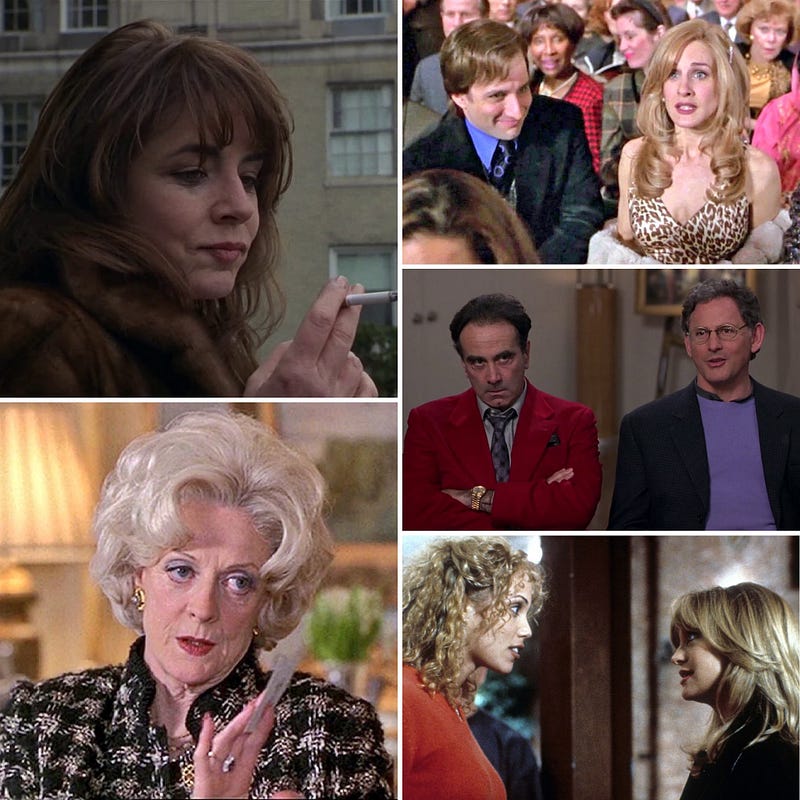
The First Wives Club had an incredible lineup of talent both on-screen and off. In addition to the trio of legendary leading ladies, it has an absolutely astonishing supporting cast that is easily one of the most impressive ensembles in modern film history. It co-starred two-time Oscar winner Maggie Smith (The Prime of Miss Jean Brodie), Oscar winner Marcia Gay Harden (Pollock), Oscar winner Eileen Heckart (Butterflies Are Free), Emmy winner Sarah Jessica Parker (Sex and the City), Emmy- and Tony-nominee Victor Garber (Alias), Dan Hedaya (Clueless), Stephen Collins (7th Heaven), Bronson Pinchot (Perfect Strangers), and Elizabeth Berkley (Saved by the Bell). It features cameos from Emmy and Tony winner Stockard Channing (The West Wing), Oscar winner JK Simmons (Whiplash), Emmy and Tony winner Debra Monk (NYPD Blue), Emmy winner Rob Reiner (All in the Family), Emmy nominee Timothy Olyphant (Justified), Emmy and Tony nominee Kate Burton (Scandal), television icon Heather Locklear (Melrose Place), talk show host Kathie Lee Gifford, former NYC Mayor Ed Koch, feminist icon Gloria Steinem, and Donald Trump’s ex-wife Ivana.
Behind the scenes, it had an impressive roster of talent as well. The film was based on the best-selling 1992 novel by Olivia Goldsmith. Sherry Lansing bought the unpublished manuscript and turned it over to stage and screen super-producer Scott Rudin to produce when she became the CEO of Paramount Pictures in 1992. To date, Rudin has amassed an astonishing 10 Oscar nominations (with 1 win), 5 Emmy nominations (with 1 win), 1 Grammy nomination (which he won), and a whopping 47 Tony nominations (with 17 wins). Of note, his legacy has been recently tarnished by a slew of well-substantiated allegations of abuse that were famously chronicled by The Hollywood Reporter here.
The novel was adapted for the screen by Robert Harding, who previously had written two well-received films — 1989’s Oscar-nominated, all-star smash drama Steel Magnolias and 1991’s equally star-studded soap opera satire Soapdish. The film was directed by the late Hugh Wilson, who was previously best known for WKRP in Cincinnati (the radio station-set CBS sitcom that aired from 1978–1982 and then became a huge hit in syndication) and Police Academy (the slapstick comedy classic that was a box office smash and has spawned six sequels to date). The score was composed by Marc Shaiman, the 7-time Oscar nominee and Grammy, Emmy, and Tony winner.
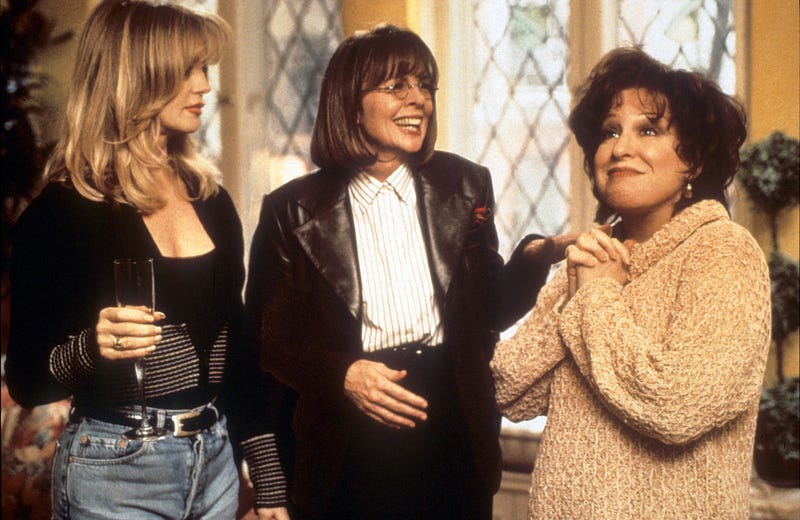
The film was released in the United States on September 20, 1996 and grossed a stunning $181 million ($105 million in North America and $76 million abroad). It was enormously profitable considering its modest $26 million budget and its success ignited a conversation about how undervalued women’s stories are in the film industry, especially those that focus on and appeal to middle-aged women. It received mediocre reviews (it holds a 50% approval rating on Rotten Tomatoes and a Metacritic score of 58/100), but it was beloved by audiences and managed a few year-end notices during awards season. These accolades including the award for Best Acting by an Ensemble by the National Board of Review, an Academy Award nomination for Shaiman’s score, Satellite Award nominations for Bette Midler and Sarah Jessica Parker, and a Blockbuster Entertainment Award (remember those?) for Goldie Hawn.
Following the success of the film, Diane Keaton got a slew of good roles, including two that earned her additional Oscar nominations — Marvin’s Room (opposite Meryl Streep and Leonardo DiCaprio) and Something’s Gotta Give (opposite Jack Nicholson and Keanu Reeves). Bette Midler didn’t headline any more blockbusters, but she continued to have hit albums and lucrative tours and residencies. She also scored a Tony for her much-hyped turn in the title role of Hello Dolly! (2017–2018). Unfortunately, the success of the film did not translate into major career revitalization for Hawn, who has only had 6 major big screen roles since the film was released. (Although it has never been clear how much of Hawn’s disappearance from the public eye has been a self-initiated early retirement as opposed to a lack of opportunity.)
But the film’s impact went far beyond the careers of these legendary women. A slew of female-led films got the green light from major studios (even though a quarter century lately there is still major resistance from Hollywood to support films made by and focused on women). And the film itself has become a cultural phenomenon. A TV series based on the series with a majority black cast has just been renewed for a 3rd season by BET. Two major attempts have been made to get a musical based on the film to Broadway (although it has never quite made it to the Great White Way). There have long been attempts to get a sequel made, although script problems and stalled salary negotiations have reportedly prevented it from happening. And the film remains an all-time favorite among its hordes of fans, which are disproportionately older women and gay men who identify with the themes of self-empowerment and mix of campy humor and heart.
It is clear that The First Wives Club was and remains a pop culture phenomenon, but as we all know too well not all pop culture phenomena hold up well (and many were not even good to begin with). So it was with some trepidation that I revisited the film in honor of its 25th anniversary. I was relieved and delighted to see how incredibly well it held up. In fact, it was better than I remembered it — and certainly better than the reviews suggest.
The Re-evaluation
The film opens with a retro animated opening credits sequence set to the standard “Wives and Lovers.” It may seem kitschy and merely aesthetic at first, but it is actually a storytelling device of its own. It gives us a glimpse of the cultural context that our protagonists were raised in. Following the credits, the film features a flashback to the four ladies’ Middlebury graduation that establishes their personas and bond and is primarily notable for its absolutely impeccable casting. (The four young actresses do absolutely uncanny impressions of the stars).
The jauntiness and giddiness of the film’s opening is immediately undercut with flash-forward to the present day when one of the four women goes on a boozy bender in her lavish New York penthouse. We see all the tell-tale signs of suicidal despair — alcohol bottles strewn about, newspaper clippings about her ex-husband’s new marriage, precious belongings being given away, and a stack of elegantly-penned suicide notes. And, then, without further ado she leaps from her balcony to her death, clad in a nightgown and fur coat. It is a jarring kick-off to the film that works because of skilled direction and a brilliant and affecting cameo from Stockard Channing. She gives one of the film’s best performances despite only being in the film for a single brief scene.
The film then shifts focus to the other three women who are going about their crummy day-to-day lives when they receive the news about their friend’s suicide. We see Elise (Hawn) desperately begging for cosmetic procedures so that she can competitive for a new film role. We see Annie (Keaton) struggling with her separation from her husband (Stephen Collins), her overbearing mother (Eileen Heckart), and the news that her daughter (Jennifer Dundas) is a lesbian. We see Brenda (Midler) preparing for her son’s bar mitzvah, struggling to make ends meet financially, and trying to keep to her diet.
The ladies reunite at Cynthia’s funeral, where they are disgusted to see her ex-husband shamelessly groping his new trophy wife (Heather Locklear). They reunite afterwards for a long boozy lunch that truly establishes the film’s tone and plot. The ladies discuss what’s been happening in their lives and how they became estranged, while instantly falling back into old patterns of camaraderie, jealousy, and sniping. The actresses display incredible chemistry and the film never works better than when the three are on screen together. This is not an all-star ensemble film where you have to wait until a key scene to see the beloved icons interact; this film is first and foremost about their extraordinary chemistry.
What follows is the women’s very elaborate scheme to get justice. It is filled with clever twists, cathartic expressions of rage, and a sprinkling of slapstick (particularly the memorable scene when they rappel down a skyscraper on a window washing platform). As part of this journey, each of the three main characters has strong character development.
Elise confronts her alcoholism and overcomes her vanity by embracing a new, more mature phase of her career. She also exacts revenge on her ex-husband Bill (Victor Garber), who became famous “producing” her hit films like Animal Nature (in which she played an “extremely sensual veterinarian”). She does so by finding some dirt on his young new girlfriend Phoebe (Elizabeth Berkley, who apparently was cast because Hawn felt she deserved redemption after Showgirls). Hawn is superb throughout, showing all of the comic and dramatic chops that made her famous, while showing an impressive willingness to both skewer and explore her public persona and career.
Annie develops a backbone after discovering that her soon-to-be-ex-husband Aaron (Stephen Collins) has been having an affair with their marriage counselor Leslie (Marcia Gay Harden). Compared to Elise and Brenda, Annie actually believes her marriage can be saved up until this point, which makes the betrayal sting even more. She exacts revenge by plotting to buy out her husband’s company. Keaton gives one of her most iconic screen performances as Annie, which is the perfect role for her unique blend of dithering ditziness and soulful dramatic work.
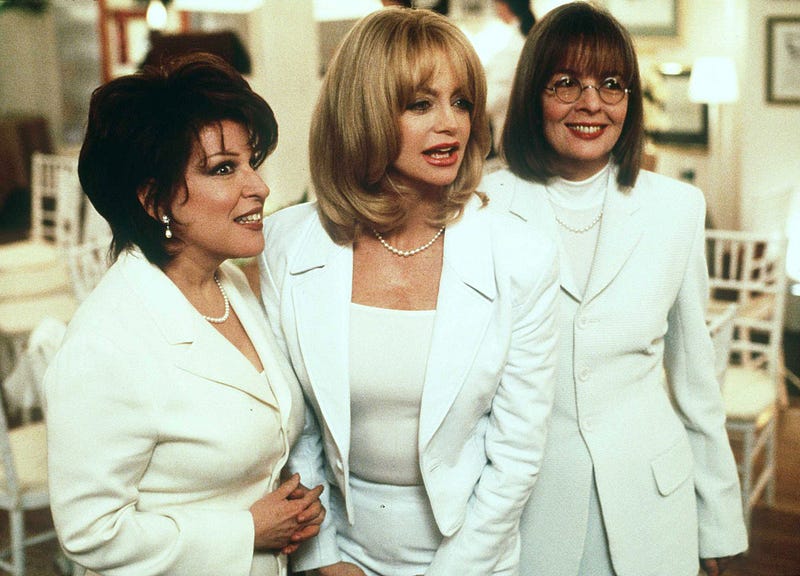
Brenda confronts her own insecurity (exacerbated by her weight struggles) and loneliness (exacerbated by her son nearing his high school graduation) and exacts revenge on her ex-husband Morty (Dan Hedaya) through blackmail. Hers is by far the most clever of the revenge schemes, as it incorporates a number of twists as well as the film’s most delightful supporting characters — Morty’s vain young girlfriend Shelly (Sarah Jessica Parker), revered socialite Grunilla (Maggie Smith), and disastrous interior designer Duarto (Bronson Pinchot). In contrast to her bawdy public persona, Midler actually has the most nuanced of the roles here. Although she expertly delivers some of the film’s most savage and insightful lines, her best work is in the moments of quiet heartbreak.
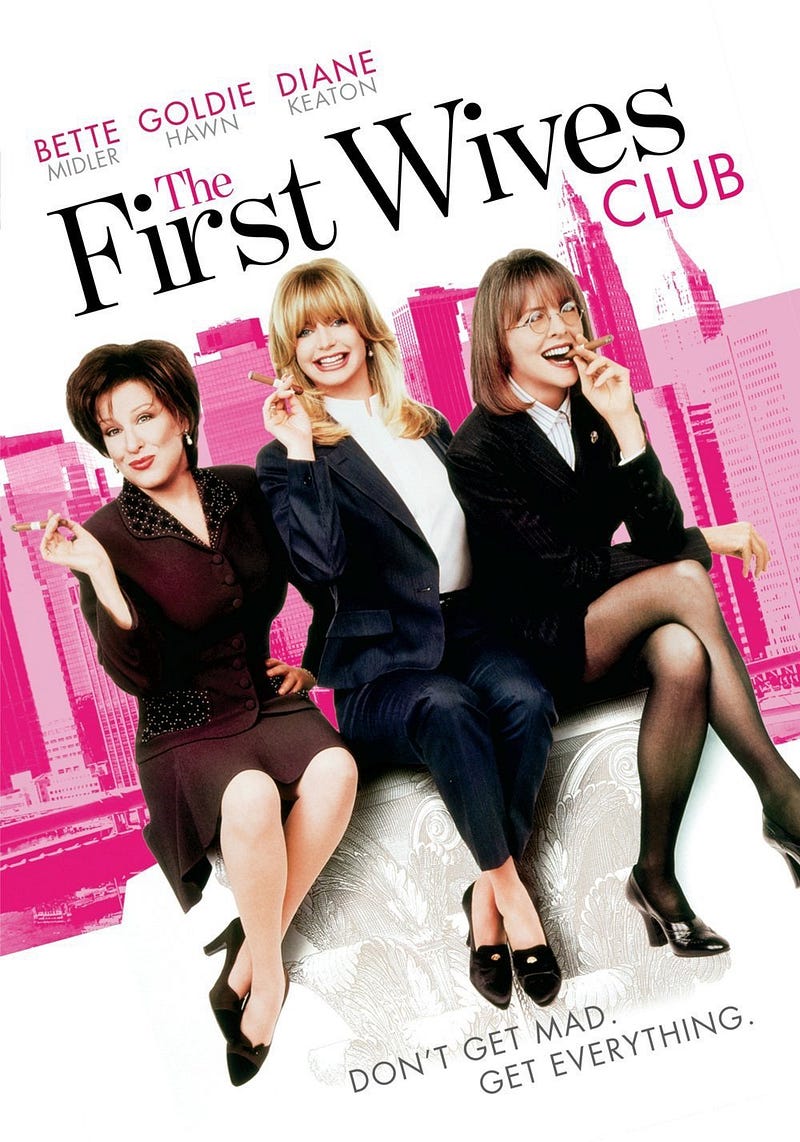
However, the ladies quickly learn that the satisfaction that comes from revenge is short-lived. They channel their rage into a good cause by using the money they gained from their divorces to open a women’s crisis center named for their beloved Cynthia. The film’s climax takes place at the center’s opening, which allows for an amusing array of cameos. The most memorable of these belongs to one of the world’s most famous first wives, Ivana Trump, who memorably purrs “Don’t get mad, get everything.” (The phrase became the film’s tagline.) After the party is over the women reflect on their friendship and accomplishments and break out into Lesley Gore’s feminist classic “You Don’t Own Me,” a dramatically rousing and narratively fitting song that superbly caps the film.
One of the most remarkable things about the film is how efficient it is. Despite its sprawling ensemble, multiple subplots, and multi-act structure, the film wraps up in a brisk 102 minutes. Unlike most films released nowadays of all genres, it ends when the central plot is over. There is a brief voiceover that wraps up some loose ends, but it transitions to the credits just as the women leave the grand opening and joyfully stroll down a New York City street arm-in-arm clad in their iconic white ensembles.
The First Wives Club is not a perfect film. There are aspects of it that feel distractingly dated, plot twists that feel a bit cliched, and numerous dynamics that feel under-explored. It likely would have been better if it had been written, directed, and produced by a team of women who could more deeply connect with the material. But despite these issues, it holds up remarkably well. The film is crisply placed while also having a complex and dense plot. And it contains numerous quotable lines, terrific scenes of top-notch farce, brilliant performances, moments of real dramatic power, and far more character development than the typical big studio comedy.
Considering that the film is centered on a trio of women reuniting 25 years after their graduation, there is something poignant about watching the film on its 25th anniversary. Imagining them now, an additional quarter century removed from the film, it’s hard not to wonder what became of the trio. I think it’s time to finally make that sequel happen.
Follow the author of this article on Medium and Twitter.
Read recent articles about revisiting modern classics:
- “Bridget Jones’s Diary”: A Modern Romantic Comedy Classic Turns 20
- “The Birdcage”: An Underrated Comedy Masterpiece Turns 25
- “The Silence of the Lambs”: A Timeless Masterpiece Turns 30
- “The American President” at 25: An Ode to My Favorite Movie
- As If! “Clueless” Turns 25
- A Celebration of “Speed” on its Silver Anniversary


