
The First United States Congressman to Be Assassinated
This Black History Month we should honor Representative Jim M. Hinds
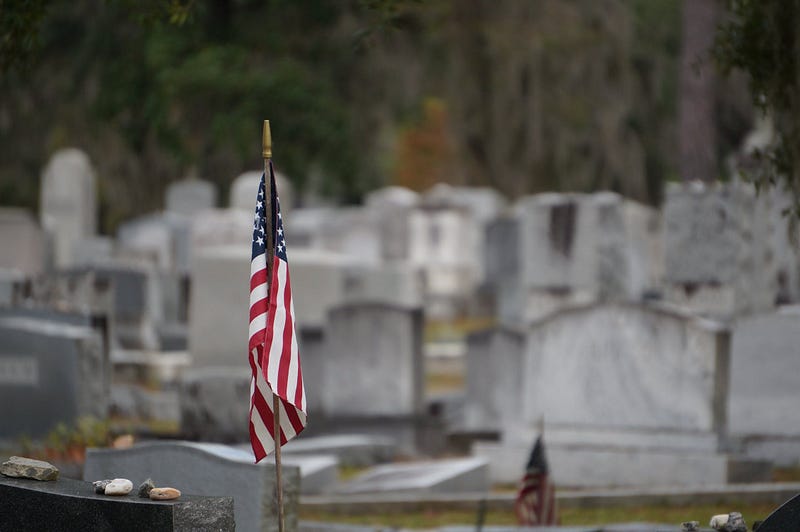
United States Representative James M. Hinds is dead.
Even though he was born and raised in Hebron, a small town in northern New York, Congressman Hinds was the Arkansas representative for the 2nd congressional district. He had arrived in Arkansas after the “War between the States” which had ended in 1865. A graduate of the Cincinnati School of Law, he realized that St. Peter, Minnesota, the town that he and his wife, the former Anna Pratt, lived in would not grow much further. Like many of the young, they discussed moving to a place where there was more opportunity.
In 1865 they moved to Little Rock, Arkansas.
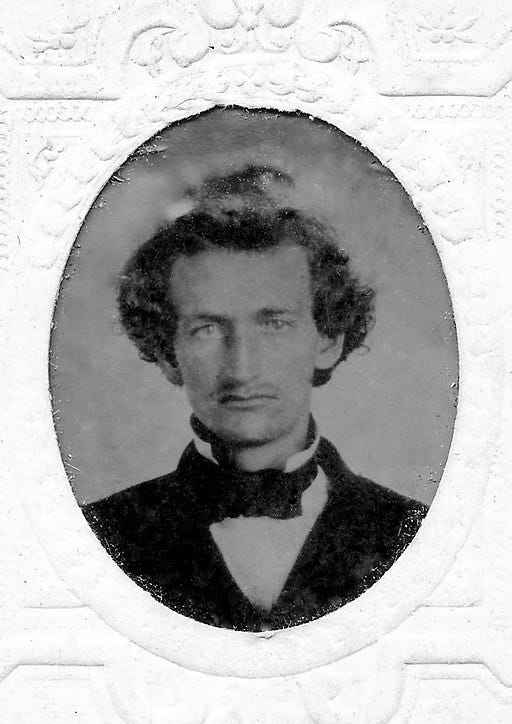
Little Rock was a wasteland. Buildings, commercial and private alike, had been burned to the ground. The net worth of thousands, some who’d been well-to-do with slave ownership and free labor, had been devastated. Even before the war, Arkansas was considered “backward” compared to other nearby states.
It was considered a boom state, yes, but much of the land was still underdeveloped, the forests were untamed, and the roads were substandard.
But many have found that there is an opportunity for those with the energy to rebuild in destruction. And energy was something that Hinds had in abundance. You may remember him. He strolled the streets of Little Rock, carrying a law book, which it was clear he actually read. *Most of the time, he wore a long black coat, over a white shirt, and black slacks, with a white cravat. He always had a smile on his face.
Hinds was called a carpetbagger
That was the name given to Yankees who went south after the war. Hinds formed a law partnership with Elisha Baxter, who had fought for the Union Army. Once a pro-slavery Democrat, Hinds was converted after recognizing the injustice of slavery, and he made the conversion to Republican, supporting Abraham Lincoln as president.
Hinds rolled the “carpetbagger” title off of his shoulders and went to work, helping Arkansas become the first confederate “rebel” state to be readmitted to the Union after the war in 1867.
When one does not grow up in a particular culture, it’s difficult to grasp the hatreds and passions that exist to retain the old racist ways.
Hinds didn’t know it, but IF there were a path to prosperity for all, these die-hard confederates would fight to remain poor to the nth generation, if only to stop the “inferior” colored race from doing well financially. In fact, many would die first.
Many already had.
James Hinds believed in equality
Despite these beliefs, other Arkansans valued what the congressman had to offer. In early 1868, he became a delegate for the Arkansas State Constitution. When the Arkansas constitution was issued that March, it included citizenship for the colored man. It was one of the conditions required for confederate states to re-enter the Union.
The Ku Klux Klan (KKK), formed by ex-confederate soldiers in 1865, did not care. They were incensed.
Hinds was an oddity in that he truly believed in the future of the newly freed people. He invited members of the colored community to his home. No one, they say, had more influence with colored people than James M. Hinds. He treated them as social equals, a rarity indeed, even for those who were kindly disposed to the other race, especially in 1868!
Traveling the state, he ran for United States Representative and won the 2nd congressional district's seat in June 1868. While he was working with his constituents, meeting with them to identify their needs, the Democrats gerrymandered his district.
As a result, his district was removed.
But the Honorable Hinds announced that he would not run again.
Hinds was free
That meant he was free to work on two major issues; to campaign for Ulysses S. Grant, a Republican, and to continue to speak about expanding civil and voting rights for freedmen. Grant was not anti-slavery; he owned slaves through his marriage to Julia Dent, a slaveowner. But he had fought for the Union.
And Grant was so much better than Andrew Johnson, who followed Lincoln after the assassination in 65'. Johnson didn’t agree with the 14th amendment. He was impeached for high crimes and misdemeanors, and known as the worst president, we reckon, that ever existed.
Hinds took to the road with Joseph Brooks, a Republican who had edited the antislavery newspaper the Central Christian Advocate during the civil war. That called for steely nerves, especially in confederate Arkansas. But for every pro-slavery advocate, there were one or more anti-slavery opponents.
The nation is looking forward, not backward, and the black man’s emancipation, full of equality and promise, lies so close one can almost grasp it. Arkansas, with people like James M. Hinds, Elisha Baxter, and Joseph Brooks in leadership, was headed in that direction.
These are heady times, are they not?
He was threatened
His family tells us that the Ku Klux Klan threatened him, a group everyone thought little of, but he was determined to press on for what was right. The KKK was killing hundreds of people (White and Colored) throughout the state to stop the vote.
He had work to do. Hinds noticed that Arkansas was woefully uneducated compared to other states. There were very few schools. He fought and received funding for schools for white and black children. He made sure that colored soldiers received the same pay as white soldiers. He educated the newly freed slaves about their rights. He represented them in court.
In addition, Hinds and Brooks campaigned throughout the state for Grant. If he happened to stump for the colored man, who would be surprised? He was an advocate for the civil rights of former slaves. He was skilled at pointing out the hypocrisy of the Democrats who said that colored men were brutes, unable to make good judgments. But once these “brutes” gained the right to vote, they said, “Vote for the Democrats!”
The shooting of James M. Hinds and Joseph Brooks
Then while on the road on October 22nd, 1868, near Indian Bay, Arkansas, Monroe County, Hinds was shot in the back (can that be any more cowardly?) by George W. Clark, a Klansman. The Democrat Committee secretary for Monroe County, Clark, was furious that Hinds dared encourage large groups of African-Americans to vote. Even though Clark had signed a document promising no violence, he ignored it. He actually told some fellow Democrats that:
“Goddamn them, if I see them they won’t speak today, for I shall put daylight through them.”
And this is who Hinds and Brooks met on the road. They asked him for directions to their next campaign stop at Lambert Plantation. Clark was amiable and told them how to reach their location. He then went home and filled his double-barreled gun with buckshot and returned. They may have thought he wanted to join them.
Clark also shot Joseph Brooks from a distance, in the back, but Brooks was able to escape the shooter and rode off to obtain help.
That’s when he shot Hinds, almost point-blank, in the back. He fell to the ground.
As Hinds lay there in the dust, he wrote this in the lining of his hat;
Acceptance. Hinds accepted that he only had a few moments left on earth. His colleagues looked on such calmness, such as composure, because he was still breathing when they arrived. His only thoughts were of his wife and daughters.
Congressman James M. Hinds was 34
The shooter George W. Clark was well-known. The nest day on October 23rd, a report was issued by seventeen Democrats and Republicans:
A warrant was placed for this arrest for the murder of Hinds and the injury to Joseph Brooks. But the man abandoned his family and all he knew, never to be seen again. It is rumored that he left the country.
That is how it stands today. We, the community, look at Clark’s abandoned family and wonder. Was it really worth it? Was such hatred and madness necessary? Is Clark even alive? One hears of those souls who kill due to unstable emotions-just like a mad dog — but then commits suicide due to shame and regret. Was this such an instance?
For those of you who say, “this is not who we are,” this is who we are, at least now and here in the present time, that is, in 1868.
Thousands of colored and white alike paid tribute to the congressman in a funeral procession that was three-quarters of a mile long. It was a massive procession and took an hour to pass by. The silence was full of tears, loss, and regret. Hinds had such integrity and spirit in the face of so much hatred.
And yet, he never quit. He was, gentle man that he was, stopped by buckshot from a Klansman.
We ask ourselves this all the time: Why is it so easy for one man to take another man’s life?
Life stopped
All businesses closed during the procession.
The people of Arkansas, Minnesota, New York, Washington, D. C., and nationwide…mourned. The residents of Little Rock, Arkansas observed a day of mourning, and all retail was stopped. Fifty carriages strong were present. His exquisite metallic coffin was presented for public viewing in the hall between the Senate and the House of Representatives.
Representative James M. Hinds was the first sitting congressman to be assassinated in the United States.
Hinds’s remains were returned to Salem, New York, via railroad transport and interred there in Salem’s Evergreen Cemetery.
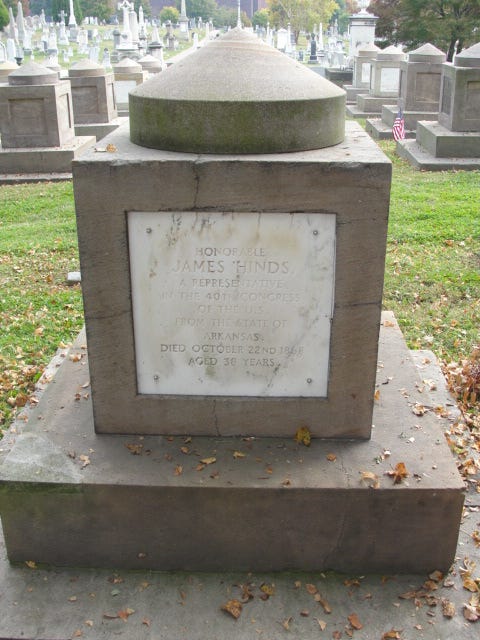
He also has an honorary marker, a centograph, in the U.S. Congressional Cemetery in Washington DC. It is located at Range 59, Site 107.
Thank you, Congressman Hinds, for your sacrifice. The Republican Party of Lincoln thanks you. It’s 1868 and we can be sure the Grand Old Party (GOP) will always stand for the abolition of slavery and the rights of humanity for all.
May your spirit, Congressman, the spirit of universal freedom and equality, live on forever.
*Darrow, William B. “The Killing of Congressman James Hinds.” The Arkansas Historical Quarterly, vol. 74, no. 1, 2015, pp. 18–55. JSTOR, www.jstor.org/stable/24477498. Accessed 4 Feb. 2021.