REFLECTIONS ON RACISM | BLACK IN AMERICA
The First Time I Was Called The N-Word
Who’s going to teach your children about racism?
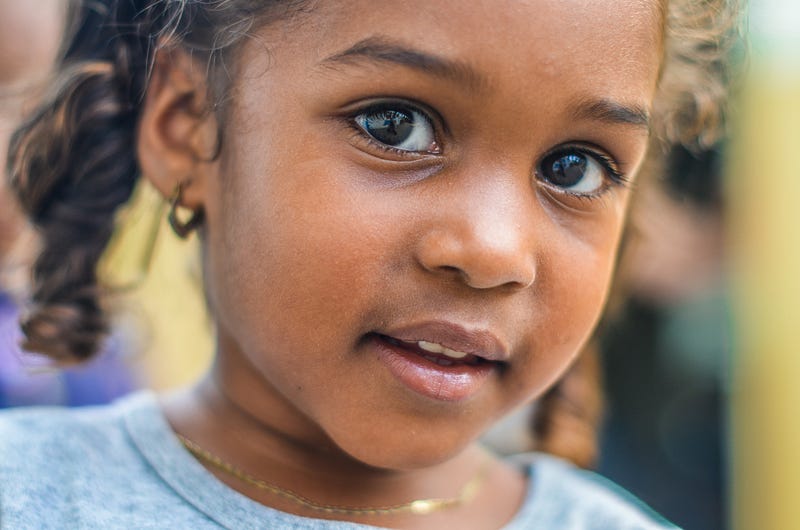
I grew up in a small town in the midwestern United States. Translation: there wasn’t (and still isn’t) a very diverse population in my hometown. I was one of very few kids in my elementary school that looked liked me and one of the only kids in my grade. I wasn’t bullied growing up and I had friends, but early on in my childhood, it became glaringly apparent that I was different from my peers.
It is unfortunately common for parents of minority children to have a variety of race-related “talks” with their kids. I, however, was catapulted into the conversation about race so early in my childhood, it was even before my parents had made the conscious decision to talk to me about the n-word.

It was the end of the school day and I was walking out of school to the corner where my mother always parked and waited to pick me up. I was upset and crying, which my mom immediately noticed. “What’s wrong?” she would ask.
“He called me a name. He called me a jigger.” I was only in elementary school. I didn’t know what he had actually said because I didn’t yet know about the n-word or what it meant. All I knew was that what was said to me was said with the intention of being mean and that it hurt to be called a name.
My mother grabbed her purse and started to get out of the car. “We’re going into the school. I need to speak with the Principal about this.” And so we did. It wasn’t until later that I learned what had really happened and why.
And I also came to learn that this boy, an elementary-aged child himself, may not have truly known what he said either before he said it. But he had to have heard it somewhere; learned it somewhere. Maybe from his own parents. Maybe not. Either way — Parents, it has to start (and stop) with you.
We have to talk to our kids. They’re always listening, watching, and learning. Their innocence around race will be removed at one point and, if you don’t take control of it, it will happen in a way that is completely out of your hands.
Who’s going to teach your children about racism?
You need to be the one to talk to your kids. Further, you have to talk to them. Don’t leave it up to society or the education system, with its gaping holes. Certainly, these will both be teachers, but the message and the delivery leave much to be desired.
A white friend shared with me earlier this week that recent events have encouraged her to talk to her 10-year-old daughter about race. She felt she had previously done a good job of shaping her young daughter’s mind around equality, so she was shocked to hear her daughter say, “I thought racism ended with slavery. That’s what I learned at school.” That was a reality check for her that they needed to have more conversation.
Another white friend recently told me that she has never talked to her 9-year-old son about race, because she doesn’t want him to see color. Not only is this outlook of colorblindness dangerous, it also perpetuates the cycle of white silence as opposed to vocal anti-racism. Thankfully, she has since had a conversation with her son.
I’ve had a few other white friends reach out to me and share that they will teach their children to “be better than this”. There’s also a viral post currently circulating Social Media in which parents make this declaration:
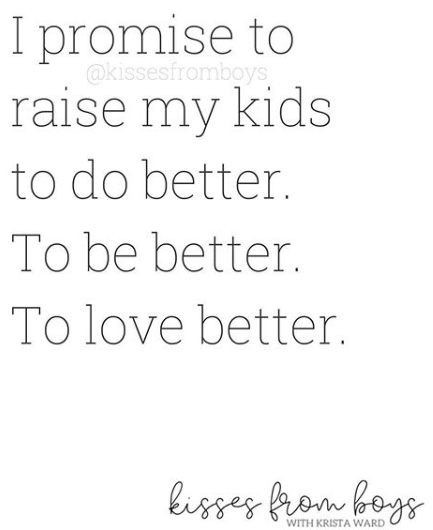
I appreciate this sentiment; I just hope it’s more than that. To follow through with this vow, you’re going to have to do the hard work and have the hard conversations.
How do you explain something so heavy to a child?
First, you need to know that talking about race is not racist. It’s okay. Rather, it’s critically important that you open the door for this conversation. Children are going to be naturally curious and have questions about race, and you need to be prepared to answer them.
Second, it is okay to meet them where they are and at their developmental level. I won’t pretend to be an expert, but there are many resources out there from those who are experts around approaching this. Resources include articles such as this one, lists of recommended children’s books, and even television specials dedicated to the topic.
The takeaway here is: If elementary school was old enough for me to experience jarring racism firsthand, it is old enough for you to talk to your child about not perpetuating it.
Third, know that talking to your kids about race won’t (and can’t) be a one-time thing. But it is, however, a very complex thing. That’s why it needs to be an ongoing conversation, with periodic check-ins as your child grows up, and you should plan to revisit the topic of race in different ways over time.
Talking to children about race is to educate them about their world; it isn’t to rob them of any innocence. You must do it so that they will be better and do better. Race is a common topic for discussion in minority families, but the conversation about race has to be had by all parents, no matter the family’s make up.



