
The First Anti-Promethean Rebellion Of Modernity in England
‘Frankenstein’ (1818), Promethean Transgression And A New Hope
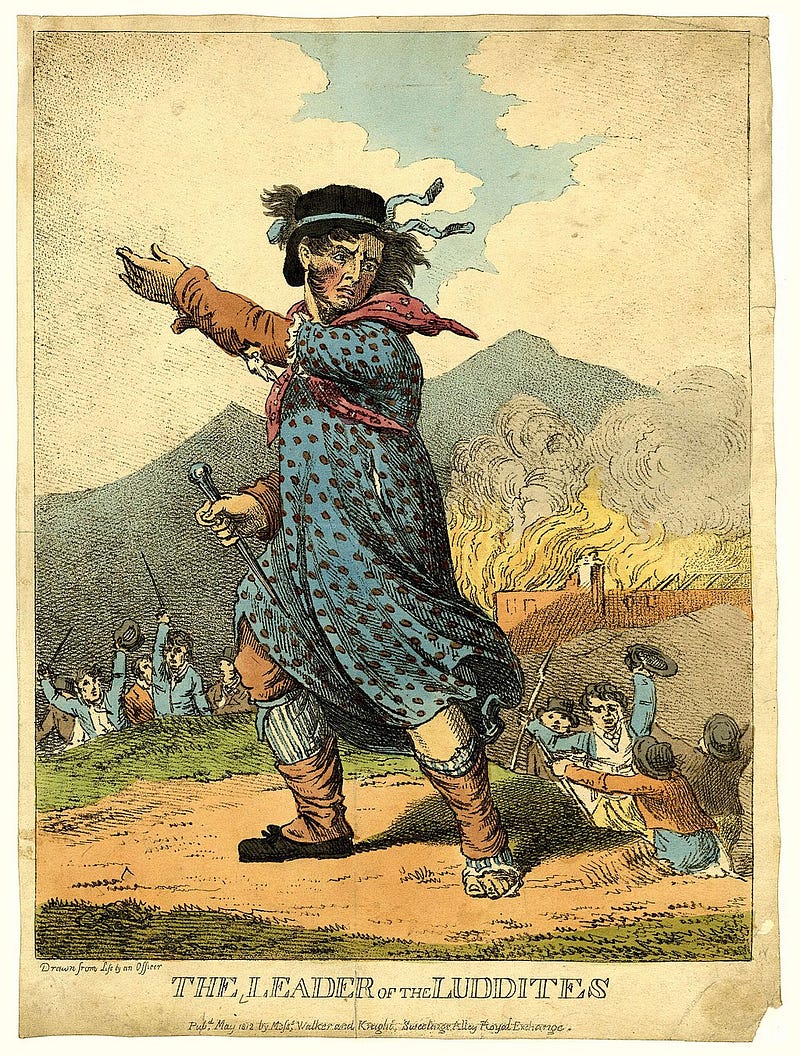
On 9th October 1779, a group of English textile workers in Manchester rebelled against the introduction of machinery which threatened their skilled craft.
And so began the first anti-Promethean rebellion of modernity against the will of the Father and its economic application through the early stages of the Industrial Revolution with profits before the welfare — and liberty — of the people and their rural communities. The socio-economic landscape of England would forever change into a servile workforce of the urban proletariat in a single generation.
A new scientific Prometheus was now engaged in transforming and enriching a few lives through the exploitation of the powerless. However, a few would stand together and fight to stop this simultaneous Promethean and Existential Transgression.
The word ‘Luddites’ refers to British weavers and textile workers who objected to the introduction of mechanised looms and knitting frames. As highly trained artisans, the new machinery posed a threat to their livelihood and after receiving no support from the government, they took matters into their own hands. By 1812, organised frame-breakers became known as Luddites, using the name King Ludd or Captain Ludd for their mythical leader. Letters and proclamations were signed by “Ned Ludd” (see photograph of engraving above).
The Luddite attacks were organised and used sledgehammers but in some cases escalated to gunfire when the factory owners responded by shooting the protesters. Whilst the workers hoped the uprising would encourage a ban on weaving machines, the British government had no such plans, and the movement was eventually suppressed by spies, military force, and draconian punishment, which included execution and penal transportation of accused and convicted Luddites.
There was much support for the Luddites and the movement in England and both Percy Shelley and Lord Byron gave their vocal and written support to the cause. In fact in Byron’s maiden speech in the Lords, he eloquently defended the actions of the Luddites and was critical of what some would call today the extrajudicial powers the government of the day instituted to extinguish a very serious industrial dispute and rebellion, he began,
“Nothing but absolute want could have driven a large and once honest and industrious body of the people into the commission of excesses so hazardous to themselves, their families and their community,”
Byron continued,
“You may call the people a mob, but do not forget that a mob too often speaks the sentiments of the people,”
he went on,
“Can you carry this bill into effect? Can you commit a whole county to their own prisons? Will you erect a gibbet in every field and hang up men like scarecrows?”
Two weeks later, Childe Harold was published and Byron awoke to find himself famous.
It is therefore unsurprising then that Mary Shelley would incorporate such a rebellion by the wretched of the realm — a nascent proletariat — in her story of The Creature’s rejection of Patriarchal Authority and Promethean and Existential Transgression.
This unique creation — this “Adam” — will reject the rejection of his Creator. Sired by a scientific Prometheus who would erase the existence of such a being because its shape and form were so ugly so “wretched”.
Yet Dr. Frankenstein/Authority had created it. How can one destroy — this Adam of a Brave New World — that one has painstakingly and lovingly created? A being created by the apotheosis of Promethean science? A being that was decided upon and then forced into an ontology of existence. How cruel such omnipotence. How irresponsible.
To have such great power does require great responsibility. The tale of Frankenstein (1818) by Mary Shelley is about the complete irresponsibility that such scientific hubris — the state of being beyond the normal human levels of transcendence — always brings with it.
Dr Frankenstein continues with his Promethean Transgression (as later did Dr Robert Oppenheimer). I call it ‘Transgression’ because one may well be given ‘fire’ by Prometheus but the human scientist has the choice whether to then use it or not and how far to use it.
It is the adaptation of scientific knowledge through technology that takes the Promethean Transgression into an Existential Transgression. But how does one stop such transgressions?
The original Luddites tried. But failed.
Dr. Frankenstein is obsessed with Death. His motivation to transgress the Promethean boundary is to bring his loved ones back to life. A very human-centered desire. Using the available technology of his day — the early 19th century — he creates life from death. He builds a creature from the dead and sparks life into it. His experiment is a success. Dr. Frankenstein is the ‘New Prometheus’.
But the crossing of the boundary between life and death which humanity has worshipped in various ways as a liminal boundary is only rarely opened to human beings and only violated at specific ceremonial moments and at unique astrological times of the year.
One opens the space with carefully chosen spiritual guides. Great reverence with even greater responsibility is attached to such ceremonies. Most of which was co-opted from Paganism by the Latin/Catholic Church and present-day eschatology.
In modernity, the crossing of this liminal space has become the essence of all horror stories and films. It is the very origin story of the zombie and the undead in whatever form and shape that takes. Dr Frankenstein is not only the progenitor of modernity’s Adam but so many ‘ugly’ creatures of horror.
Dr Frankenstein transgresses the spiritual and moral lines — and liminal space — between the living and the dead. Mary Shelley personifies this transgressive product of the Promethean Transgression as the Creature or as we think of him in modernity — the monstrous.
In Oppenheimer — I have read the book and watched the magisterial film it was adapted brilliantly into — you would not expect to find anything to do with that earlier depiction of the monstrous. But I think we can accept — as Oppenheimer the man did himself — that he was involved along with other brilliant scientists in a Promethean transgression beyond that mythic transgression. An existential transgression?
But this one — as Oppenheimer rather casually states to Einstein at the end of the film — could be the last Promethean Transgression by humanity. The end result of this/his ‘successful’ experiment could be the annihilation of the entire human race.
Not only has the liminal space between the living and dead been shattered as in Frankenstein but we are now living in a quantum world of being both alive and dead. The omnipresent threat of nuclear war, which could be termed Schrödinger’s nuclear war has been created.
The transgressors cannot unlearn their transgressive knowledge but they can resist its existentially transgressive adaptation. Or perhaps, we must act, just as the Luddites did when in the decades before the writing of Frankenstein took action — violent — into their own hands by destroying the machinery that posed an existential threat to their skilled work and their communities’ cultural and historical survival.
Mary Shelley was influenced by this powerful and violent reaction in the North of England. The Creature can be interpreted as the very personification of the working-class Luddite movement.
The monstrous creation is very much alive and well but this time we do pity the monster and understand his revolt and rage against the Maker, and fear its completely overwhelming scientifically-created monstrousness in our deaths through weaponised technology.
This American Prometheus is also the American Frankenstein. An undoubtedly unique scientist obsessed with building the bomb — before the Nazis and the Japanese — but in the end creating not an individual nemesis as Dr Frankenstein does but a nemesis of the entire planet. His is the Promethean transgression and then the existential transgression that can now only be matched by the Frankenstein-like transgression in Artificial Intelligence.
If only these new Prometheans obsessed with a Brave New World would put themselves in the body of the Creature and the monstrous which they have created. It is still not too late to understand and empathise with the Luddites and those rural communities that started the first existential rebellion of modernity against unrestrained technological power. We still have the power to halt those dangerous scientific Promethean Transgressions that create such exploitative and ultimately life-annihilating Existential Transgressions.
It is because of such hubris — combined with the power of technology — that new and efficient modes of slaughter demonstrated by Auschwitz and Hiroshima were creations of such evil. The fate of humanity is to be forever tortured by the transgression of Prometheus and our ongoing Existential Transgressions exacerbating environmental cataclysm and increasing the likelihood of mass extinction.
Humanity has gone from creating life from death or the inanimate to now universal death from technology. We have come in a complete existential circle. It is not too late to use the (stolen) knowledge with greater responsibility and with greater reverence for its inherent danger to life. Therein lies the existential hope of redemption.