19 341 Feet: Kilimanjaro Part XIX
The Final Ascent
If I ascend, everything is uncertain
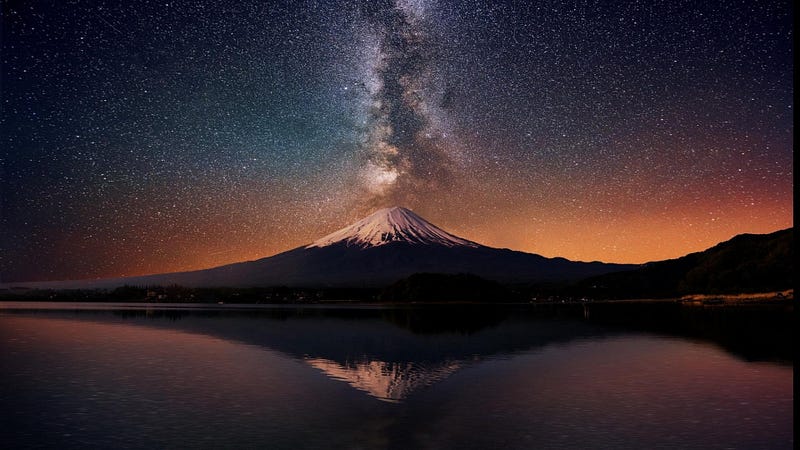
Kilimanjaro is colorless.
It’s as if the full moon is looking in a mirror, casting its reflection onto the ground, making a moon out of the surface of the earth. It is nothing but grey rock and glaciers from here to heaven.
Life stops at sixteen thousand feet, but in the silence that fills the absence of creation, I can hear the mountain breathing. It creaks and whistles. It becomes an old man — not feeble, but eternal — frowning down, warning our expedition not to venture another step.
“Away with you!” Kilimanjaro howls. “Back! Back! Back where you belong!”
We are ascending a mountain that does not want us, and it will do what it can to stop us. We need oxygen, but Kilimanjaro does not. With every step the air becomes more vacant, and we must take three breaths to find what one breath used to furnish.
When we left our hut we were laughing, teasing, dancing. Now the joy in our journey has evaporated. We walk in a single file, keeping all thoughts and encouragement to ourselves. The mountain isolates us. It knows we are more likely to turn back if we cannot encourage each other.
Our lead guide Ibrahim calls out: “Happy happy?” One at a time, we lie to him.
“Happy happy!”
“Happy happy!”
“Happy happy!”
Kilimanjaro scowls. Every time I try to look upon its face, the mountain lifts its chin, stretching its peak further into the sky. It’s three in the morning, and there is no identifiable end to our misery. Maybe we are already dead. Perhaps this is purgatory, a cursed place of expiation, where we struggle without ever escaping our past. Where we suffer a perpetual now, never breaching forth into our future.
The mountain whistles a cold wind down its chest. Kilimanjaro can make its own weather, can sink our Celsius, and can freeze the sweat beneath our wool jackets. The only way to stay warm is to keep walking. Long stop, long freeze. My eyelids frost together when I blink. My bones shake when I take a deep breath of thin, frozen air.
We forge our own switchbacks, leaving our footprints in twelve inches of volcanic ash. For every step we take, we slip back half as far on this great, frozen sand dune. All the while knowing that nothing will catch our fall if we slip.
I can trace our footsteps straight back to Kibo, to warmth and safety and sleep. If I quit the road is clear. If I keep ascending, everything is uncertain.
“Danger spot! Careful!” Ramisha says. Ramisha is my personal guide for the final ascent, always three steps behind me. To avoid a large jagged rock, we have strayed towards a cliff.
“Does anybody ever fall off?” I ask Ramisha.
“Sometimes,” he says. “Don’t look down.”
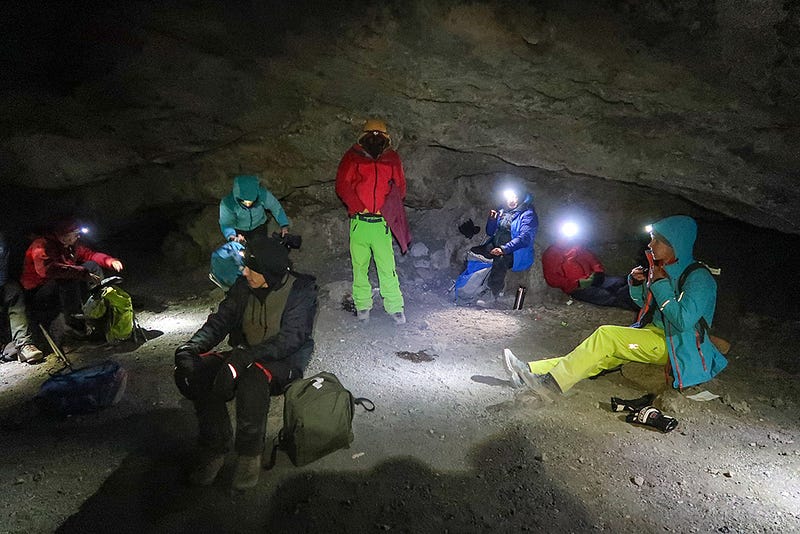
Hans Meyer Cave is barely a cave, little more than an indentation in the mountainside. We hide from the mountain inside this old scar. I have to bash my water bladders against the rock walls to break up the ice before water can flow through my spout.
A group that left an hour before us is huddled here. They are frozen and exhausted. Worse still, they are discouraged.
“We need to keep moving. We’re going to freeze!”
“I need rest! I’m exhausted!”
“We’re so close!”
“We’re not close at all!”
I look to Ramisha. He shakes his head. They aren’t going to make it.
As we snake up through the volcanic ash, my head pounds. I haven’t had a hangover in two years, but this feels worse than any hangover I can remember. I can’t hold a thought, can’t remember what Ramisha just said to me a second ago.
Luca, our hotel manager, told us to count our steps as our brains begin to fog over. I can only count to thirty before I lose track and have to start all over. So I count to thirty a hundred times, but when I look up, we are no closer.
I have to fart, but I’m terrified. Diarrhea is a common side effect of mountain sickness, so I try to hold it in for Ramisha’s sake. Then a strange thought comes over me.
‘If I shit my pants, it will won’t even be close to the worst thing that’s happening to my body right now.’
I risk the fart, and it’s nothing but warm air, a lone lovely moment in a long stretch of misery.
Ramisha doesn’t notice. He is arguing with Ibrahim. He thinks we are climbing too fast. He is watching us stagger up the slope as if we’d been sucking on a bottle of rum all night, a warning sign of possible pulmonary edema. Ramisha and Ibrahim are arguing only a few feet in front of me, but I can’t tell if they are speaking English or Swahili.
I want to intervene, but there is another problem. A dog.
It looks like the bush dog that crossed our trail on the first day. Its body is black, swaying back and forth as it trots against the volcanic ash. I do not know how a dog got this far up the mountain, and I don’t have time to care. Ibrahim and Ramisha are too busy arguing to notice, and I am too exhausted to alert them. I steady my footing, preparing myself to wrestle this beast if it decides to lunge at me. My only hope is that it will pass as peacefully as it has approached.
I step within reach of the beast’s fur, and I laugh. It’s no dog. I’m hallucinating. My brain is turning jagged rocks into beasts, another trick up Kilimanjaro’s sleeve. Everything I see has a pulse to it. Everything looks like it might reach out and bite me. How can I go on if I can’t even trust the rocks ahead?
I close my eyes.
This is a terrible idea. You should never close your eyes on a cliff. But I close them anyway because it feels warm, and it makes the pulsing stop. If I fall asleep I can easily spill off this mountain, but I no longer care. In this fog of thoughts, falling down the mountainside might not be so bad. If I fall this torture comes to an end.
Why did I ever believe I could make it to the top of Africa?
I close my eyes again.
Catch the previous article in my Kilimanjaro series here:
Check out this article too. A great read on deciding to travel by kat.: