
The Film That Most Scared Me as a Child: Christine
The car that won’t let you go
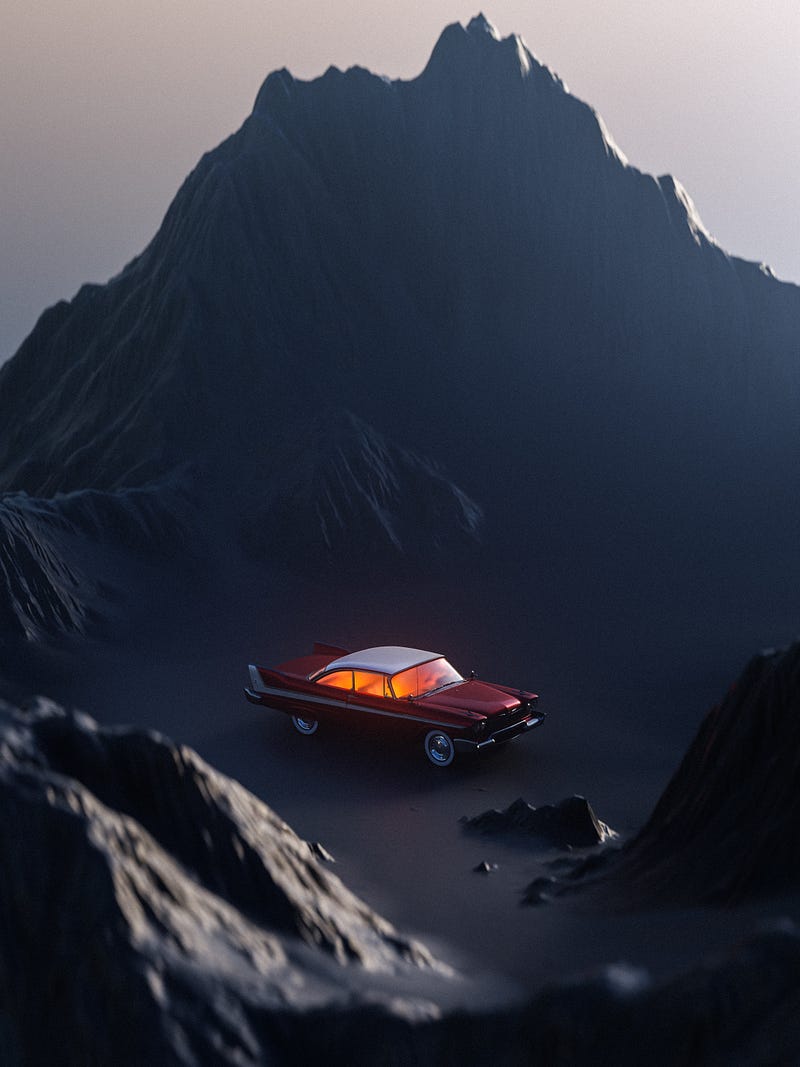
This is a response to the prompt The Film That Most Scared Me as a Child proposed by Simon Dillon and the team at Fanfare for October.
I consider my childhood blessed with oddities. My parents were considered unorthodox compared to my friends’ folks. I wasn’t indulged with confectionery, birthday cakes with trimmings, and toys like the other kids. There were no birthday parties, camping trips, and sleepovers — not that I ever complained.
But my folks gave me creative independence. I was given unrestricted access to movies, books, and art. That, to me, was a privilege. I was 7 when I watched The Omen, at 8 The Godfather, and at 9 Once Upon A Time In America (all four hours of it). By the time I turned 12, I developed an affinity for horror. I watched The Poltergeist four times within the same week.
There is much beauty in horror films. I love the sense of dread through frightening images, themes, and situations. I discovered there’s a spectrum to appreciating horror.
My three brothers prefer the slasher kind. They get their goosebumps from the gore, the screams, and messy bloodshed. They enjoyed Hostel and the Saw saga, often playfully mimicking the diabolical mastermind Jigsaw at the dinner table. I, on the other hand, get my satisfaction from psychological thrillers, where much of the scare, startle, shock, and repulsion comes from the mind more than the eyes.
I’ll never forget the first time I watched The Fly starring Jeff Goldblum and Geena Davis. How sad it was, I thought, for someone so brilliant to be so tormented. It wasn’t the fact he was dying looking like an insect from the teleport mishap. It was haunting that he had to die at the hands of his own ambition. Much like Kenneth Branagh’s Mary Shelley’s Frankenstein starring Robert De Niro and Helena Bonham Carter. Violence begets violence, and death becomes the only escape from your self-inflicted madness.
It’s not that I avoided flicks like Friday the 13th, Night of the Living Dead, and The Texas Chainsaw Massacre. I enjoyed them. But to me, the splashes and coagulation of blood, the mutilation and splattered brain matter become tasteless after a certain point. The body count reduces the suspension of fear. It becomes mere statistics.
Disappearances, cliffhangers, and the unseen work magic in my fertile imagination. For that The Vanishing, Children of the Corn, The Mist, 1922, Gerald’s Game, and Jeepers Creepers are formidable classics for leaving audiences baffled and disquiet. From the list alone, you can tell I am a fan of Stephen King and John Carpenter. Wes Craven has a special place in my heart for The Nightmare on Elm Street franchise. The Serpent and the Rainbow, Shocker, and The People Under The Stairs deserved more attention than they received.
My preferred blend of horror is what the eyes can’t see but the mind can’t cease to imagine. A knife may visibly stab the heart and stop the body from functioning. But a stab in the mind torments you differently. It leaves you lost in a labyrinth you cannot escape. I’d stay up all night, sometimes for a few days, thinking about how things could be different. That’s what happened when The Blair Witch Project was released.
Looking back at my childhood of cinematic horror, from the gothic Nosferatu the Vampyre through to The Shining, the movie that was a turning point in my youth was the 1983 adaptation of Stephen King’s novel of the same name, Christine. That has to be the film that scared me most as a child.
When I sat down to watch Christine for the first time, I didn’t know it was from a Stephen King novel. I was poorly prepared. I thought it was going to be a John Hughes high school yarn: boy-meets-girl with class division. I was wrong.
On the surface, Christine is a story about a car — a 1958 Plymouth Fury — that’s possessed by a mean spirit. Its previous owners — and people associated to them — died from grisly deaths ranging from suicide, accidents through to suffocation. This was a brand new horror for me at the time. There was no face to this poltergeist save for a vehicle. It communicated through its radio, and could magically fix itself despite many attempts to be destroyed. The fact that it was indestructible made it frightening.
If Jaws freaked me out about swimming in the ocean, Christine made me think twice about being left alone in a car.
The story begins in the 1950s at the assembly line. Almost immediately, we are introduced to a particular model that is symbolically painted red, as opposed to the others at the factory that are off-white. Without much rhyme or reason to its behavior, it already shows us how it’s up to no good, with a mind of its own: Less than four minutes in, a man gets injured. Another minute in, a (different) man dies. Both incidents occurred at the assembly line.
But if you look under its hood (metaphorically speaking) Christine is a story about human frailty, vengeance, and desire.
Arnold “Arnie” Cunningham is polar opposite to his best friend Dennis Guilder. Arnie is an introvert and socially awkward, made worse by a toxic mother and a weak father figure at home. Arnie, who feels ugly and invisible at school, walks in Dennis’ shadow. He watches with envy at Dennis who plays football and is liked by everyone. Although Dennis cares and looks out for Arnie, there are times when the bullies get to Arnie first.
One day Arnie catches sight of the beaten up Plymouth Fury at a yard. For inexplicable reasons, he gets drawn to it despite Dennis’ protest. Arnie purchases the car for $250, names it Christine, with the intention of fixing up the car himself. He hides Christine from his naggy and badgering folks at a junkyard owned by the not-so-nice Will Darnell.
At this point it seems like everyone, save for Dennis, are harsh and unpleasant to Arnie. This is where the Fury and Arnie are thematically intersected by individual characters. Both are misfits, strengthened by the force of deep-seated anger and injustice. The car seems intent to protect its new owner.
As Arnie works on Christine, he changes his appearance for the better. He becomes arrogant but attractive, confident but with a temper. He even wins the attention of a new girl in town Leigh.
But as Arnie grows into his new confidence, people begin to die around him. Anyone who presents a danger or a threat gets mysteriously killed by Christine. Once, on a date with Arnie, Leigh feels uneasy sitting inside the vehicle. As soon as he steps out of the vehicle, Christine tries to suffocate Leigh (who manages to escape in time).
With the string of coincidental deaths and Leigh’s intuition alarm bells ringing, Dennis’ own investigation on Christine’s previous owner reveals identical behavior of obsession and ultimately suicide. Both he and Leigh then try to save Arnie by destroying Christine, but it’s not as easy as it looks.
The ending is predictable, but it doesn’t leave viewers dissatisfied.
In the 80s and 90s, horror films were still clear-cut about good combating evil. Today, there is a shift where the lines are blurry, and evil may win, so producers can pave the way for layered sequels.
Christine requires no sequel. To me it makes a better classic than Carrie (also about another marginalized and abused character). Christine isn’t about jump scares, and that’s why it was different for a kid like me, often left to figure things out on my own. I extended my sympathy for Arnie. I saw Arnies in my school too. Some of them were my friends. Throughout the movie I was baffled: Why do people have to be so mean and nasty towards him?
He was constantly tormented and accosted by bullies that you feel a sense of vindication when Christine kills them in order to protect her owner. I love the movie for its unique chemistry. There is an almost palpable affection between Christine and Arnie, signifying the longing and loneliness felt by both “energies”.
Perhaps if Arnie was treated better, he wouldn’t have connected with the Fury. It was clear that the Fury was seeking an owner. Decades of sinister loneliness attracted an equal energy. It raises many questions about us as a society, and how we push the good out of people like Arnie, belittling their potential, leaving them with little to no choice but to submit to the dark forces that would accept them.
I felt sad when Arnie woefully described to Dennis one night on the way home about his fixation with Christine: “I dunno. Maybe it’s because for the first time in my life, I found something that’s uglier than me.”
My hat’s off to actor Keith Gordon for capturing the depth of Arnie’s loneliness and gradual madness for a four-wheeled paramour. Shit can’t get crazier than that in the 80s.