avatarCarl L. A.

Free AI web copilot to create summaries, insights and extended knowledge, download it at here

2642

Abstract

="a27d">The face-to-face section of the 5th United Nations Environment Assembly took place between February 21 and March 3, 2022. Thus, the invasion of Ukraine caught the delegates by surprise in the middle of the meeting in Nairobi. Since then, several interventions have condemned the Russian Federation’s invasion of Ukraine, especially from the European Union and Ukraine itself. At the closure of the meeting, Ukraine’s delegate expressed readiness to fight for the environment “like we also fight for our future”. He condemned Russia’s aggression and said that “when these international terrorists leave, we will rebuild our country”. Delegates also elected by acclamation Oleksandr Krasnolutsky, from Ukraine, as UNEA-6 rapporteur [3].</p><figure id="989a"><img src="https://cdn-images-1.readmedium.com/v2/resize:fit:800/1*N4GpZWTXoi4WS4OV1a4U3A.jpeg"><figcaption>UNEA 5.2 High Level Session by <a href="https://www.flickr.com/photos/unep/51914395402/">UNEP</a>.</figcaption></figure><p id="49d4">Despite the tension the invasion of Ukraine had brought to the negotiation table, the delegates were able to agree on major initiatives to stop biodiversity loss, pollution, and climate change. The main resolutions adopted at UNEA 5.2 are:</p><ul><li><b>“End plastic pollution: Towards an internationally legally binding instrument”:</b> Through this resolution, UNEA requests the creation of an Intergovernmental Negotiation Committee (INC) that will start to work on the development of a legally binding instrument to end plastic pollution by the end of 2024 [4].</li><li><b>“A science-policy panel to contribute further to the sound management of chemicals and waste and to prevent pollution”: </b>Through this resolution, UNEA will start the development of a scientific panel (similar to the IPCC) that will help to prevent future pollution and find solutions to present and future issues of concern. The parties considered that the panel should be an independent intergovernmental body and should deliver policy-relevant scientific evidence without being policy prescriptive [5].</li><li><b>“The animal welfare–environment–sustainable development nexus”:</b> UNEA acknowledged that animal welfare can contribute to addressing environmental challenges. This resolution, clearly inspired by the origin of the pandemic, remarks that the welfare and health of animals, sustainable development, and the environment are connected to human health and well-being [6].</li><li><b>“Environmental aspects of minerals and metals management”: </b>UNEA, underlined the specific environmental challenges related to artisanal and small-scale mining

Options

and their related health risks. It, therefore, starts the work required to hold a global meeting with the aim of developing non-prescriptive proposals to enhance the environmental sustainability of metals and minerals along the entire lifecycle [7].</li></ul><p id="951b">Given the international situation, very few expected that UNEA 5 would pass these historical resolutions. An international treaty on plastic pollution had been on the environmentalist agenda for years, but until now, the international community did not show the will to take this important step.</p><p id="28f3">Unfortunately, there is a real possibility that the conflict could affect future negotiations. If the war continues, Russia may boycott initiatives coming from Western countries as retaliation for the sanctions imposed by these nations.</p><p id="7366">References:</p><p id="e5b0">[1] <a href="https://www.unep.org/environmentassembly/about-united-nations-environment-assembly">https://www.unep.org/environmentassembly/about-united-nations-environment-assembly</a></p><p id="1cbc">[2] <a href="https://enb.iisd.org/unep/unea5/summary-report-22-23-february-2021">https://enb.iisd.org/unep/unea5/summary-report-22-23-february-2021</a></p><p id="03da">[3] <a href="https://enb.iisd.org/unea5-oecpr5-unep50-daily-report-2Mar2022">https://enb.iisd.org/unea5-oecpr5-unep50-daily-report-2Mar2022</a></p><p id="79f0">[4] <a href="https://wedocs.unep.org/bitstream/handle/20.500.11822/38522/k2200647_-_unep-ea-5-l-23-rev-1_-_advance.pdf?sequence=1&amp;isAllowed=y">https://wedocs.unep.org/bitstream/handle/20.500.11822/38522/k2200647_-_unep-ea-5-l-23-rev-1_-_advance.pdf?sequence=1&amp;isAllowed=y</a></p><p id="c70b">[5] <a href="https://wedocs.unep.org/bitstream/handle/20.500.11822/38228/L.14%20-%20DRAFT%20RESOLUTION%20FOR%20A%20SCIENCE-POLICY%20PANEL%20TO%20SUPPORT%20ACTION%20ON%20CHEMICALS%2C%20WASTE%20AND%20POLLUTION-%20English.pdf?sequence=1&amp;isAllowed=y">https://wedocs.unep.org/bitstream/handle/20.500.11822/38228/L.14%20-%20DRAFT%20RESOLUTION%20FOR%20A%20SCIENCE-POLICY%20PANEL%20TO%20SUPPORT%20ACTION%20ON%20CHEMICALS%2C%20WASTE%20AND%20POLLUTION-%20English.pdf?sequence=1&amp;isAllowed=y</a></p><p id="c49f">[6] <a href="https://wedocs.unep.org/bitstream/handle/20.500.11822/38524/k2200594_-_unep-ea-5-l-10-rev-1_-_advance_-_.pdf?sequence=1&amp;isAllowed=y">https://wedocs.unep.org/bitstream/handle/20.500.11822/38524/k2200594_-_unep-ea-5-l-10-rev-1_-_advance_-_.pdf?sequence=1&amp;isAllowed=y</a></p><p id="88b9">[7] <a href="https://enb.iisd.org/unea5-oecpr5-unep50-summary">https://enb.iisd.org/unea5-oecpr5-unep50-summary</a></p></article></body>

The Fifth UN Environment Assembly — A Meeting Marked by the Russian Aggression

International tensions could not stop historic agreements at the Fifth UN Environment Assembly
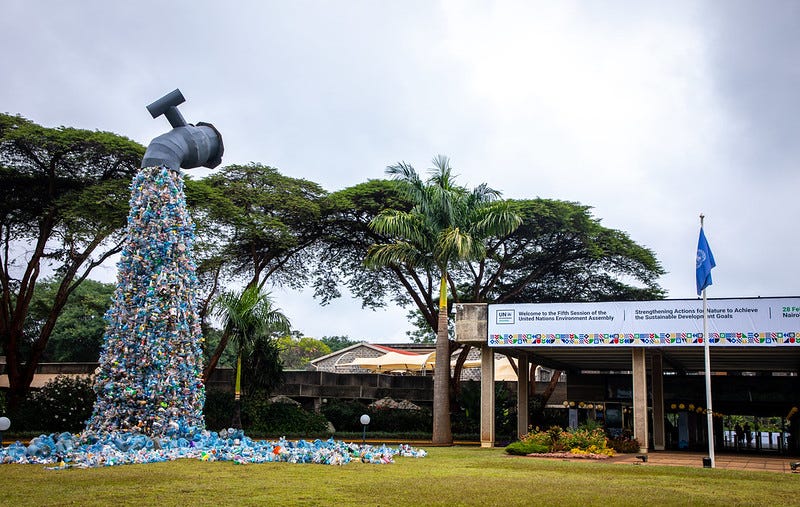
Plastic art installation at UNEP headquarters (Nairobi) by UNEP.

What is UNEA?

The United Nations Environment Assembly (UNEA) was formed in 2012, after the UN Conference on Sustainable Development (Rio+20), as it was clear at that time that the challenge posed by environmental degradation required more action from the international community. This assembly is currently the most relevant and influential decision-making organization in the area of the environment and sets the agenda on the actions to combat climate change, biodiversity loss, and pollution. The former UNEP Executive Director, Achim Steiner, described UNEA as “the world’s parliament on the environment” [1].

UNEA 5.1

Due to the COVID-19 pandemic, the United Nations Environment Assembly (UNEA) could not meet face-to-face as planned and was forced to split its work into two segments. The first segment (UNEA 5.1) was held online in February 2021 and discussed organizational and budgetary matters. It was agreed that the second segment (UNEA 5.2) would be held face-to-face in Nairobi in February 2022 and the work would be focused on technical and political issues.

151 member states attended UNEA 5.1 last year, which is considered a success considering all the technical difficulties that such a large meeting entails. The assembly adopted three procedural decisions:

  • endorsement of the Medium-Term Strategy (MTS) for 2022–2025, and programme of work (PoW) and budget for the biennium 2022–2023;
  • the management of trust funds and earmarked contributions;
  • agreement to convene a resumed, in-person fifth session in 2022.

These decisions allowed the UN Environment Programme (UNEP) to continue its work at a time when face-to-face meetings were not possible. Also, many leaders had the opportunity to stress the links between nature’s health and human health, the importance of a green recovery that addresses the needs of the poor and vulnerable, and, most importantly, the ambition of using this pandemic as an opportunity to strengthen UNEA’s work [2].

UNEA 5.2

The face-to-face section of the 5th United Nations Environment Assembly took place between February 21 and March 3, 2022. Thus, the invasion of Ukraine caught the delegates by surprise in the middle of the meeting in Nairobi. Since then, several interventions have condemned the Russian Federation’s invasion of Ukraine, especially from the European Union and Ukraine itself. At the closure of the meeting, Ukraine’s delegate expressed readiness to fight for the environment “like we also fight for our future”. He condemned Russia’s aggression and said that “when these international terrorists leave, we will rebuild our country”. Delegates also elected by acclamation Oleksandr Krasnolutsky, from Ukraine, as UNEA-6 rapporteur [3].
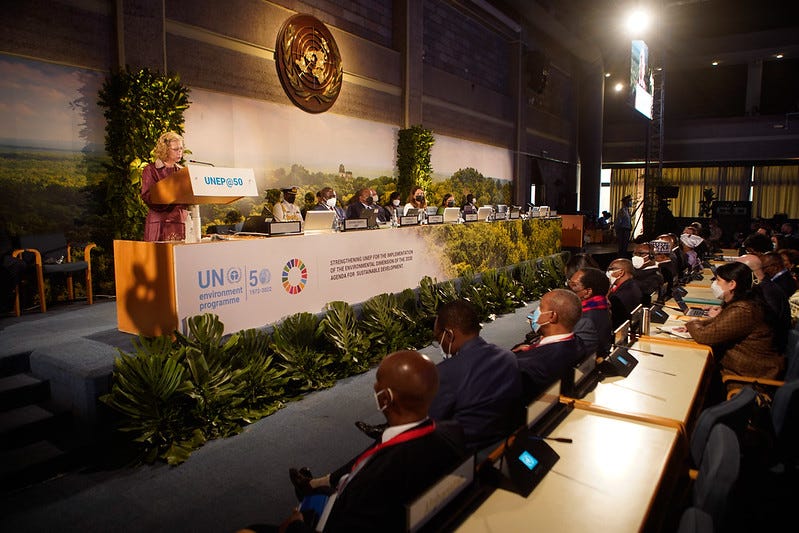
UNEA 5.2 High Level Session by UNEP.

Despite the tension the invasion of Ukraine had brought to the negotiation table, the delegates were able to agree on major initiatives to stop biodiversity loss, pollution, and climate change. The main resolutions adopted at UNEA 5.2 are:

  • “End plastic pollution: Towards an internationally legally binding instrument”: Through this resolution, UNEA requests the creation of an Intergovernmental Negotiation Committee (INC) that will start to work on the development of a legally binding instrument to end plastic pollution by the end of 2024 [4].
  • “A science-policy panel to contribute further to the sound management of chemicals and waste and to prevent pollution”: Through this resolution, UNEA will start the development of a scientific panel (similar to the IPCC) that will help to prevent future pollution and find solutions to present and future issues of concern. The parties considered that the panel should be an independent intergovernmental body and should deliver policy-relevant scientific evidence without being policy prescriptive [5].
  • “The animal welfare–environment–sustainable development nexus”: UNEA acknowledged that animal welfare can contribute to addressing environmental challenges. This resolution, clearly inspired by the origin of the pandemic, remarks that the welfare and health of animals, sustainable development, and the environment are connected to human health and well-being [6].
  • “Environmental aspects of minerals and metals management”: UNEA, underlined the specific environmental challenges related to artisanal and small-scale mining and their related health risks. It, therefore, starts the work required to hold a global meeting with the aim of developing non-prescriptive proposals to enhance the environmental sustainability of metals and minerals along the entire lifecycle [7].

Given the international situation, very few expected that UNEA 5 would pass these historical resolutions. An international treaty on plastic pollution had been on the environmentalist agenda for years, but until now, the international community did not show the will to take this important step.

Unfortunately, there is a real possibility that the conflict could affect future negotiations. If the war continues, Russia may boycott initiatives coming from Western countries as retaliation for the sanctions imposed by these nations.

References:

[1] https://www.unep.org/environmentassembly/about-united-nations-environment-assembly

[2] https://enb.iisd.org/unep/unea5/summary-report-22-23-february-2021

[3] https://enb.iisd.org/unea5-oecpr5-unep50-daily-report-2Mar2022

[4] https://wedocs.unep.org/bitstream/handle/20.500.11822/38522/k2200647_-_unep-ea-5-l-23-rev-1_-_advance.pdf?sequence=1&isAllowed=y

[5] https://wedocs.unep.org/bitstream/handle/20.500.11822/38228/L.14%20-%20DRAFT%20RESOLUTION%20FOR%20A%20SCIENCE-POLICY%20PANEL%20TO%20SUPPORT%20ACTION%20ON%20CHEMICALS%2C%20WASTE%20AND%20POLLUTION-%20English.pdf?sequence=1&isAllowed=y

[6] https://wedocs.unep.org/bitstream/handle/20.500.11822/38524/k2200594_-_unep-ea-5-l-10-rev-1_-_advance_-_.pdf?sequence=1&isAllowed=y

[7] https://enb.iisd.org/unea5-oecpr5-unep50-summary

Climate Change
Sustainability
Plastic
Policy
Environment
Recommended from ReadMedium