
The Fertility Rate in the US Has Plummeted
It affects everything and no one is talking about it.
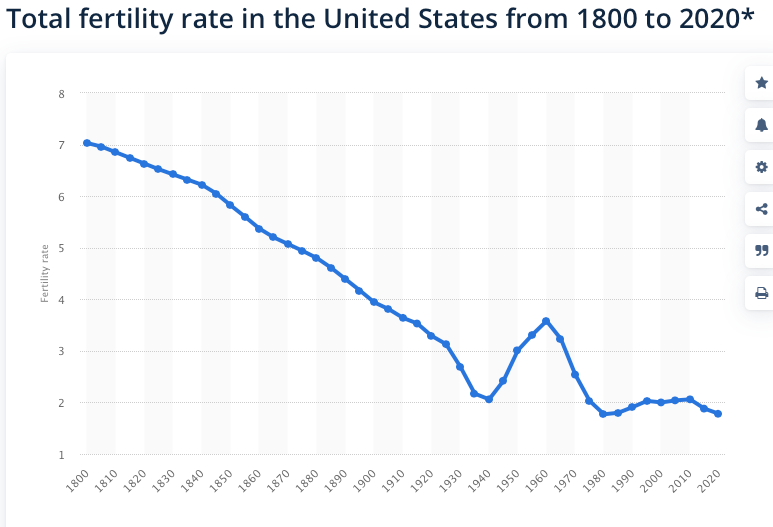
For a population to replace itself, the fertility rate, historically and without scientific question, has to be 2.1 (births per woman). In the US, right now that number is 1.70, and decreasing.
In other words, as our population ages, we’re not replacing the people who pass away with new people at a high enough rate. It’s called an “aging population” and it means, among other things:
Fewer new people in the work force.
Greater difficulty in caring for our elderly.
Why is this happening?
Fertility rates are down all over the world, particularly in developed nations, in prosperous nations. (A “jaw-dropping crash” according to BBC News.)
That doesn’t mean particularly for “white” people. Developing nations certainly seem to be growing — the highest world fertility rate is Niger, at 6.82 — but developed nations like Japan rank among the lowest, at 1.36. (The lowest is Singapore, at 0.8.)
The fertility decline is most striking in two of the world’s biggest countries, Russia (1.50) and the United States (1.70). Let’s look at the US and see what’s going on.
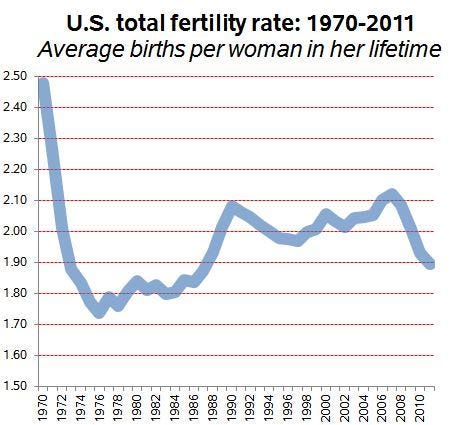
Social scientists have studied the data for a couple decades now and what they’ve found is that in the US, women working is one of the biggest contributors to fertility decline. It makes sense — the more women are working, the less, generally, they’re having babies.
Of course, we all know (or should know) that women have every right to work, so let’s not call it “women working” and make it an issue of sex, but call it what it is:
The need for two incomes.
The need for two incomes — and then the costs associated with that; two vehicles, child care, etc. — is considered one of the main causes of fertility rate decline.
It used to be that a family — even of four or five people — could be supported on one income. But real income hasn’t risen along with the cost of living over the past several decades, so more than one income is needed.
When both parents need to work, it reduces the incentives for children, or more children.
No maternity leave
The US is also one of the few countries in the world that does not have guaranteed maternity leave. It trails the rest of the developed world in family leave, paternity leave and disability. What many people deride as “free stuff” are simply taxes other nations allocate for these periods. This way, parents can have children and care for very young children without loss of income. Many developed countries are way ahead of the United States providing free child care as well.
But do these other developed nations all have higher fertility rates than the US?
Actually, no, they don’t. Some do, while others, such as the Netherlands and Denmark, have a lower rate than the US (1.57 and 1.70, respectively). It’s not clear whether making maternity and paternity leave mandatory would change US fertility.
So what else is going on? What else is driving down the fertility rate in the US?
Prosperity
Much of the data is still coming in, and there has to be some speculation. But social scientists who have dedicated themselves to researching fertility rates have come up with a range of factors. These include prosperity itself.
In prosperous countries, there is less economic incentive for children. It seems counterintuitive, but it’s a sound finding. As a nation grows more prosperous, there is a trend to wait until later in life to have children. This is due, perhaps, to people lavishing more time and attention on themselves.
There is also a growing consensus that the way children experience the first few years of their lives are hugely impactful — everything from brain size to IQ and emotional well being can be traced to early development. So the idea is to have fewer children and invest more time and energy in them — devoting more resources to fewer offspring.
This is not really an option in countries like Niger, where the resources are scarce. There, more children means more help with chores and even making money from an early age.
Free trade
It is likely (according to the bulk of peer-reviewed economic data) that free trade helps developing nations, even if the trade policies don’t always ostensibly help the US middle class, who see some job loss when large companies outsource labor.
But it is reasonable to think that the more work opportunities a developing country has, eventually the fertility rate will go down, since each person will have a greater earning potential. This then aids global economic balance, good for US workers.

Immigration
Here is another big piece of the puzzle to consider: since 1990, 60% of replacement population the US has come from immigrants, most of them Hispanic. As the US population ages, it will be immigrants making up a large part of the work force and helping distribute the burden of medicaid and social security. But the path to citizenship is long and serpentine, often taking close to a decade to complete. The last I checked, the US does not hand out work visas at the border, so that potential revenue is lost until the immigrant is a citizen.
It’s possible if the US were to make the path to citizenship easier, not only would the burden of elder care be more distributed, but the country might again see a rise in fertility rate, as more people would be sharing the overall economic pie. On the other hand, if wages continued to stagnate and cost of living continued to rise, it could backfire.
Raising the minimum wage, in concert with more permissive naturalization and/or work visas would seem to be a course that could increase the fertility rate.
Divorce
Unwed mothers make up a large part of the fertility rate since divorce has become so common. It’s probably impossible to reverse the social-acceptability of divorce and scale back to a time when married couples stayed together “no matter what.” And would we want that? Of course not.
The data do show that children do best — in terms of poverty, education, mental health — when in original nuclear families with the biological parents. But joined families work too, and better than single-parent families. So it would stand to reason that if we cannot force people to stay together, we can help single parents as much as possible ease the burden and help to promote proper childhood development. We can also encourage joined families and “alternative” families, regardless of our biases.
Climate fears
Finally, another factor cited in surveys by people having fewer children is a concern for the future environment on Earth. Though climate deniers persist, the overwhelming scientific consensus is that the Earth is warming up, and the cause is anthropogenic. This means rising oceans, and potential devastation to coastal towns and cities.
In the United States, a 2010 study found that 40% of the US population lives in a coastal county. And 44% — nearly half — the global population lives within 150 kilometers of the sea, a UN Atlas study has shown. People worry about coastal erosion, worsening storms, poor air quality, and other potential disasters.
This environmental anxiety can lead to a diminution of child births. Who wants to bring up new life in a dying world?

But wait, is a lowering fertility rate even a bad thing?
Especially if fewer people was better for the planet?
Well, some people, such as Michael S. Teitelbaum and Jay M. Winter, do tout the benefits of population decline:
“Slower population growth creates enormous possibilities for human flourishing. In an era of irreversible climate change and the lingering threat from nuclear weapons, it is simply not the case that population equals power, as so many leaders have believed throughout history. Lower fertility isn’t entirely a function of rising prosperity and secularism; it is nearly universal.”
This perspective notes the “demographic dividend,” which is a short-term decline of the “dependency ratio” — the number of dependents (children and older individuals of retirement age) weighed against the number of productive workers (generally citizens in the 18–59 age range).
“(An) oversupply of working-age labor relative to dependents can do wonders for economic growth. China’s remarkable run of economic progress over the course of the last several decades has largely been due to this.”
However, as others warn, then comes trouble. This working-age population gets older, and is no longer able to work. It has not replaced itself adequately. And so dependency, once more, increases.
“Productivity declines, economic growth stalls, and other issues (e.g. high social welfare expenditures, higher costs of labor, low tax revenues, etc) creep up.”
So, where does that leave us?
It seems that a declining fertility rate can be considered good or bad, depending on your perspective and metrics. Even your beliefs.
On the one hand, less people kind of means more resources to spread around, and maybe an easier time for the environment. Remember how pollution dropped and wildlife rebounded at the start of the pandemic?
But on the other hand, this could prove disastrous as we age, with no one to care for us, and far fewer paying into social security. Also, if your beliefs align with the “be fruitful and multiply” edict, then a declining fertility rate can’t be good.
Yet it seems that every social welfare program on the chopping block, every immigrant mired in a labyrinthine path to citizenship, every family told you’re-on-your-own about raising children, is counterproductive to the cause of a sustainable fertility rate.
Free trade can help to balance the scales around the globe, immigrants offset the burden of an aging population, welfare programs can help children in single parent families have a chance to flourish. Not to mention that environmental progress and energy reform — moving towards sustainable and clean energy while combating the use of dirty energy through caps and regulations — could help instill confidence in people to begin reproducing again.
The irony really seems to be that, by and large, the people who have the most vehement sense of nationalism when it comes to the US — decrying free trade, demanding a shored-up border, lamenting “free stuff” and denying climate change — are championing social and economic policies which are the most deleterious to the fertility rate. In other words, those who stick to these policies are the ones snuffing themselves out.
A version of this article was originally written by me and posted on Tumblr on 3/21/16. It has been lightly edited and updated. (The fertility rate in the US in 2016, for instance, was 1.88 and is now 1.70. In fact, all numbers I double-checked were now even lower than at that time, including Russia, Japan, and Niger.)


