
The Fertile Darkness of Apocalypse: Some Preliminary Notes on Epistemological Revolution
“Go tell my friends that I have set sail on the sea, and that my boat is smashed.”
-Mansur al Hallaj
Wifi at the Apocalypse Bunker
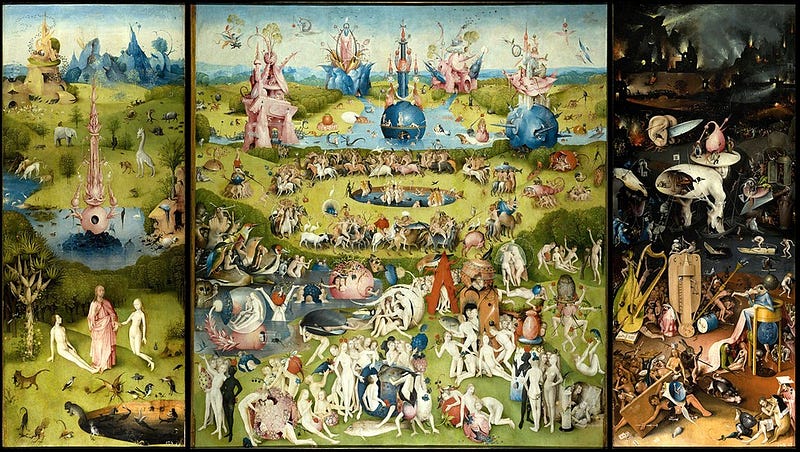
Something dark seems to be murmuring in the unconscious of humanity. Whereas in bygone eras, humanity — and western civilization in particular — looked beyond to a golden future, characterized by flying cars and liberation from alienating labor (cue: fully automatic space communism), it has nowadays become fashionable to instead ruminate on catastrophe: dystopian dramas occupy our screens and our attention, leaving us drooling and decomposing into an apathetic nihilism that is only occasionally punctuated by the exhilaration provided by the potential future opportunity to shoot zombies from a bunker with your friends; Insha’Allah they have wifi at the compound.
These tremors, these ripples through our cultural unconscious, are pointing to something very real. Despite the incessant propaganda duping the masses into believing the myth of unfettered ‘progress,’ there are various reasons to believe that our global civilization is marching towards collapse. Though the existential landscape is characterized by a variety of threats, the single biggest danger is the breakdown of our collective systems for sensemaking: for understanding, orienting, and acting in the world. Consequently, in order to navigate the threat of collapse, we must disrupt the tyrannical and paternalistic grip of our modern rational paradigm and memetically induce the birth of a new epistemology.
Cascades and Shark Fins
In order to understand the problem of collapse, we must first get a sense for what a civilization even is. Let’s define a civilization as a complex system that emerges over time to deal with a variety of problems on multiple simultaneous fronts such that the individuals in that system and the system itself are able to adapt and replicate over some period of time.
Though the collapsed civilizations of the past have occupied distinct geographical locations and historical circumstances, the fact that they were all complex systems means that they share a variety of attributes that allow them to be profitably compared. The first of these characteristics is interdependence: complex systems consist of a set of variables that are interconnected such that a change to one variable changes or may change all variables in the system. These changes often trigger feedback loops, which may cause the system to react nonlinearly to changes. This means that a change to some seemingly insignificant variable in the system can ripple and cascade in unpredictable and potentially catastrophic ways. Complex systems have infinite and unbounded phase spaces, meaning that the system itself is constantly evolving, and the kinds of states it can occupy is itself changing. One consequence of these characteristics is that causality is totally opaque to us in complex systems; we have no idea what causes what, and in what way. Properties can appear to emerge in seemingly discontinuous ways as the system evolves, causing dramatic alterations to the system’s topography.
These attributes are quite different from those of complicated systems. In a complicated system, causality is clear and predictable, so we can construct intelligible instruction manuals for handling anything that occurs in the system. The phase space of a complicated system is finite and bounded, meaning that there are a fixed number of forms that the system can potentially take. And complicated systems respond linearly to changes, meaning that it’s possible to fully understand the system by reducing it down to its component parts. Even if the system is too large or complicated for a single individual to manage, a well-assembled team of experts can reliably and precisely handle any kind of complicated system.
The entire game of civilization has been to devise complicated structures to manage underlying complex systems. We can call these structures civilizational architecture. However, any interaction between the complicated architecture and the underlying complex reality will inevitably produce some externality; and the management of these externalities will itself cause complex dynamics to form. Due to the causal opacity, feedback loops, and tendency for changes to cascade through complex systems in nonlinear and unpredictable ways, these emergent dynamics are impossible for any human intelligence to consciously manage. Rather, they are tracked by the civilization’s unconscious complex systems of collective intelligence — for example, their financial markets or evolved decentralized cultural systems.

The externalities levied by the interactions between the complicated and the complex, however, tend to be too much for even those unconscious systems of collective intelligence to manage, and therefore eventually result in the breakdown of some component of the system. For example, the society may hunt a food source to extinction, as we presently appear to be doing with many of the ocean’s apex predators (see: shark fin soup). Or the neighboring forests may be deforested at a rate and scale that exceeds their capacity for regeneration. Or the management of a regional military empire becomes so costly that its sustainment produces diminishing or even negative returns on investment, such that the society spends more time, money, and energy supporting a system that is decreasingly generative to its individuals. The weakened state of the empire may leave it vulnerable to terrorism — itself an emergent externality of the system’s state. Whatever the specific externalities may be, the civilization will eventually find itself in a situation that its brightest individuals and most robust systems of collective intelligence will not be able to innovate out of fast enough to avert calamity.
The speed element is critical here, as the insufficiency of cultural adaptation to move fast enough to respond to emerging threats may be indistinguishable from environmental catastrophe itself. So environmental catastrophes are only existential to the degree that they emerge faster than the given society’s ability to adapt. If adaptation fails, some part of the civilizational architecture managing the complex underlying reality may collapse. And though this collapse may initially appear to be bounded to a given localized domain, the complex properties of the system (nonlinear response, causal opacity, emergent properties, systemic cascades, feedback loops, etc.) are such that a localized collapse can ripple through the entire system and devastate the whole civilization.
Geographical Membranes
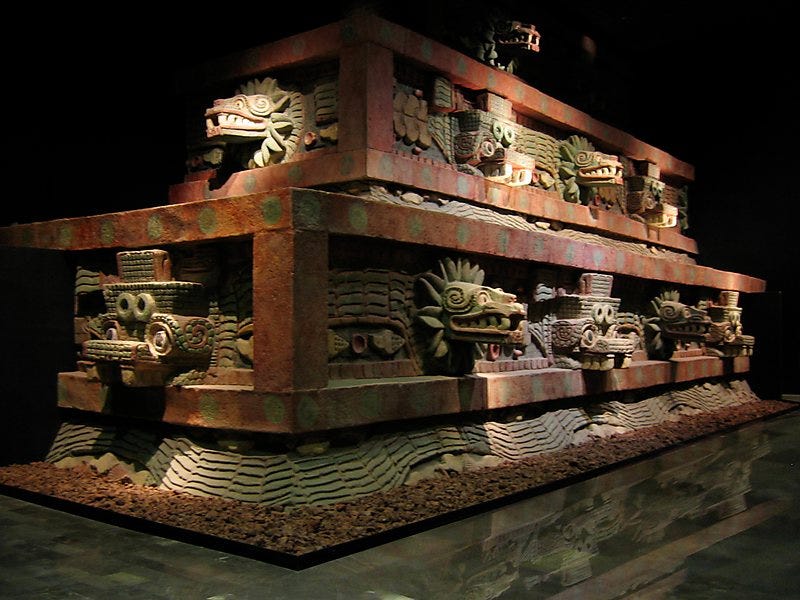
All of this has happened numerous times before: to the Western Romans, to the Mayans, to the Western Chou, and to many others. But though our current historical moment may rhyme with those of the past, it is fundamentally different in one critical way: when the Western Roman Empire collapsed, no one in Teotihuacan gave a shit. There were geographical membranes around the collapsed civilizations of the past such that — though they were certainly existential for the Western Romans or the Mayans or the Western Chou themselves — they were not actually existential threats for humanity as whole.
Things are different this time. We live in a global civilization, and our local actions have global — not just regional — consequences. The unprecedented scale and complexity of our civilization means that the variables are even more interdependent, causality is even more opaque, and the system is even more vulnerable to systemic cascades. These cascades are likely to move faster than our civilization’s capacity to orient and adapt, meaning that we are incredibly vulnerable to the possibility of global existential catastrophe.
Take the present crisis in Syria for example. An unusually extreme series of droughts triggered mass migrations to the city centers, far exceeding their carrying capacity. The resulting unemployment and food shortages escalated dormant social tensions enough to disrupt an already fragile regime and result in civil war. The ensuing mass Arab migrations to Europe escalated cultural conflict, leading to an increasingly belligerent and tribal attitude that has made Fascism appear once again as an attractive ideology. And this, in turn, has increased the risk of (nuclear) world war. Though these types of narrative explanations com easily in hindsight, few of us would have preemptively considered a rural Syrian drought to be a global existential threat.
Consequently, we must revise our methodology for assessing existential risk. Suddenly it becomes inappropriate to ask whether a minor change in climate is actually existential, or to dismiss any issue as a merely localized concern. Rather, we must develop the capacity to view issues such as regional pandemics, mass migrations, exponential technologies like AI and CRISPR, and extreme weather phenomena in a unified fashion that considers the ways in which they influence and reinforce each other. That is to say, we must reexamine our capacities and systems for collective sensemaking.
Structuring the Unknown
Sensemaking is literally about the making of sense. Sensemaking theory is concerned with how agents structure the unknown, why they structure it in a given way, and how that structure guides their actions. This process of structuring the unknown involves placing stimuli within frameworks in order to understand, extrapolate, and make predictions in the world. Sensemaking is a reciprocal process, meaning that information seeking, meaning ascription, and action all feed back into each other in complex and causally opaque way. This reciprocal process causes maps of meaning to emerge, both at the individual and collective level. And those individual and collective maps themselves feed back into each other.
Sensemaking occurs rapidly, so the best way to study the process by which humans make sense of phenomena is by examining what happens when predictions break down or the unexpected occurs. These unexpected occurrences provoke the question: is it still possible to take the world for granted? If not, why? And what’s next? These breakdowns in sensemaking are existential, in that they throw into question both the nature of the self and the agent’s conceptualization of the world.
This is because sensemaking is grounded in identity construction, retrospective rationalization, and the maps of meaning that emerge from the complex, reciprocal interactions between the two. Sensemaking is grounded in identity construction, because the perceived world shapes the identity as much as the identity shapes the perceived world. Jordan Peterson (or really Nietzsche and Hillman) have argued that our identities consist of a constellation of conflicting sub-personalities. These sub-personalities arrange themselves partly due to contextual considerations, ‘asking’ questions such as: which identity, and what corresponding sort of behavior, is appropriate here? The answers to these types of unconscious evaluations dynamically shape how the agent’s identity expresses itself and experiences the world. When we say that sensemaking is grounded in retrospective rationalization, we mean that “any intellectually conceived object is always in the past and therefore unreal.” Whereas “reality [itself] is…the moment of vision before intellectualization occurs,” sensemaking is the process of placing attention on the past in order to make sense of the present and orient towards some desirable future. This whole process is reciprocal, because people create their worlds based on their retrospective rationalizations, and orient their retrospective rationalizations towards the beliefs held by their identity, which itself is constructed and arranged based on external considerations such as ‘appropriateness.’
This blurring of the inner and outer world may trigger Cartesian anxiety in the modern sensemaker. Modern, rational epistemology is based on categorical thinking: something is either cause or effect, stimulus or response, subject or object, etc. As Weick has pointed out, “People seem to need the idea that there is a world with pre-given features or ready-made information, because to give up this idea of the world as a fixed and stable reference point is to fall into idealism, nihilism, or subjectivism, all of which are unseemly.” The phenomenon of Cartesian anxiety triggered by the dissolution of these categories is “best put as a dilemma: either we have a fixed and stable foundation for knowledge, a point where knowledge starts, is grounded, and rests, or we cannot escape some sort of darkness, chaos, and confusion.”An alternative to this nihilism, however, is accepting that “groundlessness is the very condition for the richly textured and interdependent world of human experience…[the world is not fixed or pre-given] but continually shaped by the types of actions in which we engage.” This approach is actually more congruent with the infinite and unbounded nature of the phase spaces that characterize the complex systems we inhabit.
A deeper understanding of sensemaking must acknowledge that the process is rooted in flow and characterized by thrownness (Heidegger). Sensemaking is rooted in flow because it never starts or stops; people are always in the middle of things, and only conceptualize those things as things retrospectively; and sensemaking is characterized by ‘thrownness,’ because it occurs in ongoing situations, situations in which we find ourselves ‘thrown,’ situations ‘in which we must make do if we want to make sense.’ This thrownness has six properties: (1) you can’t avoid acting, (2) you can’t step back and reflect on your actions, (3) you can’t predict the effects of your actions, (4) you don’t have a stable representation of the situation, (5) every representation is an interpretation, and (6) the act of interpretation, whether via language or any other tool for representation, still constitutes an action and thus changes the system.

Flirting at Fukushima
We should be sensitive to the subjective quality of thrownness, and to how people chop up the flow of reality into discrete units for understanding. The world is continuous, yet we categorize; those categories orient goal-directed action, but mutilate large regions of fluid continuity in the process. This mutilation produces blind spots, and those blind spots create opportunities for miscalculations. The consequences of these miscalculations manifest as anomalies, and those anomalies themselves feed back into the system to potentially trigger the dissolution of the old and birth of a new framework — the birth of a new world. Resisting this process of death and regeneration via the repression of anomalies is incredibly dangerous, as the model will break as a result of changes to the underlying landscape regardless of whether or not the sensemaker decides to consciously participate in updating their maps. Furthermore, an intelligence’s unwillingness to update its maps means that its view of the world drifts further from reality over time, resulting in the blind participation in potentially catastrophic behaviors.
Therefore, the deepest existential threat to our current civilization is our unwillingness to allow our collective systems for sensemaking to break down and take on new form. Our frameworks (based on ‘objective rationality’) and corresponding instruments (such as science and journalism) are no longer adequate for the types of problems we now face. There is ample evidence that corporate influence has distorted the reliability of published scientific research, and even the papers that manage to elude that distorting influence still seldom replicate. Moreover, the scientific process — even when functioning properly — still moves much more slowly than the speed at which risks emerge at our civilization’s scale and complexity. There is also sufficient reason to believe that the news is often fake, and we are very bad at determining the cases in which it is or isn’t so. For example: does anyone honestly know what’s presently taking place in Syria? Can anyone claim to know the state of Fukushima at the moment? The increased capacity to falsify believable video and audio combined with the sheer magnitude of contradictory available information makes it so that we can only dimly guess what’s ever actually taking place in the world.
These instruments and frameworks may have been sufficient for the lower complexity and scale of past civilizations. But they mutilate too much of the underlying flow of reality for us to continue relying on them for sensemaking under present conditions. And it’s unlikely that we will technologically innovate our way out of this dilemma, as our increased technological capacities are themselves at least as threatening as they are promising — especially given the low reliability of our sensemaking frameworks. If the depth at which we understand our environment ( understand ourselves) doesn’t exceed or even nearly match our power to alter it, then that power is more of a threat than a solution. As Daniel Schmachtenberger has pointed out, we must be cautious of attaining the power of the gods without also attaining their wisdom. Less abstractly, this means that if we can’t make sense of the human genome, we can’t expect to use CRISPR to edit it safely; if we can’t make sense of the deep internal architecture of AI, we can’t assume we aren’t “summoning the demon” with its creation; if we can’t make sense of complex ecological systems, we can’t expect to manage environmental and pandemic risks without incurring invisible externalities; and if we can’t make sense of these domains independently, we certainly won’t be able to make sense of how they interact.
Archetypes of Autistification
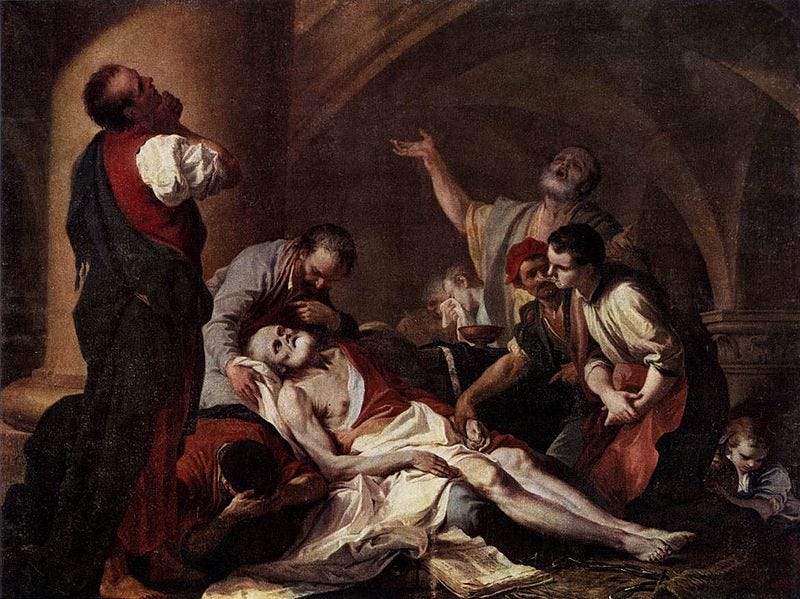
To understand how we got here, we must examine the processes by which our modern civilization has chopped up the flow of reality while keeping a watchful eye for what may have been excluded, mutilated, suppressed, or ignored. There is a felt quality to, and corresponding image or archetype for, our modern civilization’s conceptual model for sensemaking; the felt quality is dry, objective, detachment, and the archetype is the dying Socrates, whom Nietzsche has termed the primordial Theoretical Man. As he points out in The Birth of Tragedy, the most representative statement of this way of thinking and feeling (of unfeeling?) is Socrates’ realization that he knew nothing, and that all the greatest artists, poets, and statesmen of Athens also knew nothing. This degradation of the intuitive, instinctual felt-sense, this rejection of anything outside of the confines of logical apprehension, this insistence that the unintelligible is unintelligent, occupies the core of Socratic thinking. The central illusion underlying this way of thinking is the belief that reality can be penetrated by pure rationality, guided by causal thinking. This “metaphysical illusion” (Nietzsche) underlies the foundation of our modern scientific paradigm, of our primary framework for collective sensemaking.
We can refer to this paradigm as rationality. Rationality is the set of rules and assumptions that allow us to organize, contextualize, and interpret stimuli such that we can make sense of the world and act. These rules and assumptions include: detached objectivity; the belief in a world ‘out there,’ independent of subjective experience, simply waiting for us to discover it; the belief in the ability to determine the causal relationship between stimulus and response in the natural world; and the need for others to be able to independently replicate and verify your work. Using the instruments of rationality, we chop up the flow of reality and construct mental models that orient attention to only those stimuli that can be rationally explained. Anything outside the domain of the rationally explicable is dismissed as merely irrational, or as Socrates put it, merely instinctive, and subjected to a process of interrogation. The aim of this interrogation is the either produce a rational explanation for the phenomenon, or to justify discarding it from one’s model of the world.
This interrogatory process guides the clarification and expansion of the modern, rational scientific paradigm. The process is clarifying, because with each integrated or discarded anomalous stimulus the form of the paradigm becomes further articulated; and the process is expansive, because paradigms shift and expand via the retroactive explanation and integration of anomalous phenomena. These anomalous phenomena are, as a rule, arrived at irrationally; if the encounters were rational, the phenomena would already be within the paradigm and consequently not deemed anomalous in the first place.
Kekulé’s Dream
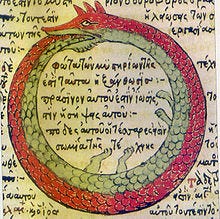
The story of Friedrich Kekulé’s discovery of the structure of the benzene molecule is illustrative of this process. In 1865, Kekulé had a dream in which he saw atoms dancing around and linking to one another. He later had a second dream in which the dancing atoms formed into strings, and moved around in a serpentine fashion. This visionary dream continued until the snakelike strings of atoms took the more coherent form of a serpent swallowing its own tail — that is, the archetype of the uroboros. Upon waking, Kekulé immediately sketched what he’d seen in his dreams, and used the image of the serpent swallowing its own tail as the basis for his discovery of the cyclical structure of benzene molecules. In this case, as in others, Kekulé’s rational analysis occurred only after the initial irrational moment of revelation.
This disconnect between the irrational, intuitive nature of discontinuous discovery and the rational process of paradigmatic integration is perhaps one way to interpret Nassim Taleb’s declaration that “history is written by the losers.” Rationality is mostly concerned with retrospective integration, with packaging irrational insights into a form conducive to scholarly analysis and institutional regurgitation. It is the realm of the copyists, the Nestorian scribes of the modern world, feverishly scribbling revisionist narratives in which the subjective and revelatory processes of discovery are retold as cold and detached rational investigations.
Song of Socrates
Even Socrates, in his final days, was forced to confront the inadequacy of his rationality. In The Birth of Tragedy, Nietzsche uses the image of the Music-Making Socrates as the archetype for the rationalist’s confrontation with the tragedy and chaos of irrational revelation. During his time in prison, Socrates often had a dream in which he was told: “make music!” To soothe his soul, he eventually succumbed to an experience beyond his rational domain and constructed a hymn to Apollo (it should have been Dionysus!) which he sang in his prison cell. The vocalization of this dream-vision is the only indication that Socrates gave any consideration to the limitations of his logic. And at that moment of vocalization it’s possible that he realized a terrifying truth: the Apollonian Greek world of modesty, sobriety, and prudence was but a thin veneer, desperately flailing to suppress the Dionysian underworld from which it emerged. That subterranean underworld, the womb of classical civilization, was the dwelling place in which suffering and knowledge, ecstasy and union, death and creation all mingled and fucked, swirling in the chaos of undifferentiated potentiality.
That irrational chaos has always provided the guiding intuition behind innovation and discovery. Even our scientific language reflects this fact. The word theory itself comes from the pre-Socratic mystical Orphic tradition, and originally referred to a “passionate sympathetic contemplation” in which the mystic is “identified with the suffering god, dies in his death and rises again in his new birth.” And Orphism itself was a reformation of the Bacchus (Dionysian) cult, whose adherents induced mystical states to produce “enthusiasm,” which etymologically meant “having the god enter into the worshipper, who believed that he became one with the god.” This approach to knowledge entered the scientific tradition via Pythagoras, himself an Orphic, but its roots trace back to the mystical Dionysian orgies of the Bacchus cult, whose “matrons and maids, in large companies, would spend whole nights on the bare hills in dances.”
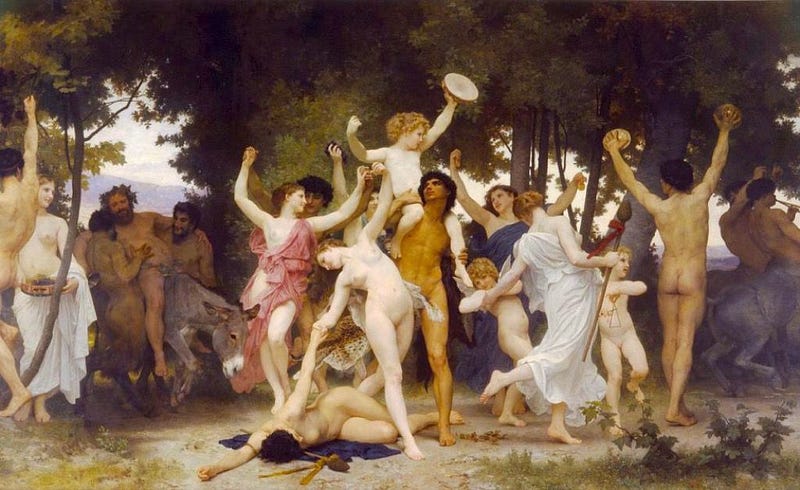
Integrating those insights into a paradigm based on linear rationality was tolerable (but insufficient) in the past, when civilizations lived their lives and died their deaths on a more local or regional scale. But we live in a complex civilization that is global, and consequently the tools that were once adequate for understanding and acting in the world are no longer reliable. They may in fact even produce catastrophe, which would be a final, because global, catastrophe. Therefore, we need an epistemological revolution. We need to move beyond the categories, beyond rationality, beyond the dry Socratic world of Theoretical Man and his retroactive causal rationalizations, and into the more irrational, feminine world of flow: a world based on connection to what is rather than what should be; a world rooted in intimacy with all parts of reality, rather than preferential mutilation.
Anything Goes
The seeds of this new transrational theory and praxis may be found in the worldviews and thought-systems that we’ve traditionally dismissed as irrational and therefore unworthy of serious examination. As the philosopher of science Paul Feyerabend wrote in Against Method, “the only principle that does not inhibit progress [in this search] is: anything goes.” To this end, we must examine the claims and worldviews of the crazy saints and madmen, sex cults and apocalyptic movements, with a watchful eye for the seeds from which components of our new paradigm may bloom.
Considerations such as ‘objective accuracy’ should be considered tertiary to flexibility and flow. This approach is consistent with sensemaking theory, which itself considers accuracy to be “nice but not necessary.” The more critical considerations are: what information does a given filter include and exclude? Can we layer filters in such a way that previously rejected but useful content gets through? And, ultimately, can we be intimate with all parts of the world? As identity and world construction are reciprocal in the process of sensemaking, to be intimate with all parts of the world means to be intimate with all parts of yourself, and vice versa. This sympathetic, feminine, connection-based mode of feeling and processing could potentially heal the traumatic disconnection, the mutilation of self and world, caused by the tyranny of Theoretical Man and his rationality, and — in doing so — allow us to enter into a more intimate relationship with reality.
Pythagorean Shipwrecks
But we should be cautious of the dangers inherent to any descent into the darkness of irrationality. The Pythagoreans had a curse: whoever discloses the secret of the irrational is to die in a shipwreck, “for the unspeakable and formless must be left hidden forever.” As the philosopher and collapse theorist Oswald Spengler wrote in The Decline of the West, “the idea of irrational numbers — the unending decimal fractions of our notation — was unrealizable within the [Classical or Apollonian] Greek spirit…the fear that underlies this [curse] is the selfsame notion that prevented even the ripest Greeks from extending their tiny city-states so as to organize the country-side politically, from laying out their streets to end in prospects and their alleys to give vistas, that made them recoil time and time again from the Babylonian astronomy with its penetration of endless starry space, and refuse to venture out of the Mediterranean along sea-paths long before dared by the Phoenicians and the Egyptians…it is the deep metaphysical fear that the sense comprehensible and present in which the classical existence had entrenched itself would collapse and precipitate its cosmos into the unknown primitive abyss.”
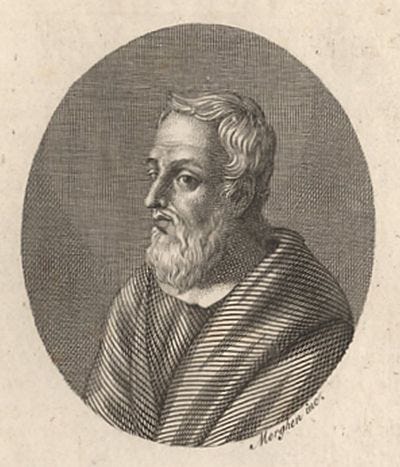
Their fear was justified. Irrationality is fundamentally subversive to a society, because it points to a world beyond the paradigm and, in doing so, disequilibriates its foundational assumptions. These foundational assumptions — and their respective norms, codes, and traditions — anchor a culture and its people into what philosopher Ken Wilber refers to as a certain center of gravity. The idea is that culture acts as a scaffolding that we layer onto the world to create the illusion of finitude and intelligibility out of the infinitely complex underlying reality. This scaffolding constrains behavior to a certain range; deviation too far above or below that range — that cultural center of gravity — threatens the society with the possibility of confrontation with the great unknown, and may consequently call its thus-far-adaptive assumptions into question. Therefore, there is a certain escape velocity needed in order to escape the gravitational pull of the culture’s center.
The Valley of the Shadow
We can use the evolutionary biological concept of fitness landscapes to formalize this journey through the uncharted territory beyond this center of gravity. To understand fitness landscapes, just imagine a field with a topography characterized by hills and valleys. Positions on the x and y axis represent certain ways of being or evolutionary strategies, and the height on the z axis represents the sum of all environmental feedback elicited as a result of those strategies. If a strategy occupies a high z, a high hill, then it has a high level of adaptive or reproductive fitness. A strategy with a low z, occupying a low valley, has a low probability of replication. Over time, the fit ways of being will reproduce and the unfit ways of being will disappear.
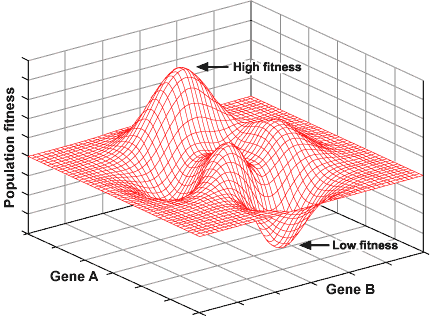
To borrow Jordan Greenhall’s example, imagine the fitness landscape of an old growth forest. The topography has a few hills: one for jack rabbits, one for dark black bunnies, and one hill for fat brown bunnies. The adaptive fitness of the combination of attributes such as color, ear size, running speed, etc. shape the height of each particular hill on the landscape. Being a small white bunny has a negative fitness in this particular landscape, and consequently there are no small white bunnies. But if the landscape were to shift, for example, to the arctic, then all but the white bunnies might disappear over time.
This framework allows us to distinguish between two key adaptive strategies: hill climbing and valley crossing. Hill climbing involves a set of skills, behaviors, and strategies that are optimized for climbing a particular hill on the fitness landscape. The accumulation of these behaviors constitute a certain aptitude, what Greenhall calls a “meta-strategy, or the capacity to have strategies.” So an agent can optimize for hill climbing over time. Valley crossing, on the other hand, involves going down in fitness for a period of time. This descent into the valley is risky, as the probability for death or the inability to reproduce is incredibly high. Consequently you wouldn’t want to engage in this strategy unless you believed that there might be another even higher hill somewhere beyond for you to discover. The potential for discovering a better hill is what makes valley crossing adaptive. This aptitude is critical for a species, because the fitness landscape may shift such that the hill most organisms are optimized for may suddenly disappear. Without the ability to cross the adaptive valley, even minor alterations to the fitness landscape may constitute an existential threat.
Individuals and cultural frameworks that are highly optimized for hill climbing will often either vehemently resist any moves towards adaptive valley crossing or be entirely blind to the changing topography of the underlying fitness landscape that would motivate such moves. This is a result of a phenomenon called niche construction. Locally adaptive behaviors produce meta-strategies that are optimized for climbing a particular hill. Over time, physical, social, and perhaps even metaphysical architecture emerges to increasingly focus in on the skills, assumptions, and behaviors most optimal to getting as high on that hill as possible. In the same way that the act of interpretation, whether via language or any other tool for representation, still constitutes an action and thus changes the system, the act of niche construction causes the topography of the fitness landscape itself to change: you build a hill out of your niche and then climb it, altering the landscape in the process. Individuals and societies with an overdeveloped adaptation for climbing these hills eventually lose the capacity to cross valleys, as the process of optimizing for the given local hill has gradually eliminated the feedback signals that indicate and train for valley crossing.
Descent into Madness
But it’s possible to construct a niche that allows for and reinforces both hill climbing and adaptive valley crossing. Rites of passage, for example, are culturally transmitted behaviors that are optimized for valley crossing and have existed in tribes for millennia. Archetypally, this initiatory venture into the chaos of the unknown is represented by the hero, who leaves the safety of his culture’s center of gravity, descends into the adaptive valley, and returns with a revolutionary insight that may stimulate the evolution of his society. In tribal societies, this role has traditionally been occupied by the shaman. Shamans voluntarily undergo processes of initiation whereby their personality is dissolved and reintegrated at a higher level of awareness. These individuals live in the liminal space between the borders of the paradigm and the primordial chaos that rages beyond, and consequently have an increased sensitivity to the emergence of anomalous stimuli. Having detected these anomalies, they begin their descent into the depths of the adaptive valley well before anyone else in their society has even noticed any potential disruption. By descending into the valley, the shaman experiences the dissolution of the entire paradigmatic framework that organizes his society. In doing so, he lives the future of his society. (Peterson)
Traditional societies have always distinguished their shamans from their lunatics, but the line between the two tends to be thin. Eliade has argued that “the total crisis of the future shaman, sometimes leading to complete disintegration of the personality and into madness, can be valuated not only as an initiatory death but also as a symbolic return to the pre-cosmogonic Chaos.” This disintegration hurls the shaman into the primordial unknown, where stimuli are stripped of all culturally assigned significance and are therefore both infinitely threatening and infinitely promising. According to Jordan Peterson, “every ‘step forward’ [into the depths of the adaptive valley] therefore has some…aspect of the revolutionary ‘descent into madness.’”
Societies adapt and survive the ever-shifting terrain of their underlying fitness landscapes via this revolutionary act of integrating anomalous insights. This process of integration, however, may be sufficiently disruptive to confront those identified with the paradigm with the primordial chaos of the adaptive valley against their will. Philosopher of science Thomas Kuhn states that “this transition from a paradigm in crisis to a new one from which a new tradition of…science can emerge is far from a cumulative process, one achieved by an articulation of extension of the old paradigm. Rather, it is a reconstruction of the field from new fundamentals, a reconstruction that changes some of the field’s most elementary theoretical generalizations as well as many of its paradigm methods and applications.” We can’t underestimate the terror this transitionary period can induce, particularly in those most optimized for climbing the local adaptive ‘hills’ of their environment — hills which may suddenly no longer exist. Einstein, for example, said that this experience of paradigmatic disruption felt to him “as if the ground had been pulled out from under one, with no firm foundation to be seen anywhere, upon which one could have built.”
One Funeral at a Time
Resistance to this paradigmatic disruption, though psychologically soothing for the conservative (here, rationalist), ultimately threatens the entire society with the increased potential for total systemic collapse. As Peterson has argued, “this ‘spirit of unbridled rationality,’ horrified by his limited apprehension of the conditions of existence, shrinks from contact with everything he does not understand. This shrinking weakens his personality…and makes him rigid and authoritarian, as he clings desperately to the familiar, ‘rational,’ and stable.” This clinging inhibits adaptation at the paradigmatic level, which is incredibly dangerous, as the underlying complex reality continues to move whether or not the custodians of that paradigm move with it. In the case of our present global civilization, this gripping constitutes a global existential threat to humanity.
Therefore, given the critical nature of this moment in history, we cannot afford to passively await the emergence of a new epistemology, for science to progress “one funeral at a time.” Rather, we must vigorously trawl through the underbelly of our tradition, and extract the irrational insights that have thus far been discarded or ignored; and we should not even discriminate between those insights affiliated with shamanism and those outbursts associated with lunacy. In order to successfully adapt our sensemaking frameworks to the rapidly shifting nature of our existential landscape, we must fearlessly venture into the depths of the adaptive valley, the dwelling place of Dionysus, with the attitude of ‘anything goes’ and the image of the Music-Making Socrates: shrieking and howling enraptured in his death cell.
And having extracted these seeds from the depths of the irrational, we must scatter them shamelessly in the dark fertile soil of the fields of our apocalypse, such that we memetically trigger the transition of our paradigm. But we should also remember how dangerous this is. The Pythagoreans were right: we risk inadvertently losing the very fabric that holds our civilization together, the scaffolding preventing our world from total dissolution into the raging seas of chaos. But it’s also inevitable, for if we don’t volitionally confront the chaos we will nevertheless find ourselves involuntarily confronted.
Therefore, I suggest you begin by seeding your own mind with irrationality. Volitionally enter the chaos within in such a way that your inner world transforms from the rigid, categorical, rational paradigm to a more fluid, intuitive, connection-based world.
There are better and worse ways of doing this, but that will have to wait for a future essay.
Bibliography
(Title Adapted from Nicole Daedone’s Fertile Darkness of Trauma).
“American Meteorological Society.” Water, Drought, Climate Change, and Conflict in Syria: Weather, Climate, and Society: Vol 6, No 3, journals.ametsoc.org/doi/full/10.1175/WCAS-D-13–00059.1.
Feyerabend, Paul. Against Method. Verso, 2010.
Greenhall, Jordan, director. Crossing the Adaptive Valley. YouTube, YouTube, 22 Feb. 2018, www.youtube.com/watch?v=RIY-Fm74KXI.
Greenhall, Jordan, director. The Cynefin Framework — Complicated, Complexity, Chaos. YouTube, YouTube, 14 Feb. 2018, www.youtube.com/watch?v=su91uPR_jmM.
Greenhall, Jordan. “The War on Sensemaking — Rally Point Perspectives — Medium.” Medium, Rally Point Perspectives, 22 Apr. 2017, medium.com/rally-point-perspectives/the-war-on-sensemaking-900086bca636.
“Kekulé’s Dream.” ChemDoodle Web Components RSS, web.chemdoodle.com/kekules-dream/.
Mierzwinski, Ed. “Monsanto Manufactured Scientific Studies And Then Used Those Studies To Influence EPA, Other Regulators.” The Huffington Post, TheHuffingtonPost.com, 15 Mar. 2017, www.huffingtonpost.com/entry/monsanto-manufactured-scientific-studies-and-then-used_us_58c95699e4b0009b23bd94d9.
Mitchell, Melanie. Complexity: a Guided Tour. Oxford University Press, 2011.
The National Bureau of Economic Research, www.nber.org/digest/mar16/w21788.html.
Nietzsche, Friedrich Wilhelm. The Birth of Tragedy. Dover Publications, 1995.
Peterson, Jordan B. Maps of Meaning: the Architecture of Belief. Routledge, 1999.
Russell, Bertrand. A History of Western Philosophy. Simon and Schuster, 1972.
Sapolsky, Robert, director. Chaos and Reductionism . YouTube, YouTube, 1 Feb. 2011, www.youtube.com/watch?v=_njf8jwEGRo.
Schmachtenberger, Daniel, director. Winning Humanity’s Existential Game. YouTube, YouTube, 16 Oct. 2017, www.youtube.com/watch?v=IfoPitvLY7c.
Spengler, Oswald, and Charles Francis Atkinson. The Decline of the West. A.A. Knopf, 1926.
Tainter, Joseph A. The Collapse of Complex Societies. Cambridge University Press, 2017.
Taleb, Nassim Nicholas. Antifragile: Things That Gain from Disorder. Random House, 2016.
Triana, Pablo. “In Finance, History Often Written By Losers.” The Huffington Post, TheHuffingtonPost.com, 25 May 2011, www.huffingtonpost.com/pablo-triana/in-finance-history-often_b_227923.html.
Vasishth, Shravan. “The Replication Crisis in Science.” The Wire, 29 Dec. 2017, thewire.in/science/replication-crisis-science.
Weick, Karl E. Sensemaking in Organizations. Sage, 2009.
Wilber, Ken. A Brief History of Everything. Shambhala, 2000.