
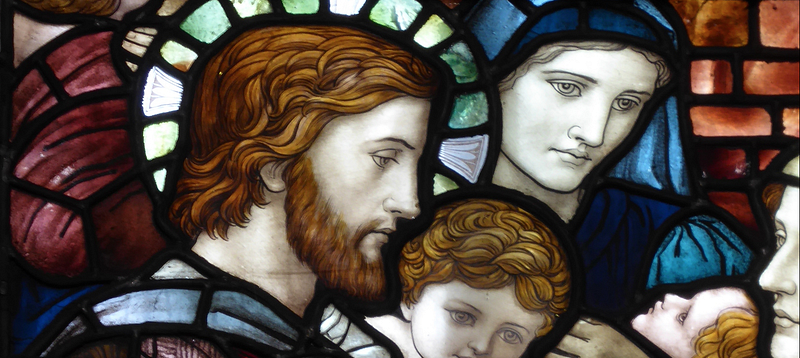
The Feminist Jesus
Gender equality originates, historically, in one place.
When Christians talk about sexual issues, I often wonder what Bible they’re reading? All the focus on male clergy, male power in marriages, male oversight of children—is weirdly detached from the scriptures.
All his life, Jesus treats women as friends, helpers, co-workers. He uses female reference for himself. Nowhere else in the ancient world, that I have ever heard of, are women understood as full, self-determining partners in life. But that is his message, insistently.
Let’s talk about the feminist Jesus?
Jesus’ story starts with an angel meeting with Mary. The angel lays out the problem: a human mother is needed for the messiah to be born. “I am the Lord’s servant,” she replies in Luke 1:38.
We realize: the angel was asking her permission. “Mary’s consent to impregnation appears to be a salient point of tension in the passage,” notes Michael Pope.
No woman is told to do anything. It is her choice. This moment reverses, as Pope details, the long biblical history of sexual violence.
The angel does not ask Joseph if his wife-to-be can be made available for this surrogacy. Mary is not his property.
Note that Joseph is never quoted. Where Mary was engaged in a dialogue, and sings, demonstrating extensive theological knowledge, her husband is ‘commanded’ by the angel. He thinks in terms of rules, and punishments, not communication and interaction.
These are clues that Jesus, from the start, indicates a shift in thinking about sex. A new age is beginning from an alliance of an angel, a woman, and her female-identifying son.
Jesus will be called “son of Joseph”— by men — as in John 1:45, but this is just another of their gendered mistakes. As in Mark 6:3, Jesus is better described as the “son of Mary.” This expression, says the Bible scholar Andries van Aarde, indicates that “Jesus is without identity, an illegitimate person without a father who could have given him credibility.”
He is without identity from men. He finds himself through God and women.
Jesus keeps a wide network of female contacts, as indicated in Luke 8:1–3, where women like Joanna, Susanna and “many others” were “helping to support them out of their own means.”
As Rob Bell says. “This movement started with women not only being fully empowered participants but also bankrolling the work.”
No man ever offers to take over, or even contribute. The disciples’ are essentially boys, reliant on female provision and oversight.
Jesus never prevents women from seeing or experiencing. If anything, it is the men who are the weaker sex. His male disciples flee the crucifixion, but “many” women come, as in Matthew 27:55–56.
These references to women are not extensive, but remind us that spiritual truth is not handed to you. It is a process. As Larry Hurtado notes, at finding “many” women at the crucifixion, the reader “retroactively inserts them into the whole preceding account of Jesus’ activities.”
Therefore, we have to go into other scenes . . . and find them.
The “many” women around him serve an important function that is rarely noted. Jesus is the ‘Temple’, as in John 2:21, and in the Bible, women guard the temple.
We see them in Exodus 38:8 and 1 Samuel 2:22 — “the women who served at the entrance of the tent of meeting.” This tells us something crucial about God. In order to talk to Him, you have to go through a woman. If she doesn’t let you in, you don’t get in.
Joan E. Taylor notes the curious wording of Mark 6:7: “Calling the Twelve to him, he began to send them out two by two and gave them authority over impure spirits.”
This ‘two by two’ language is a clear pointer to Genesis 6:21 — the animals that Noah loads into the Ark. If sent out ‘two by two’, this would mean a male and female pairing. The disciples were in pairs. As God is male-female from Genesis 1:27 on, a human male and a human female create, together, the godlike personality.
Jesus sends out women, with men, to represent him personally, and to do his work in the world. You can guess who is paying the bills as they go.
The (male) disciples never seem to understand Jesus. Far from a group that privileges maleness, they are a class for slow learners. They provoke in Jesus, notes Leif E. Vaage, “a growing sense of frustration at their unflagging failure to grasp what he embodies and displays before them.”
Over and over the male disciples misunderstand Jesus, fail to make connections, get in his way, and even openly oppose him. Their presentation, Vaage adds, seems intended “to eliminate them from the field of possible exemplars of discipleship.”
Jesus is often concealed from the disciples, and men in general, who look to him for a military leader, a political figure, a conquerer. Around women, Jesus finds and becomes himself—a spiritual teacher.
Note the Samaritan Woman of John 4. “Nowhere in the fourth gospel is there a dialogue of such theological depth and intensity,” notes Sandra M. Schneiders. “She is a genuine theological dialogue partner gradually experiencing Jesus’ self-revelation even as she reveals herself to him.”
To see Jesus, you must do so as a woman: not by judging, manipulating, arranging, and categorizing . . . but by listening and feeling.
As Christianity has been obsessed with strong male leaders, Jesus disallows them! In Matthew 23:8–12, hierarchies are prohibited. Those who try to ‘exalt’ themselves, he says, will be disciplined. A central spiritual teacher isn’t even allowed (cf. Col 3:16; 1 Cor 14:26; Rom 15:14).
A pastor or poimenas, in the Bible, is simply a shepherd, a role that is often done by women. Note Rachael (Gen 29:9), Zipporah (Exo 2:16–21), and the Shulamite in the Song of Songs (1:5–8).
Jesus discusses himself as a ‘mother hen’ (Matt. 23:37–39; Luke 13:34) and seems to try and guide men into female activities. In two scenes intended to model Christian leadership, Jesus bathes feet (John 13:1–17), and cooks (John 21:12–13). In the Bible, as in life, cooking is regularly considered a female activity (cf. Lev 26:26; 1 Sam 8:13, etc.).
Then washing feet is the work of a wife (cf. 1 Sam 25:41). Done between men, it is widely seen as a tool of humiliation.
His casting the moneylenders out of the Temple is often seen, by Christians, as a violent, male activity. But this is ‘cleansing’. This is housework.
Hanna Wolff, the theologian and psychologist, called Jesus “androgynous” and a model of psychic totality, the first “anima-integrated male in world history . . .”
To understand this insight is not possible within traditional Christianity, as its core religion is actually misogyny. Peter John Barber, in an important paper, “The Role of the Androgyne in the Biblical Subversion of the Mytho-Sacrificial World,” sketches out a different way to read the biblical evidence.
It’s a story of an original androgyne dividing, in Eden, then slowly recombining and reformulating into the messianic totality.
Story by story, the Old Testament narratives have feminine men and masculine women, each sex learning aspects of the other.
The Bible teaches, as Barber says, “it is in bigender or rather nongender that Godlikeness, or more precisely Yahweh-likeness (the particular Hebrew God) is manifest.” As he suggests:
The notion thereof Jesus and his followers as realizers of the new Adam themselves (e.g., Rom. 5:14; 1 Cor. 15:22–45), as becoming angels in the sense of being genderless or androgynous (e.g., Matt. 22:23–33), is likely a continuation of the biblical motif explored here.
To become Christlike is to become male and female together.
Women with male features, commonly called ‘feminist’, was then an important biblical movement.
We might note that many feminist leaders were Jews with biblical knowledge: Emma Goldman, Betty Friedan, Gloria Steinem, Shulamith Firestone, etc. And earlier pioneers, like Elizabeth Cady Stanton, were Bible scholars. The Woman’s Bible is a central feminist text.
God works in mysterious ways, and I’d say He worked through them.
We might find, in time, a widespread “religion” that is actually reading the Bible, and understands that Jesus was on earth to find a ‘Bride’. This to be the character of Christians—an active and alert, wise and loving woman.
A Christian church that thinks of itself as male, punishing of humans and hostile to sex, isn’t the kind of girl Jesus would want to marry?
But isn’t Paul the sexist sex-punisher? They say that. But Paul prompts us to be, as in 2 Corinthians 11:2, a ‘pure virgin’, i.e. a girl. He often describes himself in female terms. In Galatians 4:19, he calls himself a woman in labor. In 1 Thessalonians 2:7, he’s a nurse weaning a child, and in 1 Corinthians 3:2, a weaning mother.
“With only a few exceptions this striking ‘transgendering’ Pauline self-description in terms of symbolic birth-labor has been ignored — it does not fit into any of the standard Pauline interpretations and stereotypes,” notes Brigitte Kahl.
Paul has been twisted into sexist contortions. It wasn’t until the 20th century that scholars realized, for example, that the 1 Corinthians letter was a Q&A. Paul works off questions he’s received, and marks replies with phrases like ‘With regards to…’ (cf. 7:1; 7:25; 8:1; 12:1; 16:1; 16:12).
We can now begin to read Paul’s letters as they were written. The instruction that women should be ‘quiet’, in 14:34–35, is a question he’s received. He quotes it, and replies. The reply is highly negative: “Nonsense!”
The ‘head covering’ passage is another exchange. Paul’s letters were not ‘letters’, but . . . dialogues. They were conversations between Jewish people who had a frame of reference later Christian readers did not understand, and misunderstandings came to be enshrined as “tradition.”
The Jesus movement was reliant on women and characterized by their involvement. Women are the investors and early adopters. In Acts 16:13, Paul gives his first sermon in Europe to women “who had assembled there.” His first convert is Lydia. As noted throughout Acts (17:4, etc.), women are the basis of the early church.
Paul frequently honors the mother as the divine guide. He says Timothy “learned” from his mother and grandmother (2 Tim 1:5; cf. Acts 16:1). Whatever is special in Timothy came from them, and so Timothy becomes yet another man-woman, a divine androgyne.
We will, in time, realize the sex-punishing Paul was really the later Christian men reading him, pretending they knew what they did not.
A typically male situation.
graphic: “Christ Blessing Children,” Henry Holiday, Hexham Abbey, c.1900


