
The Fediverse: What it is And Why You Should Care As a Creator

Elon Musk appears to be head bent on ruining X (formerly Twitter).
If that is your primary platform, you may want to move before the house comes crumbling. Moving is easy, the problem is that you’d need to start from zero to build your audience once on a new platform.
But this is not a problem specific to X. Meta is prone to data privacy violations across its many social networks. With an account on any of its platforms, you will also be faced with the same challenges should you see the need to move.
Now, imagine a world where there’s nothing like Facebook friends, or X, Instagram or TikTok followers. Where your friends and followers on one platform are your friends and followers on all platforms.
These platforms are different, with their strengths, weaknesses, tools, and moderation policies, but your online assets –friends and followers, are the same, and you follow the same accounts across all platforms. Also, all your posts on platform XYZ, for example, can be viewed on ABC, Instagram, or Facebook.
This is called the fediverse. It’s already gaining steam, and you should care.
What Is The Fediverse?
The fediverse is short for federated universe.
It comprises interlinked servers owned by different platforms, also called instances, that allows a user to own an account on one instance and post on other instances.
Meta owns Facebook, WhatsApp, Instagram, and Threads; it allows you to post to Facebook from your Instagram account, and you can also run ads across each platform. This is possible because all four platforms have Meta as their parent company. How this works is a close semblance of how the fediverse works.
In the fediverse, different social media platforms, owned by different companies, will be able to interact with each other, by running software compatible with a set of open protocols.
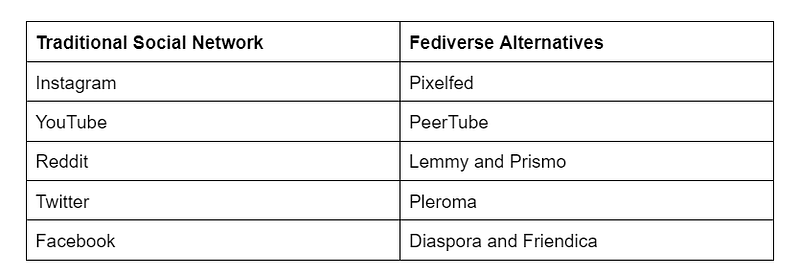
One of such protocols is ActivityPub, which is also the most popular. It has PeerTube, Mastodon, Lemmy, and Pixelfed in its fediverse. There are other protocols, like OStatus and Diaspora, yet the same rule applies: a user on one instance, say Mastodon, can follow, mention, and interact with users on other instances running the same protocol.
See the fediverse as decentralised social media.
Your account’s followers do not live on a company’s server, like we have with traditional social networks, but exist on an independent server. If for any reason you can’t or don’t want to use a platform, you can move to another and import your followers along with you as you move.
Traditional social networks and their fediverse alternatives:
Reason for the growing interest in the fediverse
The fediverse is not new, but recently began gathering some steam. The reason for this is largely due to the loathing of mainstream social media. Their excesses are many and obvious:
- Censorship.
- Privacy violations.
- Policy changes that can hurt the user.
- Performance issues as a result of server downtime.
- Complete shutdown of a platform.
By providing solutions to these drawbacks, the fediverse is turning into a promising alternative
Popular names are also getting in:
The BBC recently got in on Mastodon and reported that the fediverse is better fit for public purposes.
Meta is also trying to get in. The first cue is that before you join Threads, a disclaimer usually pops up: “Future versions of Thread will work with the Fediverse, a new type of social media network that allows people to follow and interact with each other on different platforms.”
Considering that Threads has millions of users, its integration into the fediverse will be massive and make the fediverse even more relevant.
Benefits of the fediverse
Creators with large influence on one platform can have little or none on others.
Different content thrive on different platforms, and this can make moving to a new platform hard since a user may, for instance, be good in text-based content but not in video or audio-based content.
Yet, with all the drawbacks of traditional social networks, there is no way out for a creator who, after building influence on one, gets affected by any of the drawbacks rife with these platforms. Moving to a different platform is a thing to dread..
The fediverse solves these problems by making it easy for users to move around instances without having to disconnect from one. It helps you maintain your influence on one instance across other instances that you choose to sign into.
With this superpower, creators can focus on creating content and not worry about what would happen should an instance become unfavourable.
Another important benefit of the fediverse is the handling of user data.
Users retain control over their data in the fediverse, since they’re not giving them to one individual platform. Here’s what this means:
- You can download all your data.
- You can delete your downloaded data on all instances and your data remains yours.
When an instance becomes unfavourable, maybe their newest policy starts affecting your content negatively, you can download and delete the data you have with them and sign up somewhere else. You own your data, and you can choose to delete them from all instances.
This will also force platforms to act more favourably to users since traffic is not something exclusive to one platform, but can move based on user’s satisfaction or dissatisfaction with a platform.
The fediverse is gaining steam and is predicted to change social media as we know it. Creators need to gear up to learn to play in the new era of social media.