
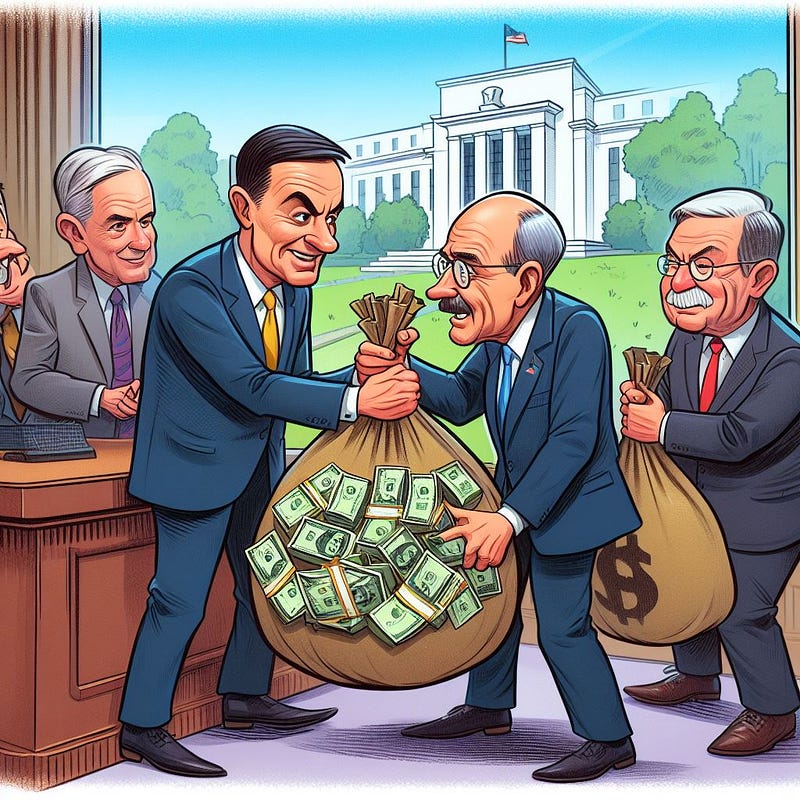
The Fed Buys Off Economists — No Wonder They Never Predict Crashes Accurately
This Week in Money October 22–28
Editor’s note:
On August 1st, this website changed its algorithm so that only articles favored by their elitist editors receive distribution. I have over 37,000 followers and growing, but now less than 1% of you actually see my stories. So subscribe for free via Substack or you’ll miss Surviving Tomorrow’s articles.
This Week In Money helps you discover the history of economics:
OCTOBER 22
2014 — RELEASE OF THE VIDEO, “THE MONEY FIX: A DOCUMENTARY FOR MONETARY REFORM” The video provides a good analysis of the problem. Its major solution, however, is limited to organizing community currencies — not addressing macro real monetary reform (e.g. changing laws). http://www.neverontv.com/the-money-fix-a-documentary-for-monetary-reform/
OCTOBER 23
2008 — TESTIMONY OF ALAN GREENSPAN, FEDERAL RESERVE CHAIRMAN, BEFORE HOUSE COMMITTEE ON OVERSIGHT AND GOVERNMENT REFORM (NEW YORK TIMES ARTICLE) Question to Greenspan: “Do you feel that your ideology pushed you to make decisions that you wish you had not made?” Mr. Greenspan conceded: “Yes, I’ve found a flaw. I don’t know how significant or permanent it is. But I’ve been very distressed by that fact.” “Those of us who have looked to the self-interest of lending institutions to protect shareholders’ equity, myself included, are in a state of shocked disbelief.”
2009 — PUBLICATION OF ARTICLE, “PRICELESS: HOW THE FEDERAL RESERVE BOUGHT THE ECONOMICS PROFESSION” PUBLISHED BY RYAN GRIM “The Federal Reserve, through its extensive network of consultants, visiting scholars, alumni and staff economists, so thoroughly dominates the field of economics that real criticism of the central bank has become a career liability for members of the profession, an investigation by the Huffington Post has found. This dominance helps explain how, even after the Fed failed to foresee the greatest economic collapse since the Great Depression, the central bank has largely escaped criticism from academic economists. In the Fed’s thrall, the economists missed it, too. ‘The Fed has a lock on the economics world,’ says Joshua Rosner, a Wall Street analyst who correctly called the meltdown. ‘There is no room for other views, which I guess is why economists got it so wrong.’” http://www.huffingtonpost.com/2009/09/07/priceless-how-the-federal_n_278805.html
OCTOBER 24
2008 — PNC FINANCIAL SERVICES CORPORATION PURCHASES NATIONAL CITY CORPORATION Using bank bailout funds under the federal TARP program, PNC, headquartered in Pittsburgh, purchases National City Corporation, a major Cleveland based bank. The transaction created the 5th largest U.S. banking corporation. TARP funds were intended to assist struggling banks. The funds ended up in many cases, like PNC, enlarging “too-big-to-fail” banking corporations.
2019 — “AND THE NOT-THE-NOBEL-PRIZE IN ECONOMICS GOES TO…” POSTED ARTICLE “Alfred Nobel never created a prize for economists. He was seventy-three years in his grave when the Central Bank of Sweden got the idea that they could elevate the prestige of economists by awarding a Nobel Prize in Economic Sciences “in memory of Alfred Nobel”. Today, the Nobel Foundation admits that the prize is not a Nobel Prize, but it still gives it status equal to the real prizes. Even Alfred Nobel’s descendants want it scrapped. Call it the Riksbank Prize, they said, but not the Nobel Prize, with the luminary status this implies. “The prize has three big problems…” https://internationalmoneyreform.org/news/2019/10/and-the-not-the-nobel-prize-in-economics-goes-to/?fbclid=IwAR3-V2yTu9DVowcf0bkeoTnzvUdCEpetbqmYQj7FwMnqBp4MeJ17km2NMF4
OCTOBER 25
2010 — SPEECH BY SIR MERVYN KING, FORMER GOVERNOR OF THE BANK OF ENGLAND “Of all the many ways of organizing banking, the worst is the one we have today. “Change is, I believe, inevitable. The question is only whether we can think our way through to a better outcome before the next generation is damaged by a future and bigger crisis. This crisis has already left a legacy of debt to the next generation. We must not leave them the legacy of a fragile banking system too.” From speech, “Banking: From Bagehot to Basel, and Back Again” To read a summary and analysis of the talk, go to http://positivemoney.org/2010/10/mervyn-king-of-all-the-many-ways-of-organising-banking-the-worst-is-the-one-we-have-today/
2016 — FINLAND: PARLIAMENT EVENT ON MONETARY REFORM PAVES WAY FOR CITIZENS’ INITIATIVE “A successful event on monetary reform was held in the Finnish Parliament, featuring valuable expert analysis of sovereign money and two endorsements from Finnish politicians for the QE4People initiative. After pushing the debate in the political scene, the Finnish movement wants to launch a citizens’ initiative.” http://internationalmoneyreform.org/blog/2016/10/monetary-reform-finnish-parliament/
OCTOBER 26
899 — REIGN OF KING ALFRED OF ENGLAND ENDS Alfred the Great implemented a law that moneylenders who accepted usury would forfeit all their possessions to the King.
2017 — “THE NEW ABOLITIONISM — MONETARY REFORM AND THE FUTURE OF SOCIAL JUSTICE” BY REV. DELMAN COATES “What is desperately needed in the social justice and civil rights communities is a theory of change that addresses the foundational mechanisms of our monetary system that cause social and economic injustice… “This paper advances an alternative theory of change for ending poverty, unemployment, mass incarceration, violence, income inequality and wealth concentration, providing universal healthcare, investing in the environment, improving public education, etc. Rather than the almost exclusive focus on fiscal policy among progressives, this paper is based upon the following foundational claim: “all of our social and economic ills in society are a function of the nation’s debt-based monetary system. Therefore, if we hope to address today’s social and economic ills, we must bring an end to the debt-based monetary system.” Attempts to address the issues raised above that leave the debt-based money system in place may be well-intentioned, but will ultimately fail to eradicate society of these social and economic ills. We must, therefore, fix the root cause of the problem if we want to have a more just and equitable society. This leads us to the following fundamental principle for justice seeking people; “in order to have a just society, we must have a just money system.” https://btpbase.org/the-new-abolitionism-monetary-reform-and-the-future-of-social-justice/
OCTOBER 27
1945 — BIRTH OF LULA DE SILVA, FORMER PRESIDENT OF BRAZIL (2003–2010) “The Third World War has already started. The war is tearing down Brazil, Latin America, and practically all the Third World. Instead of soldiers dying, there are children. It is a war over the Third World debt, one which has as its main weapon, interest, a weapon more deadly than the atom bomb, more shattering than a laser beam.”
OCTOBER 28
1704 — DEATH OF JOHN LOCKE, ENGLISH PHILOSOPHER “Observe well these rules: It is a very common mistake to say that money is a commodity…Bullion is valued by its weight…money is valued by its stamp.”
2020 — VIDEO, ALLIANCE FOR JUST MONEY PANEL ON MONETARY REFORM Panel hosted by the Carolina Meadows retirement community. AFJM Board members, Paul Lebow, Howard Switzer, John Howell present. Ellen Jones attended and lead a later discussion
2022 — DEATH OF HERMAN DALY, ECOLOGICAL ECONOMIST, AUTHOR OF “STEADY STATE ECONOMICS” He was ignored because his ideas threatened those benefitting from our unjust monetary system. “Nationalize the money, not the banks.” https://inequality.org/great-divide/a-economist-that-future-economists-and-societies-will-dare-not-ignore/?fbclid=IwAR0IFS7-IPQrC6r8_YEb9ByhKOxWl9FnV5vYwFfkW0jriM8d9YCnKeIQofI
Thanks to the new algorithm you probably missed:
“Smart” Devices Are Just Trojan Horses for Surveillance Capitalism
Nevermind This Dip — House Prices Will 10X In Our Lifetime
Airbn-banned: New York Finally Cracks Down on Illegal Landlords
This Week In Money by Greg Coleridge helps you discover the history of economics. Get TWIM delivered directly to your email inbox for free.