The features investors want are not the ones your users need
Why UX should care about the business… but not too much.
By Lindsey Wallace Ph.D
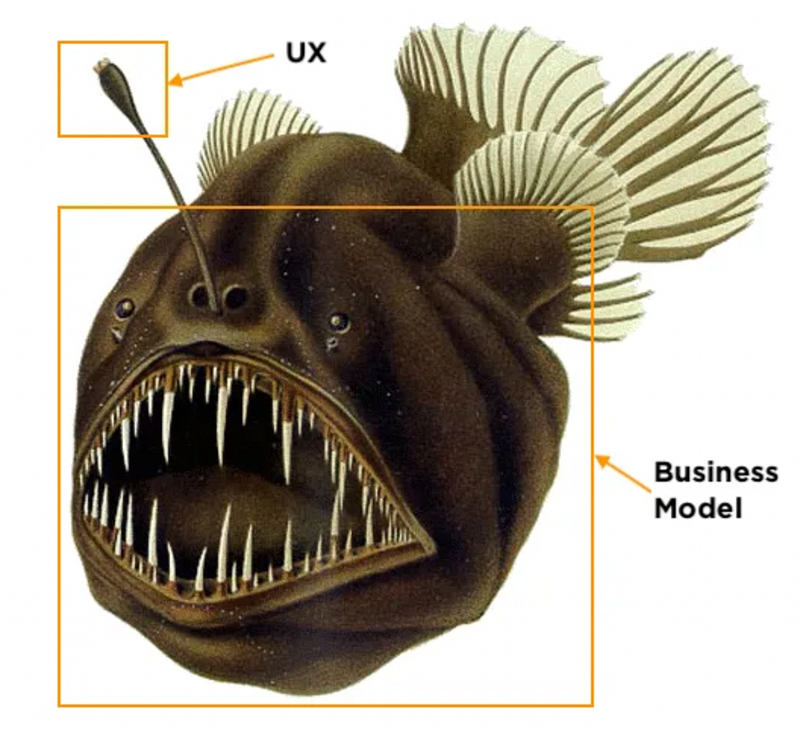
Since the beginning of the tech layoffs last year UX thinkers and leaders have been soul searching about why research and design have been particularly hard hit in corporate downsizing. Have UX and particularly UX research over-rotated to caring about the interests of the user, forgetting that they are part of a capitalist enterprise and should be prioritizing the needs of the business? In industry R&D the logic of business and the need to maximize shareholder value and drive revenue is the water we swim in and the air we breathe. In a moment where we face big and disruptive technological and social change and the future of work itself is in question we need to be thinking about the needs of people and imagining our futures with a lens beyond profit and shareholder value more than ever, so why are we so quick to give up the lens centering people that differentiates UX?
I’ve been struggling with this article for a while now, trying to put my finger on why the idea that UX practitioners should become more business-focused felt so wrong to me. The other night, I had dinner with a brilliant UX designer and former co-worker and when I asked her how things were going, she said (paraphrasing). “It’s difficult because the features that make the stock go up are not the ones that users need, so we sit in a lot of user studies where people are like, “I don’t want that, I would never use that, and they don’t understand why we aren’t building stuff that’s useful for them.” Her words stuck with me ever since and really point to the heart of the problem. The features that get investors excited are not the ones that users need, and the overwhelming focus of businesses are the desires of investors, however much they talk about being customer-focused. Ultimately, though, deprioritizing the needs of your users consistently dooms your business.
Why are investors and users’ interests in conflict?
Investors think with a business-first perspective approaches every new idea with the question: what is the revenue-generating potential of this idea? In a business-first perspective, companies exist primarily, almost exclusively, to generate value for their shareholders, and delivering value and innovation that meet the needs of people are secondary to this driving goal, in extremes, they can even be seen as detracting from it. Investors want to see flashy automation and maximize the footprint of AI because people with specialized skills are expensive to hire, and automating high-value work promises The business-first imperative shows up in relentless drives for efficiency, for “doing more with less” and leaning into “agile” product development processes where teams race to get “minimum-viable” products to the market first even if they are not ready or complete, which is contrary to the best interests of the people who have to use those products.
What does that mean for UX? As designers and researchers rightly fear for their jobs and income, they also aren’t interested in rocking the boat. In my day-to-day life I see “the needs of the business” taking new primacy among design professionals as they try to reshape themselve to what their businesses want them to be. I am not here to tell anyone that’ UX isn’t part of a business or that it is UX’s job to solve capitalism, but I think we can find a path forward and deliver unique value by being explicit about the tensions that we navigate in our work so we we can be partners in better decision-making for our users and our businesses. My day-to-day work as a design research leader is making the case for the value of caring about the needs of people and communities in the language of business. Sometimes I describe my work as “making people visible to corporations”.
I think UX can and should work beyond the limits of the needs of “the business”, it’s a core part of the value we bring to our organizations. it is hard to convince businesses to care about people because the culture, vocabulary and incentives require extensive translation and navigation, and the extent to which solving unmet needs can be prioritized is structurally limited when the needs of users and investors are not aligned. I’ve noticed a lot of UX theater, where designers and researchers burn cycles trying to reverse engineer a business decision into a value for users, and it’s frankly bullshit.
There are situations in which what the business desires and thinks it needs and the interests of the user are in conflict, and I think that in those situations if UX practitioners see something, they owe it to themselves and their organizations to say something. Here’s why:
- What the business wants and what it needs are often different and the interests of the user are the canary in the coal mine. Businesses are almost always happy to trade long-term value for short-term gain, that’s how they are structured and how the model of shareholder capitalism and quarterly earnings incentivize them to think. However, if the interests of the user are regularly in conflict with short-term thinking, that’s a red flag for a sick business. I’m in Seattle so the recent Boeing disasters are top of mind and all over the news. Boeing has repeatedly cut costs and avoided safety regulations in the interests of time to market and maximizing profits. This has made them lots of money but the reputational damage combined with the FAA grounding their planes may prove fatal to the company in the long term (and let’s not forget that prioritizing short-term gain has been literally fatal to their users). This isn’t an example where UX was directly involved, but clearly this is a company that has not put the interests of the user at the center of their work and where no-one effectively advocated for it. The job of UX is to advocate for the interests of the user and make the business understand why they should care and how it benefits them, as well as the risks of not caring. I would argue that part of the value of UX advocating for the interests of the user is also because advocating for the user is also advocating for the long-term success of the business and we are often the only ones in a position to do this work and bring this perspective.
- UX drives innovation because we ask questions about people instead of money, I would argue it is our special sauce, our differentiator. UX professionals don’t ask “how can we raise revenue by 40% next quarter?” they ask, “how can we make a great product/ improve our products enough that more people will buy it and therefore we can grow our revenue 40% next quarter?” Learning about the people using our products and caring about their needs and interests is central to the value UX brings to an organization, and UX professionals abandoning their framing and over-rotating to the needs of the business over the user diminishes the value of design and our ability to innovate. Really great innovation, innovation that creates value for people, starts from doing the work to identify real and unsolved problems people are experiencing in their day-to-day lives and looking for solutions. The most valuable and satisfying work I’ve done in my career as a researcher was work that identified unmet opportunities to add value for people that became the basis for product strategy. Organizations are full of roles laser-focused on thinking about money and technology, UX is one of few places in an organization with the mandate and skills to bring the needs of people into R&D processes to make cooler and more useful things. This kind of innovation is, again, ultimately good for the business.
- The business-first perspective values speed, efficiency, and profit above all else. The business-first perspective shapes and limits the innovations companies invest in in 3 ways.
- Be first into a proven market. This is a bit of a contradiction, but many companies do not want to be defining new market opportunities, they want to invest in problems, technology, and communities with a proven ROI attached. This shows up as blindness to the market opportunities in developing countries, “fast follow” innovations that ape a competitor product with just the bare minimum of improvements, among others. Companies are both risk-averse and obsessed with speed. One of the most effective pitches for the value of conducting research is that it “de-risks design decisions”.
- Innovation is a zero-sum game. The business-first perspective wants to “win” and “dominate” the market. This limits the scope of partnerships and makes integrations between companies’ products unappealing investments. Companies try to create walled gardens that lock customers into their own ecosystems to the exclusion of their competitors, limiting the scope of possible solutions.
- Do more with less. Companies are always trying to cut costs and maximize returns. Product development teams face regular reorganizations and layoffs. Rather than investing in deep expertise, lean teams ask people to wear many hats and do what needs to be done in the moment. This also drives the increasing popularity of agile development and the concept of an “MVP” (minimum viable product). Originally developed as a learning process in which teams ship something small then learn from their customers how to improve it, increasingly the MVP becomes the final product, bugs and all. With R&D viewed as a cost center, delivering quality innovations people need can be secondary to selling something quickly and cheaply.
Justifying harmful choices based on “the needs of the business” is a way people displace responsibility for our own choices and it gets easier to do the higher you get in an organization as the “business” becomes a more salient part of your job. Businesses are collections of people working together. “The business” doesn’t have its own sentience. There is a difference between uncritically accepting that the “needs of the business” involve delivering minimum value for maximum profit and externalizing costs and recognizing that if that’s how your organization is operating, its wrong and damaging, even if (maybe especially if) that’s the norm for how all organizations operate. Sometimes UX people do get a seat at the table and that only matters if we are brave enough to strategically question “the business” and point out when the interests of our users diverge from those of our business. We need to ask thorny questions like “why are we building this?”, “who does this affect and how” and “what is the future we’re designing?” among others as a core part of our work. Asking these questions, calling out the gaps creates the opportunity for intentional decision-making and finding win-win solutions that don’t exist if we pretend the gaps aren’t there and all our choices will benefit everyone. Yes, businesses exist to make money and that is part of our job, but that can’t be our whole job. We are people who are part of a society as well as a business and just because business currently operates with an increasing focus on extracting rather than delivering value, that doesn’t make it right, sustainable, or smart.
We all live complicated and ethically compromised lives in our current economic system. I’m not here to tell UX people they can or should be crusaders within the organization. However, my experience is that UX practitioners often have more space than their peers in product or engineering to ask difficult questions, especially researchers (this is the silver lining to the challenges of UX’s often liminal place within organizations, for better or worse we are often viewed as in but not of the business). Most people in product development want to do good work that solves real user problems, and in my experience our peers across the business in product and engineering are open to working with us to prioritize user needs when they understand them.
When we talk about these things openly with our colleagues we open up space to change. For example: what if we agreed to spend a certain percentage of our effort on “stock price features” and devote the rest to leaning into developing the (often less flashy) features people need, and delivering the quality and reliability that costs money, doesn’t directly generate revenue, but benefits our users and strengthens our business? What if we mapped out features designed to raise the stock price, analyst features for Gartner, Forester, etc. and research-backed features for users and found the overlapping places in the Venn diagrams? These are just some of the possibilities that open up through honestly identifying and grappling with places where the interests of users and “the business” may diverge, not even the best ones.
In the context of industry-led innovation the work of human-centered design does often sit in tension with the logic of business that shapes the development of technology and limits the problems that businesses choose to solve and the communities they can “see”. UX is most valuable when we can speak and understand business, but not lose our focus on people, we need to care about the business, but not too much. Each question asked, each little change adds up and makes transformative change possible in the right moment. The future holds so much possibility for innovation that creates value for people, society and companies, and I believe that UX practitioners have a key role to play by making the needs of people visible and immediate even when, especially when, they diverge from the interests of investors or the “business”. Sometimes, the business is wrong.


