
The Fate of the Gifted Generalist (I’m talking to you)
Most of us are gifted generalists by default — the question is, given the alternatives, do we really want to be?
I’m a Gifted Generalist. You’ve probably never heard of Gifted Generalists, as I just invented the term, but odds are, you’re probably one as well.
The Gifted Generalist describes the majority of us who are pursuing our vocations, from seasoned professionals to young students, however we do so without a definitive destination. So what exactly is a Gifted Generalist? You may be familiar with a Gifted Generalists’ relatives, such as the “polymath”, the “dilettante” or the “jack of all trades” (let’s be real, none of us have heard of the first two. As a Gifted Generalist, I Google’d them so I could tell my story). While they share similar qualities, the Gifted Generalist stands apart in a unique way.
“Polymath’s” are individuals of “encyclopedic learning”. They basically know a lot about a lot of different topics. You can imagine with the proliferation and accessibility of resources via the internet, the quality has expanded tremendously among the population. However, polymath’s are all about the knowledge side — it doesn’t necessarily speak to their ability to actually do anything productive with the knowledge. Gifted Generalists are able to weave their encyclopedic knowledge into their chosen fields, and do so frequently.
“Dilettante’s” are people who cultivate a number of areas of interest, but without commitment or knowledge. They’re also known as a “dabbler” or “tinkerer”. Think of it like the weekend photographer, the backyard chef, or armchair coach. People pursue hobbies, and we may pursue a lot of them. It’s a way of expanding our circles of knowledge and getting exposed to new ideas or activities. However, key to this category is that they don’t commit to an idea, meaning they lack the focus to make their interests a true personal asset. This is where the Gifted Generalist departs from the dilettante, for while the Gifted Generalist will cultivate a number of areas of interest, they often can translate it to a valuable skill, or integrate it into their chosen profession.

By definition, the “jack of all trades” is “master of none” of them. It conjures an image of someone who does a lot of things, but doesn’t do any of them particularly well. I feel this applies to the Gifted Generalist, so far as they are someone who does a lot of different things. But the difference is, the Gifted Generalist actually does most things quite well. A quick study on Wikipedia, watch a few videos on YouTube about how to do it, subscribe to a few podcasts to catch up with the latest trains of thought, watch some TED talks to speak intelligently about the cutting edge, a forum comment here, an intelligent conversation or two there, sprinkle in a little practical practice and — voila. The Gifted Generalist is the new passable professional.
The problem here, is as Gifted Generalists, we can all quickly become the passable professionals when the need arises. We have created a generation of “on-demand” pros that can acquire the skills necessary to tackle essentially any challenge thrown at them. And while it sounds great, the problem lies herein. When everyone is / can become the professional, no one is. Like a recreational youth soccer league, when everyone receives a trophy as “winners”, no one truly is.
The forthcoming advancement of mass robotization and artificial intelligence is going to wreak havoc on this audience of gifted generalists — the opportunities available to this group are among the lowest hanging fruit for disruption. The challenge is, this audience doesn’t feel a need to prepare for this scenario since they can weather it in like manner as every other challenge that crosses their path: as it comes.
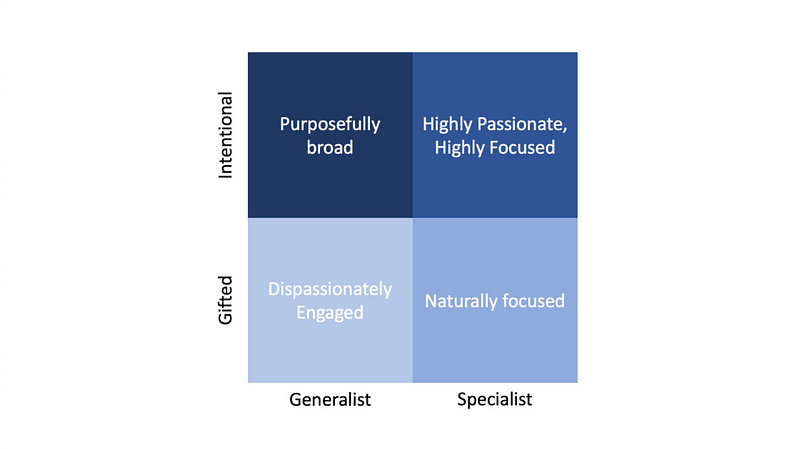
The subset of the workforce most resilient and prepared for change will be that of the Intentional Specialist. The Intentional Specialist sits opposite the Gifted Generalist, as visualized in one of my famous 2x2’s below.
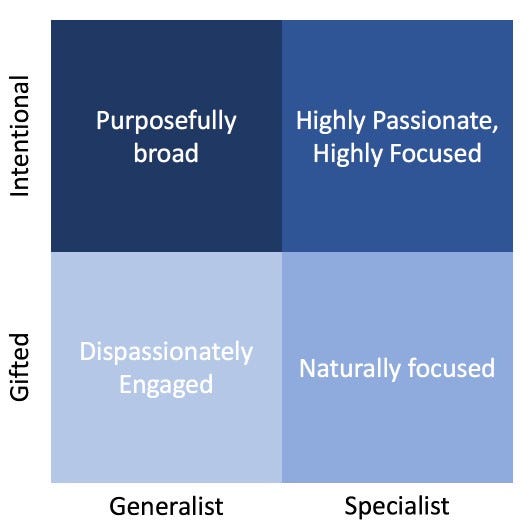
I believe everybody naturally falls into one of these buckets, kind of like how we all fall into some category in our high school gym classes. The majority of us were there because it was a requirement; we could hack it, and do whatever it took to get the grade we wanted. These are the Gifted Generalists: capable, skilled, and talented to the point that they can accomplish most anything they want. But they do it dispassionately: to get it done, to check it off our list, to get the credential under our belt, to graduate with the degree, to secure the job, to earn the paycheck.
Gifted Specialists tend to focus and excel in their given professions beyond the Gifted Generalists, but they do so because they can, not necessarily because they want to. They often take their skills for granted. They’re like the kid who ran the fun run in high school just fast enough to ensure they stay in front of everyone else — their primary goal was to come in first. And because of their natural abilities, they often did. However, they’re never going to break any world records, because they lack the passion, drive and / or motivation to answer the question “I wonder how fast I could run?”. Being ahead of everyone else was good enough.
The Intentional Generalists make a conscious decision to NOT specialize. They do so because they want to remain “open” to the world of possibilities. They believe their value comes because they are general. To stick with the track and field examples, they’re like the decathletes (I know, crazy, right?) who consciously decide they’re going to compete in 10 different competitions. There’s no denying these individuals are incredible athletes, but due to their desire to stay general, they’ll also never be able to compete at the same level as the intentional specialists. This provides them with a certain measure of mental security — knowing at any given time, even if they can no longer do the high jump, there are 9 other competitions at which they’re still aptly skilled, and they can just move on to something else. These people will set all sorts of records, but don’t expect them to be the ones pushing the boundaries of what’s possible in any specific field.
And then there are the Intentional Specialists. These are those who have received their calling in life as clearly as the sun shines. They know their mission, and every breath, every action, every personal and professional endeavor is moving them towards accomplishing their objective. They understand excellence requires nothing short of the pure, relentless pursuit of pushing the boundary on what’s possible. They have seen a vision of the future, and realize the only thing standing between now and their vision is their ability to bring it into existence.
We all know these people. They’re the ones who are continually raising the bar for the rest of us to see what’s possible. They’re lifting our own vision, and elevating our thoughts of what we should expect for ourselves. And once we catch that vision, it’s impossible to imagine how we couldn’t see it before.
There was a time when science believed running a mile in less than 4 minutes was impossible. That is, until 1954 when Sir Roger Bannister became the first human on record to break that barrier. He dedicated himself over a span of nearly 8 years to accomplish this feat, and his record only lasted for 46 days. Today, nearly 5000 people have run sub 4-minute miles. It literally just takes one Intentional Specialist to completely change the game on what we believe is possible.
Note there’s no room on the quadrant for those without gifts. That’s because at some level, I believe we truly all have some competitive advantage-esque gifts. If we don’t think we have a unique gift, it’s only because we have yet to discover them. However, once we can identify our gifts, and with the proper focus, any of us could develop that it into something that is truly remarkable — we all have the potential to become Intentional Specialists, not just those few who have been following their life calling from birth.
I believe we should each strive to become Intentional Specialists. The challenge of the Gifted Generalist is most of us have no idea when is the right time to intentionally start spending our time, or how / where we should focus on specializing our skills. So we move from opportunity to opportunity as the tides of fate and experience carries us, ever hopeful that our destination will align with our dreams — not because it’s our choice, but because we don’t necessarily know how to do it any differently.
Thus, the fate of the Gifted Generalist is one of variety and excitement that comes from having a wide array of experiences, of having a new daily mission that brings an entirely new set of challenges and questions than the day before, while simultaneously lacking the level of fulfillment that comes from understanding at one’s core how every waking breath contributes towards fulfilling their life’s mission.
What’s your fate going to be? What message resonates the most with you?