
‘The Fast Red Road: A Plainsong’ by Stephen Graham Jones
Counter Arts Book Club read, November 2022
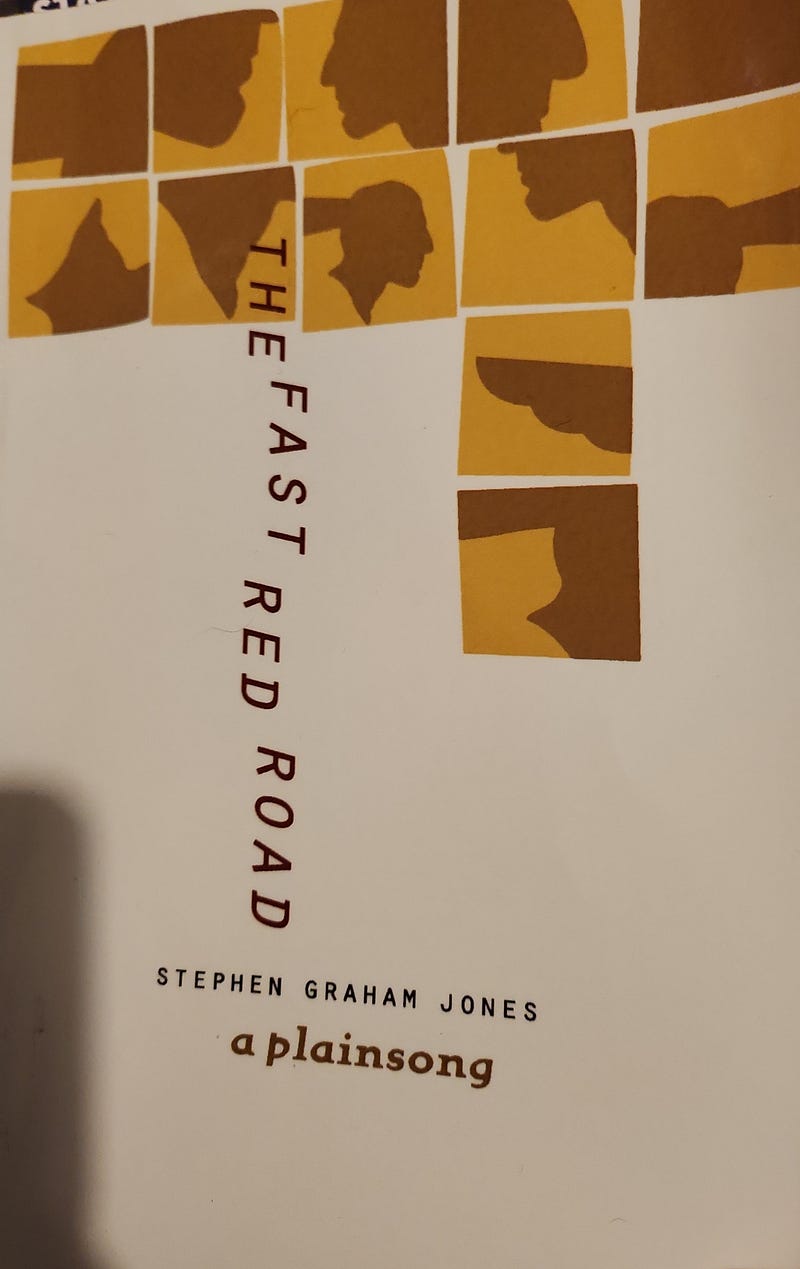
Before my second-hand copy of Stephen Graham Jones’ 2020 debut novel ‘The Fast Red Road: A Plainsong’ arrived through the post, I had a little look round for reviews which might give me some insight into what I was in for. The one which sticks in my memory the most compared reading this novel to watching a David Lynch film.
I can see that. A mixture of the Lynch original 1990 smash-hit ‘Twin Peaks’ with Gilliam’s film version of the Hunter S. Thompson drug-fest ‘Fear and Loathing in Las Vegas’(1998) and ?…. oh I don’t know, something like the TV series ‘Longmire’ perhaps, because the novel also has elements of a more modern day Western too — and an element of the 2020 series ‘Trickster’ I think.
Jones himself is reported to have said the book is:
“his version of a Thomas Pynchon novel”
Our main protagonist in this work is Pidgin: twenty-two, white American father (Cline), First Nations/Native American mother (Marina).
The name ‘Pidgin’ seems to me to be an obvious reference to this ‘mixed’ heritage, an allusion to language, ‘pidgin English’:
“A pidgin,” says R.L. Trask and Peter Stockwell, “is nobody’s mother tongue, and it is not a real language at all: it has no elaborate grammar, it is very limited in what it can convey, and different people speak it differently. Still, for simple purposes, it does work, and often everybody in the area learns to handle it” ( Language and Linguistics: The Key Concepts, 2007)
“Many . . . pidgin languages survive today in territories which formerly belonged to the European colonial nations, and act as lingua francas; for example, West African Pidgin English is used extensively between several ethnic groups along the West African coast.” (David Crystal, English As a Global Language. Cambridge University Press, 2003)
— Definition and Examples of Pidgins in Language Studies (thoughtco.com)
A pidgin language is a bridge between two people(s) who speak different languages. In a very real sense a product of European colonisation — developed for natives of various countries and cultures to speak some semblance of their coloniser’s English….but not well (not ‘parroting’ or ‘aping’), keeping them seeming ‘less than’, in the eyes of the white invaders, while also maintaining a sense of their own language and separate unique identity.
Pidgin languages, like Ebonics, are spoken with pride — I’m certainly meaning no offense by my last comments, and hope none will be taken!
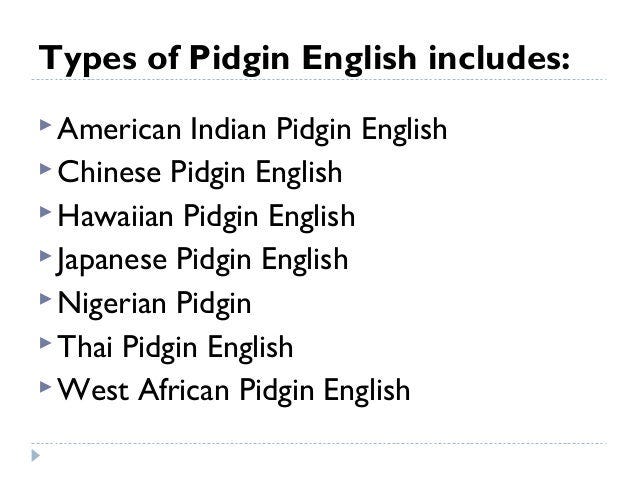
There are many versions of Pidgin English, as mentioned in the quotation above. For example:
Pidgin (the character), speaks rather eloquently in perfectly ordinary American-English. However, he also seems to be fluent in conversing via pictogram, the favoured form of communication for Pidgin’s uncle (Birdfinger). Pidgin seems to doubt the truth of his uncle’s illiteracy, but we never see Birdfinger write words. He draws, his thoughts and memories; notes he leaves; and the correspondence received by Pidgin early on in the novel which communicates his father’s internment will be happening.
Birdfinger isn’t the only one either. ‘Litmus’, the (white) travelling vacuum salesman also draws pictograms — though he also seems to have some strange (probably drug-induced) power of somehow bringing his drawings to life (so that people then fall into them, as happens in the famous music video from the Norwegian band A-ha, ‘Take On Me’ from 1985).
It’s interesting that it’s the white characters who Stephen Graham Jones has feigning illiteracy and drawing pictograms, when cultural legend would hold that the ‘native savage’ is the one most likely to lack language and reading skills.
However, this author is himself of Native American heritage (Blackfoot). He is known to make vocal and written objection to the continuing portrayal of ‘Indians’ in books, film — and just life in general. The way society still clings to stereotypical images and expectations and just assumes that every Native American author/man/person is the same is abhorrent.
Stephen Graham Jones wrote an Open Letter in 2021, which is published on Tor.com, in which he addresses the way he has experienced writers conventions. Part of what he has to say is this:
“The Trauma Question — which is a groaner. But asking it, man, it must be just super tempting, it must be natural in some way we don’t quite understand. What’s weird about it is that, no matter how it’s phrased, it’s basically asking us to perform some trauma drama, maybe some poverty porn if we’re feeling especially vulnerable, which only serves to other us to the audience, to make us exotic, and maybe even pitiful. Or, it can explain our so-called indignant attitude, anyway. It can explain feeling the need to write lists like these. That trauma question is basically asking us, “So, how rough is it being Native in today’s world?” Know what might be great, though? And pretty unprecedented? To get the same questions non-Native writers get. What else might be pretty all right? For panels to not have to become therapy sessions just because there’s an Indian at the mic.”
— Open Letter to Cons From the Indians No Longer in the Background of a John Wayne Movie | Tor.com

‘The Fast Red Road: A Plainsong’ is the first Stephen Graham Jones novel I have read — and fittingly this book was his debut. From what I’ve read, his other works are considered to fall into the horror genre, with perhaps a bit of sci-fi thrown in. I’ve also got myself digital copies of ‘Growing Up Dead In Texas’ (2012) and ‘The Only Good Indians’ (2020), though there are many others in his back catalogue, as I was interested to see how this author’s writing progresses.
In this early novel though, it becomes obvious quite soon that Jones is interested in challenging the stereotypes and assumptions mentioned above. He enters into this story, turning our internalised expectations of Native Americans right over, subverting and playing with the ‘social norm’; and also exploring memory and history.
One of the significant Native American characters in this novel, Marina Trigo was Pidgin’s mother, and she’s been dead for most of his life. Pidgin being of mixed ethnic heritage makes him a bridge, like the language he is named for. Even in the novel’s plot, he may be the protagonist, but Pidgin doesn’t really do much himself. He is an observer, the representative of the Reader’s observation and understanding of the situation he finds himself moving through. He’s not even a catalyst, though it is his presence and search for the Goliards (the remains of the cult-like group Cline his father had formed along with Marina and his twin brother, Birdfinger) which moves the action along for the most part.
We also get to see from the point of view of Birdfinger, who because of this device becomes a much more sympathetic character to the Reader. When his brother, Cline, died Pidgin was just thirteen and Birdfinger stepped in as his guardian. It wasn’t his fault that he was Cline’s twin, which is why Pidgin found it impossible to both live with Birdfinger and deal with his father’s suicide.
However, as we read further, the somewhat warm and sympathetic feeling we might originally feel regarding Bird’s unrequited love for his twin’s partner Marina begins to wane and sour. The more we learn, the more far-fetched and delusional his beliefs about his relationship with Marina seem. Or at least, we think he’s delusional — in the context of this story, it begins to feel rather difficult to tell!
We move through the novel with Pidgin, seeming to go from one character to another, especially the remaining ‘Goliards’, learning about their differing perspectives on the past and trying to track down the remains of Cline (which we are told were last seen by Pidgin being taken from his grave and carried off over the shoulder of ‘The Mexican Paiute’, the last and allegedly most dangerous of Cline, Marina and Birdfinger’s old associates).
The novel is definitely not written in a linear, chronological sense. We get episodes interspersed where we a told about the happenings of different time periods, filling in more background information about each of the main characters.
There is also the occasional drug-fuelled interlude, where visions and altered perception interfere with what our characters see — and therefore confuse our understanding of what’s going on. For example, we are told Pidgin ingests ‘beef fed beef’ at the rodeo and is then under the influence of hallucinogenic anti-spongiform medication given to the cows. Though quite why something like that would be easily available from a dedicated food stall at a rodeo attended by people of all ages, I’ve no idea. I got the feeling there was not one, but several unreliable narrators involved in this novel. Perhaps they were drug-addled, perhaps lying or merely mis-remembering….but one has a great deal of trouble believing a great deal of what goes on.
Which returns us to the question which so often plagues Native writers — that of ‘authenticity’:
“Stephen Graham Jones is one of those people for whom authenticity is a dangerous category. In something else he wrote, what he calls “A Letter to a Just-Starting-Out Indian Writer– And Maybe to Myself” he says “be wary of ever allowing yourself to think that your ‘Indian experience’ matters any less than any other Indian’s experience, or any other model of ‘Indian experience.’ That creates hierarchies, which leads to the authenticity shuffle, which is an ugly, ugly dance to do for all the people who really want us to do it. Us doing that dance, it keeps us looking at each other, not the world.”
— Best Native American Literature — Five Books Expert Recommendations

The novel ‘The Fast Red Road’ is in fact the story of a road-trip, as Pidgin travels his way around, from the porn industry in Utah where he’s been working; back to Clovis New Mexico for Cline’s interment; then around New Mexico and Texas, always in and out, constantly touching base with his birthplace in Clovis.
Less literally however, I think this can be seen as a medicine journey, a vision quest, searching for a way to reconcile and identify himself as a person in his own right.
We begin the novel with a prediction from ‘Big Springs Sally’ the psychic, reported on televised news by the ‘Star Woman’. The only prediction Sally gives for the year is “both of him are yet real”, written in felt tip on a piece of card. We are to believe that Pidgin is the “him” she refers to.
Charlie Ward, an old Native with grey hair worn in braids, dips in and out of the story, transporting Pidgin from one revelatory experience to another. To my mind, Charlie acts as a spirit guide, or at least a medicine man who would accompany and help prepare a young man embarking upon a vision quest, a journey of discovery.
Twice, we get the same description, driving in and out of Clovis:
“Charlie Ward slid his thin leather belt from his jeans and held it out the window. whipped the Cutlass faster, faster, his dyed-black hair unbraiding in the fifty-five mile per hour wind, and they never had to stop for gas.”
— ‘The Fast Red Road: A Plainsong’ (Stephen Graham Jones, 2000, page 268)
I have read in many other novels, poems and essays/articles about the difficulties felt by all people who feel torn between two cultures. Whether by virtue of translocation, or due to mixed ethnic heritage. So I read the novel with the assumption that this applies here too. Which admittedly could be wrong (it’s happened before!)….but then I read more interviews with and articles about Stephen Graham Jones and feel identity and culture means so much to this author that I must be on the right lines.
‘The Fast Red Road: A Plainsong’ is difficult to explain because, as well as being a bit of a wild ride, this novel is complicated, intricate and extremely meaningful. It’s even more of a challenge to write about without completely giving away the whole story.
I want to write so much more about recurring imagery, history, cultural references and characters — but I would so easily give away much of the novel’s substance. I could also find myself with a book length essay here, which nobody would have time or inclination towards reading!
I have much admiration for this author and will definitely be reading more of his work. In ‘The Fast Red Road’, he entwines everything in such complex strands of storytelling that it does admittedly take some concentration to start to understand everything being said. I won’t say begin to unwind, because you don’t ever get to the point of doing that, and intentionally so I feel. Yet it’s never boring and I never for a second wanted to give up trying to follow Jones’ point.
The book only runs to three hundred and twenty something pages. Less cleverly done it could have run much, much longer and lost a lot more readers along the way than this one does. I will admit, I was quite committed and invested in the novel (well past halfway in all honesty) before I suddenly felt enlightened as to what was going on. It’s well worth persevering!
Without giving anything more away, all I can say is that identity really is everything. However in the end, all we have left are songs, stories and legends — and who are we to know which parts of those are accurate, or how and where they all slot together?
“As an artist, that trap is still set in the culture, that if your character is not the default — that is, not white — the question becomes, when is that Indianness going to activate?”
Indianness, as Jones wrote in a much-discussed essay, is not a superpower that the hero reveals in the movie or novel’s final act. “You’re born Indian, you die Indian, and you’re Indian pretty much the whole way through, except maybe at Halloween, when other people get to buy a costume of you.”
I’d like to again thank the ex-boss of Counter Arts and originating member of Book Club Carlos Garbiras, who most generously provided me with the funds to buy this second-hand copy of ‘The Fast Red Road’.
Thanks for reading! If you would like to read more of the essays and reviews written for the Counter Arts Book Club (2022), they are compiled here:


