
The Fast Growing $100+ billion App Store Businesses from Apple and Google
How developers can grow their revenues, optimize their costs and leverage the latest developments
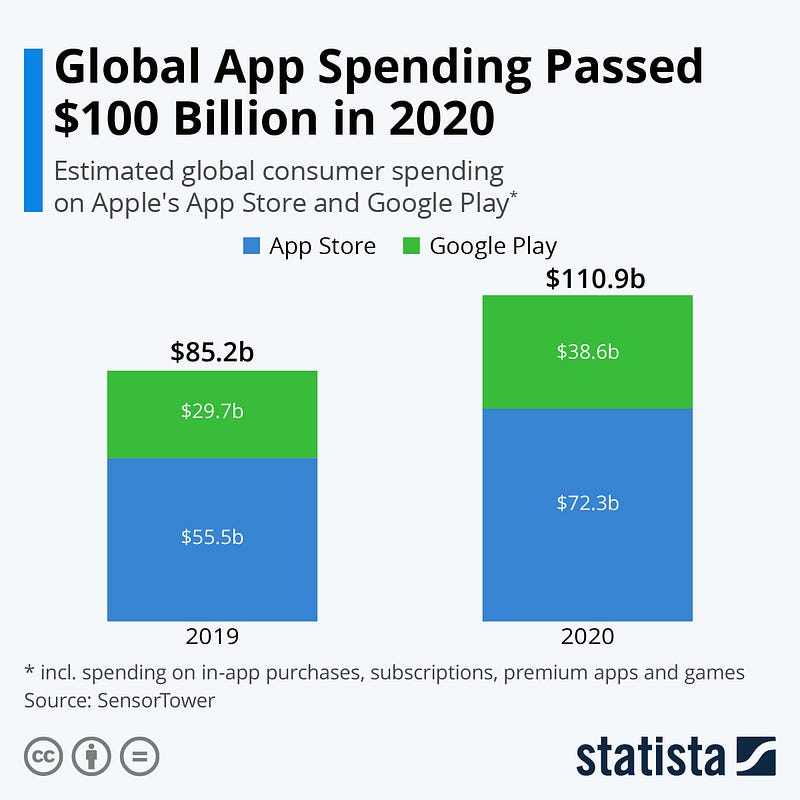
The global mobile application market generated over $110 billion in 2020 in revenues for Apple and Samsung, via the commissions charged on applications as they were being used or downloaded. It is a $25 billion jump from the previous year for the 2 largest players.
The most popular apps, such as Zoom or Among Us can be downloaded up to 100 million times a year from one app store. The pandemic, with its lockdowns and stay-at-home orders, contributed greatly to additional downloads, as users spent more time than ever interacting with mobile applications.
The market is much larger: developers retain from 70% to 100% of the revenues generated by the apps, depending on the store and type of apps.
1. The walled garden
It is more of a fortress because if a developer wants one person on the planet to download an app they created, with 2 lines of codes, and an icon that will show up on that person’s device, linking to the company website or their intranet. Their only choice is to get with the program and follow the store’s rules.
There is a process to follow to be able to publish anything in an app store or even create an icon visible on the screen of an iPhone, even if it will only be visible within the company, to link to the intranet, for example. All of those are considered applications.
Some applications can link to or access external code, other applications, and external servers. Some contain all the code within the app.
2. A wide range of fees
Regardless of the complexity of an application or how it is used, developers or companies have to pay a fee of $25 once to Google and $99 yearly to Apple, just to publish applications.
Companies are then paying a 30% fee, some 15%, and some nothing on for each downloaded app. A $10 app with a built-in 30% fee generates $7 in net revenues but without the fee, it generates $10 instead, 42% more. App store fees can be very significant for businesses and can drive strategy, especially for mobile-first companies selling digital goods.
By default, the tech giants claim that all developers pay the same fees for the same type of apps. It appears that there have been documented exceptions to and interpretations of the rules. In some cases, companies have been able to negotiate different fees. Some offered in exchange to publish an app on a device first or others had to modify the app to meet certain requirements.
“It is not personal, it is business” as they would say so there is not an official playbook listing all the rules and options for developers. There can be a bit of a trial and error approach.
3. App stores are massive operations
When looking up the app stores, I expected to find pages of legalese covering all bases. I am sure that exists somewhere. Instead, I landed on very user-friendly pages going through the various rules applying to developers.
A few “fun” facts about the Apple app store:
- 4 billion applications are distributed each day.
- Developers have been paid more than $120 billion by Apple to date.
- There are 2.2 million apps available in the App Store.
- 350,000 of them are sold for a flat fee (16% of the total), which includes a 30% store fee.
- 84% of the applications are free.
- Developers and users of free apps do not get charged per download, for support nor for hosting.
- It is possible to request waivers for the yearly membership $99 fee that developers have to pay.
- There are 20 million developers in the Apple Developer Program.
- That program alone generates up to $2 billion in revenues, based on the yearly fee, minus any waivers.
- 60% of apps are approved and the rest rejected, usually because they had small bugs but they can be resubmitted once fixed.
- Apple reviews about 100,000 apps a week (!) and makes 1,000 weekly calls to help developers.
- Apple has rebranded its website for apps developers to focus on security and on the vast amount of data they process, declining many submissions in the process.
Source: Apple store principles and practices
4. The opportunity to strive for free
It is worth noting that many types of applications can be free to download and use. Many free apps are owned by successful startups or billion dollars companies, which do not pay any 30% fees, yet generate revenues and are profitable for their owners.
For example:
- Alexa, banks, insurance, or Wikipedia have free apps and do not pay fees because they do not charge for anything for the application and do not sell digital goods.
- Instagram, Facebook, Twitter, Pinterest are ad-supported and do not charge users. Therefore they do not pay the fee. When they sell a digital good the fee applies.
- Airbnb, Lyft, Uber, Amazon, Target do not pay a store fee on transactions because they deliver physical goods.
- Netflix, Kindle, Audible, Spotify are considered ‘readers’, meaning that they access content located outside of the app and therefore do not pay any commissions on the monthly fee, which covers access to the content and not the usage of the application nor anything stored within it.

5. The hybrid model to grow both downloads and revenues
Many applications pay fees on a portion of what they offer:
- The famous “free with in-app purchases”: they are using the freemium model, such as Skype, TikTok, or Clash of Clans. They can be used without paying a fee but users keep seeing reminders of what they could buy. Anything purchased within the app comes with a 30% fee on digital goods, should it be minutes on Skype or loot boxes in a game.
- Free with a subscription: the user can download the app for free. If they purchase a subscription within the app or upgrade then it includes a fee of 30% the first year and 15% thereafter. They can subscribe outside of the app, directly with the subscription provider and the developer will not have to pay the fee. They could also already have a subscription and download the free app. Example: Hulu and Pandora.
- Cross platforms: the app exists on different platforms and the fee is charged only if the digital good is purchased inside the app, otherwise it can be purchased on one of the other platforms. Minecraft and Microsoft Word fall into this category.
6. The flat fee digital downloads
Lastly, some apps charge a flat fee as they are downloaded from the store. Those always include the 30% fee since the app is a digital good. Microsoft, Samsung (Galaxy store), and Google Play charge similar fees up to 30% as well.
It seems that it would be a less advantageous business model as most users prefer to pay nothing or less upfront, even if it means that the total cost of a subscription or upgrades exceeds the cost of one flat fee upfront.
For businesses, it is also advantageous to break down fees into monthly or yearly installments and into in-app purchases to minimize the sticker shock effect of paying upfront. Developers are often better off increasing their revenues through multiple small transactions and subscriptions than by trying to attach a one-time price to an app.
One exception is when companies are in fundraising mode and need cash quickly: selling discounted lifetime or multi-years access can appear financially advantageous compared to yearly or monthly options, for both users and the company. Users are getting a deal and the company is not diluting its equity.
Another exception is when the company is getting a break from the app store on the fees. It can be advantageous to accelerate sales and offer more expensive options, for example, if the commission charged is temporarily lower.
7. What should businesses do?
From there, a few thoughts come to mind (feel free to comment with your thoughts as well):
Small businesses
- A small company or an individual with limited time, moderate technology expertise, and scarce resources would be better off relying on Apple or any other app store for the heavy lifting.
- App stores offer a one-stop for everything, including hosting, support, and processing in-app purchases while all the code is self-contained.
- The users will end covering the 30% fee for each in-app purchase.
- The business will collect 70% with minimal effort and up to 85% after a year if it is a subscription.
- It will avoid a complex architecture to deal with or heavy R&D expenditures.
- The main business advantage is the turnkey SaaS business model.
- As revenues start coming in, it might make sense to expand to other platforms using a similar model to keep it low maintenance and grow rapidly.
Larger businesses
- As the company becomes larger or for more established firms, it might make more sense to use apps as a “reader” to access outside content or to build a cross-platform setup.
- That means the app would be accessible online on a website and other platforms, including PC, gaming console, or TVs.
- If the company sells in-app purchases, then they would get charged fees on the device.
- There are many options to buy items outside of the app. Many companies have found ways to encourage purchases in one store vs another without breaking the rules.
- Apple has been pushing companies to add in-app payment options to generate more store fees.
- It is possible to interact with the various app stores, exploring solutions, and finding common ground. The viability of both developers and store owners is based partially on a symbiotic relationship (more on symbiotic relationships here — maybe it is mutualism, maybe it is something else).
- Dialogue without strength can have limited outcomes. Developers should get organized, speak with one voice, and explore alternatives.
Largest companies
- Large companies can ask questions and negotiate before they design and build anything.
- Once built and live, it becomes much harder to backtrack and rebuild differently.
- There is a real need to plan an ecosystem and its financial aspects. It constitutes a good project management practice to figure out the business model early on and not once you start receiving your payments post Go Live.
- Given the current ongoing discussions, it is likely that we will see deeper arguments on the definition of digital goods, market and on what rules are acceptable or not, what constitutes a monopoly in an app store or an abusive competitive position…
- Many companies, including large publicly traded ones, have found multiple allowed ways to not pay fees on everything to maximize their net revenues.
- Their models are good starting points when considering new mobile applications that will generate revenues.
- There are many grey areas. Many application developers have been in contact with the app stores over the years to confirm what is allowed or not and to negotiate fees/rules/interpretations.
- If you confirm something is allowed and it is going to save you tons of fees, you would want to get it in writing and confirm it will be permanent.
- Some companies have simply disabled in-app payments and picked a fight but it is a high-risk approach that can lead to retaliation and suspension.
- App stores have started to give in without giving up, by providing temporary fee rebates. It is a good way for them to avoid a public relations backlash without impacting revenues for more than a quarter or two.
8. The current on-going battle for fees
It started as a battle between Apple and Epic about rules and fees. Each side has the opposite motivations. Store owners and developers dragged partners, competitors, and the courts into the fray.
On September 28th, 2020, a hearing took place to discuss the long-term solution for Epic and Apple, according to Bloomberg. It is now scheduled to go to trial by July 2021 according to Apple Insider.
The case is Epic Games Inc. v. Apple Inc., 20-cv-05640, U.S. District Court, Northern District of California (Oakland).
The saga continues…

9. Apple throws an olive branch
Apple CEO Tim Cook said:
“Small businesses are the backbone of our global economy and the beating heart of innovation and opportunity in communities around the world. We’re launching this program to help small business owners write the next chapter of creativity and prosperity on the App Store, and to build the kind of quality apps our customers love.”
“ The App Store has been an engine of economic growth like none other, creating millions of new jobs and a pathway to entrepreneurship accessible to anyone with a great idea. Our new program carries that progress forward — helping developers fund their small businesses, take risks on new ideas, expand their teams, and continue to make apps that enrich people’s lives.”

What is next?
I believe this trend of fees decreasing will continue due to:
- The current climate, with political and legal pressure on large tech companies and especially app stores to not dominate the market unfairly
- The constant pressure from developers who have paid billions in fees and would like to keep more of their revenues
- The change in the public’s opinion as users now realize they are paying an app store toll of up to 30% to the store owner when they purchase a digital item.
- The growth of the market. The tech giants are making billions a year but it is also becoming a line item in household expenses as people purchases video games, productivity software, and content from their devices. As the market mature, most people expect costs to decrease and companies to charge lower fees.
Parting thoughts
I hope this guide was useful! If you think I missed a point or see anything off, please feel free to reach out. I might add your point with your consent and can quote you / link back to you or your page. I am only sharing my opinion and understanding. No legal advice is given nor implied.
Max Dufour is a Partner at Harmeda. He leads strategic engagements for Financial Services, Technology, and Strategy Consulting clients. Connect at [email protected], on LinkedIn, or visit Harmeda. Any links to external sites can be affiliate links and therefore generate compensation as part of the Amazon Associates Program and other similar programs.