
The Fascinating World of Medieval Greenland
Jane Smiley makes travelling back in time possible
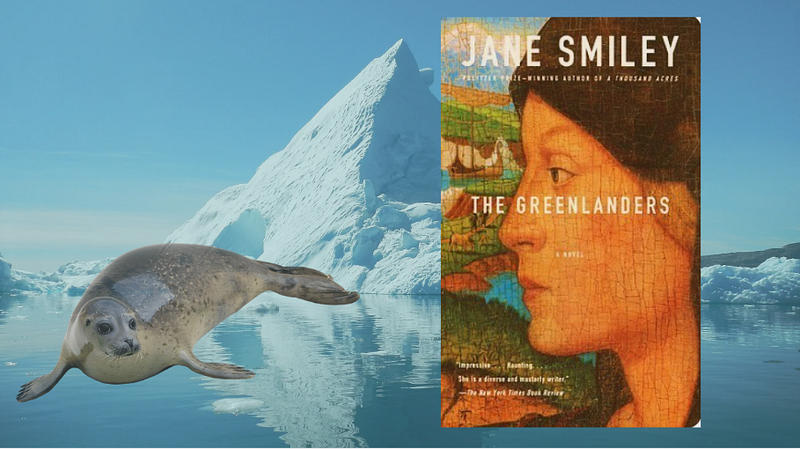
I feel I really hit the nail on the head when I chose to read this book. It was exactly how I had hoped “The Buried Giant” (by Kazuo Ishiguro) to be and wasn’t: a meaty story that got me fully immersed in the Medieval ethos.
‘The Greenlanders’, by Jane Smiley
Goodreads rating: 3.91 stars
My Rating: 5 stars
Genre: Fiction
I’ve been reading this book for two or three weeks now, but it seems to me that time has stretched, it has become elastic, and I have in fact lived for a lifetime alongside these 14th Century people in the space of these three weeks, getting to feel their joys and sorrows as intensely as they did. And… this was a very rewarding experience.
I knew nothing about Medieval Greenland and I got to learn really many things about their history, their way of life, their beliefs, their struggles, but also about their sagas, their relations with “the Skraelings” (the Inuits), the hardships they faced daily, and about their superstitions.
Greenland was a place that few came to, a place lost to the considerations of men, especially since the coming of the Great Death and its subsequent visitations.
I was well-advanced in reading the book and really struggling to remember who was who when a realisation dawned on me: their surnames are formed from their fathers’ names followed by the suffixes “dottir” for girls and “son” for boys.
So, if Asgeirs has two children, say Gunnar (a boy) and Margret (a girl), they will be called Gunnar Asgeirsson and Margret Asgeirsdottir. Duuuh! It’s the same in Spanish too (Perez, for instance, means the son (“ez”) of Per). This really made figuring out who was who a lot easier.
Greenlanders only had a few visitors in the 14th century (Norwegians and Icelanders mainly) and there was such a long time distance between the visits that the inhabitants kept talking about them for years and years after and their stories gained mythical proportions.
Also, these are not your typical Medieval people.
They have almost no wood (the only wood they can get their hands on gets on the shore as driftage), so you might think no people would be burned on the pyre.
They have no grapes, no barley, and no beehives, so there’s no alcohol and they can’t blame their misdeeds on having been inebriated.
They only have a few weapons left from their ancestors or from the occasional visitors (the iron is scarce in Greenland), so there’d probably be no savage killings either.
Except that, well, they’re Medieval people, and no story about those times would be complete or remotely authentic without witchcraft accusations and their implications, without prophets with highly imaginative minds who have portentous dreams, without religious fanaticism gotten out of hand and savage killings.
So, rest assured, these people will be creative enough to find ways to be as humans tended to be back then and they will have their lapses too.
The book is written in the epic tradition of Norse or Icelandic sagas, so the lives of the members or generations of a few families and social groups are chronicled in a lengthy, slow-paced narrative. Sagas are quite old and derive from oral storytelling, so they have a certain style and it takes some time to get used to it.
The narration seems detached and emotionally removed from what is happening, but this kind of story is supposed to record or document the facts only, as opposed to subjectively interpreting them, so it makes a lot of sense to be so. And, as one of the characters says, “these tales are meant for speaking”. Once you get into the style of it though, the story really flows.
There are a few other (fun?!) facts that I feel inclined to highlight about these people. So here they are.
They have to make do without bread (there’s no wheat in Greenland either) and the inhabitants eat their butter on dried reindeer meat. Yum, right? Also, their idea of refreshment is somehow different as, remember, there’s no alcohol there either, so visitors will only get a cup of sour milk (that is if people have any to spare). Yum, again.
If people go to any of the few feasts that take place on the island, they’ll have to carry their carved spoons with them and if they just happen to break, bummer, they might either use their fingers to eat or just stay hungry as there’s hardly any spare.
Also, as I’ve already mentioned, the iron is almost inexistent, so again they’ll have to make do with whatever else they have. And this is when bones and tusks come in handy: so their “hooks” will be made from tusks, their knives from bones, and so on.
Nothing is ever wasted, every single thing from a slaughtered animal is used, which makes me quite despondent about the contrast with the incessant waste from current times.
As I’ve said, the wood is also sparse, so they have to be creative to protect themselves from the unbearably cold winters: tapestries are put on the walls to keep the wind out, they surround the steadings with turf, and they use seal-oil lamps to heat the rooms. They also dry the meat instead of making steaks.
Definitely nothing close to what we would define as “dolce vita” for them! Oh, and I don’t even count the stench they were all probably surrounded by everywhere they went (as apparently seal oil really stinks) when I say this.
This was a fantastic book that will (for sure) stay with me for a long time. I HIGHLY recommend it to anyone who is fond of reading really immersive stories that take place in Medieval times.
Originally published at https://www.goodreads.com.


