
The Far-reaching Impact of COVID-19 in India
From counter urbanization to inclusive growth.

Unlock 4.0 brought me back. Back from the luxury of discussing a range of issues with friends which I could never avail so frequently in the last so many years. Now with business coming back to normal, rather a new normal, I am excited to share a predictive discussion I had with a very close friend.
Before sharing the details and relevance, I feel obliged to record the journey of a guy. He is from a small town of Chattisgarh, but for a decade the head of a large team in a leading oil exploration company in India.
Coronavirus and Socio-economy Inclusion
The discussions which started from a long time, in no time gave way to the predictions on lockdown fallouts, and our strategy on living with Corona.
While reminiscing the whole discussion, it started on a note as trivial as the availability of maids in Rajnandgaon (his parents live there.)
- He was comforted to know that his old parents who were struggling very hard to engage a maid for a reasonably long time, were flooded with requests of a number of maids ready to work exclusively for them.
- In the same breath, he informed me that the strategy department of his organisation feels that he is no longer needed to attend office from 9 AM to 7 PM meticulously in person. He was comfortable with the thought of shifting to Rajnandgaon and work from Rajnandgaon if that is possible.
Did both these pieces of information have any correlation at all?
At first, they appeared to me to be the issues in the realms of entirely different geographical and socio-economic spheres. But now, I know how wrong I was.
Both these and many more apparently unrelated emerging offshoots of transforming social and economic structures have their genesis in the realisation that we will have to live with Corona for foreseeable future.
After setting this context up, I am going to discuss in the rest of my article: Whether life with corona compulsions is going to introduce tangible and profound long-lasting changes in the way we work (read being in office or work from home) or on the way we live (read in Urban or Rural area,) etc.
I am trying to make peace with a new realisation about the pandemic called Corona. The unusual thing about a disease like COVID 19 is that it has the right balance of lethality & infectiousness to have created a global pandemic of such proportions.
As our daily lives go on albeit in a restricted manner, I realized that everything is not going to be the same from now onwards. We have to be prepared for the far-reaching and long term implications that COVID-19 could trigger in the socio-economic sphere.
Owing to COVID-19 the businesses are increasingly accepting and have realized the fact that growth can not come at the cost of disregarding socio-economic equality especially between urban and rural demographics.
At this stage, the larger urban narrative seems to be around, work from home and how the organisations might be able to save a lot of real estate and office costs.
The organisations, policy planners, investors, businesses who see only these as the resultant impact of COVID-19 might find themselves myopic in their approach.
India’s growth story has been largely urban-centric despite the fact that industries like agriculture employ around half the country’s working population.
If the Indian economy were to emerge stronger after the pandemic then the focus on prioritising urban-centric growth needs to give way to a more inclusive growth approach which paves the way for wider socio-economic inclusion.
Decoding Indian Growth Story of Last Three decades

On the lines of the industrial revolution, India saw a service revolution in the last three decades where the contribution of the services to GDP jumped from 42.5% to 60% in the last 30 years growing at a CAGR of 8% per annum while employing over 28 million people.
But this service revolution has been modelled on the premises of the industrial revolution where the location of workers was treated as important because the workers had to come to the manufacturing location every day and operate machines.
This led to massive urbanization in the country building IT hubs such as Bangalore, Hyderabad, Pune, etc. where more than 12 million people found employment, and millions of families migrated from their home town locations to these cities in search of a better standard of living.
This further led to a lot of support manpower migrating to these cities for purposes such as infrastructure build-up, and support staff.
This chain reaction led to massive investments from both the public and the private sector in these urban centers of agglomeration. The current reality of most of these cities is that the real infrastructure is trailing the actual requirement.
Stories of high rises or bridges collapsing across the country led to temporary outbursts around the state of apathy only to be forgotten about days later.
As per ORF online, over $1.5 trillion in international long-term capital can ameliorate this but policy bottlenecks prove to be a massive challenge in the deployment of the said capital.
In addition, the unseen exponential growth of population density in the human history (Delhi’s population is set to grow by 50% by 2040 to emerge as one of the most populated city on the planets) the environment in these cities started to deteriorate in the form of air pollution, water pollution, sound pollution, etc to the extent that India has 21 of the world’s most polluted 30 cities including the 4 leading metros. This has impacted the overall quality of life which was supposed to be better in these cities.
Urbanization also had inherent benefits of scale economies. One could create a large hospital or multiplex in Delhi or Bangalore because of higher disposable incomes and a higher density of the addressable market.
These scale benefits also made urban centers attractive for investment into various sectors such as health care, education, entertainment, etc. often at the loss of India’s Tier 2 or Tier 3 cities.
To summarize the service revolution which powered the growth engine of the Indian economy for the last 3 decades is responsible for the current degree of urbanization, living standards, investments in these cities.
However, owing to COVID-19 all this is set to change as remote working and restricted living conditions in place to prevent the spread of the virus has fundamentally altered our services industry and working population which is gradually getting attuned to remote working.
This will set a precedent to alter the narrative around India’s urban-centric growth story in the decade as the world realizes the impact of wide-scale pandemics and finding a vaccine is often a monumental challenge that takes decades to materialize.
In this context, let’s look at how our growth story could change for the better owing to this new trend of counter urbanization which can unleash more equitable inclusive growth opportunities for India at large.
Decentralized Workforce

The pandemic has made us realize that owing to internet connectivity work can be done remotely especially in the services sector. This holds true for the burgeoning IT and startup ecosystem (the 3rd largest in the world currently).
The location of white-collar employees could be made redundant for over 10 million employees in the top 6 cities in the next 12–18 months.
This could lead to at least 75% of these employees going back to their home bases since the cost of living could significantly come down, owing to lower living costs and stem the financial exigencies most of these employees are facing.
The infrastructure in metro cities will suddenly find itself being severely underutilized. Life becomes better in the top cities for air, water (pollution levels dipped by 49% post lockdown across leading metros). But employees would not be avail to services of their support ecosystem(maids, drivers, cooks, etc).
Commercial office real estate which was already burdened owing to the rise of coworking spaces and is expecting space take-up rates to plunge by 25% suddenly finds itself rendered unutilized.
I do expect recovery for the retail real estate over the next 12–18 months, but in the short term till the COVID scare remains and if we do not learn to live with it and fear it like a monster all forms of real estate is going to be severely underutilized.
While this is happening in the service industry, let’s address the challenges faced by the backbone of the nation — the bottom of the pyramid. The massive number of unsung heroes who build things in the cities, the watchmen, the maids, the construction workers could face a dual conundrum
I. They will be apprehensive of coming back to the cities because of COVID-19.
II. Opportunities in cities would become inherently unattractive in the next 3–5 years because of the lack of investment in the metro and tier 1 city infrastructure.
The Capital Allocation on Non-metros

We will not only see more money as a proportion being spent in tier 1 minus cities, because of people moving back but we will also find a lack of adequate infrastructure to support the needs of these people who are accustomed to the better facilities available in the top cities.
I anticipate that public and private capital in both private and public sectors would get re-deployed to cities like Patna, Jaipur, Vizag, or even smaller towns.
While state governments currently spend 36% more than their federal counterparts their ability to raise more funds is a challenge that can be addressed by the private sector as per the new tender norms which prioritize Indian companies, announced in the economic stimulus package.
But the reality is that these towns do lack the same standard of health care, education, and entertainment avenues. WHO estimates that India is facing a shortage of over half a million doctors and the current ratio of 1 doctor per 10,000 people underscores the actual need (1:1000).
The public sector will find it challenging to address the gap on its own and this will create an opportunity for startups to build businesses right away with a Tier1 minus focus and make money in the long term especially around core sectors such as healthcare, education, and food security.
This will solve a fundamental issue with the Indian economy that a lot of the startups and growing businesses face.
Indian startups, however, lack depth, it has a normal-sized head and a very long tail with a strong metro focus which has cast a doubt on their scalability and profitability.
For example, even though the Indian e-commerce sector has over 50 mn users yet over a million of these workers catering to this vast audience are blue-collar non-contractual workers.
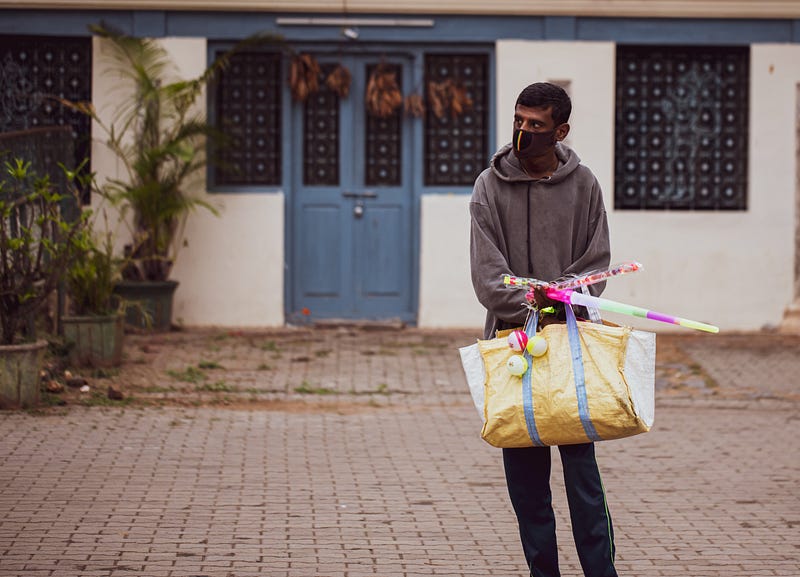
Owing to the pandemic, they will shift back to their native places which presents an opportunity for the Indian startup ecosystem to reach out to new audiences and create gainful employment.
As prosperity gets deeper and broader, the economic consumption would in general spread itself. Building businesses in these towns are going to be much tougher than what has been in metros because the density and spike in consumption are not going to be as high as previous levels.
Around 68% of India’s population resides in rural areas and for startups facing growth challenges right now this could be a way to hedge their risks and create prosperity all around.
Indian Familial Ecosystem
Indian familial ecosystem and female work participation will be geared towards enhancing our economic competitiveness.
COVID-19 could bring about a more pronounced positive impact on the familial ecosystem as the working population which was largely nuclear shifts back to non-metro cities.
The cost incidence of staying in your hometown is much lower and bodes well for the overall wellbeing of everyone. It also stands to bring about a more behavioral change in rural households especially when it comes to prioritizing healthcare and increasing women’s participation in India’s working population.
As per a study conducted by Chrome Data Analytics and Media, rural households spend more on alcohol than healthcare. As per the National Sample Survey in 2014 and analysis done by IndiaSpend, the participation of rural women in India’s workforce is declining faster than that of urban women despite the increase in better education opportunities.
When people stay in joint families with a service economy accepting work from home, the opportunities to widen this chasm of gender economic inequality increases manifold.
Studies suggest that working women can not only uplift the socio-economic status of their families but can also bring about a change in the patriarchal hindrance that prevents them from growing equitably.
Greater Female Participation in the Economy
A fundamental shift that it can trigger is that there is likely to be greater female participation in the economy.
Women in India currently contribute to only 17% of the GDP vs their global counterparts (women in China on an aggregate contribute to over 41% of their GDP which is higher than the global average of 37% including that of advanced nations such as Europe & USA where numbers are below 40%).
This could potentially mean that India is yet to leverage its demographic dividend to ensure the workforce availability of an additional 100 million women in the next decade.
The key cost for the service industry is manpower. The service industry currently employs only 25% of the labor force yet the expenditure on the manpower which is about 40% lower than the global average presents a significant cost arbitrage to the industry.
While for industries this presents an opportunity to attract foreign business to the Indian shores this could translate to higher expenditure on manpower for companies resulting in better income opportunities for the incremental 10 million+ coming to the economy at a base cost which will make the IT sector more competitive in the global scheme of things.
The Bottom Line
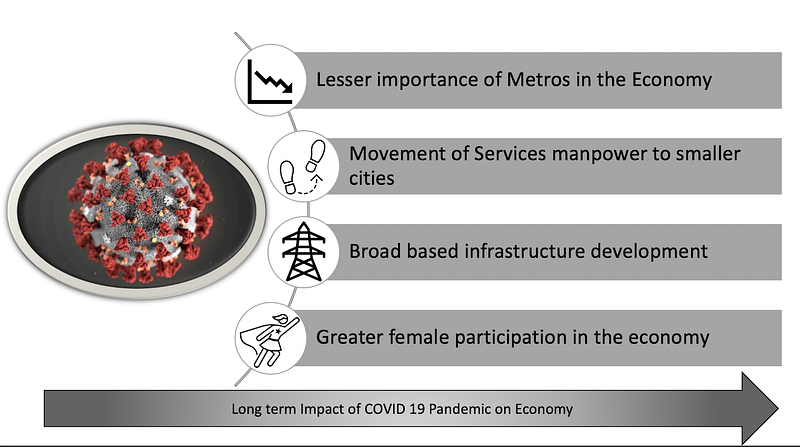
COVID-19 has made us realize that work no longer means being location-centric given that digital connectivity allows us to ensure business continuity without the need for a geo-centric workforce.
While India’s consumption and services industry is witnessing a slump right now, I predict that we can rise through the ranks as a globally competitive economy.
But this transition can only happen if the public and private sectors do not ignore this massive shift in the workforce demographic and location, owing to COVID-19, and take steps to leverage the same if we are to achieve a self-sustaining — Atma Nirbhar economy.