
Retro Rewind
The Fantasy and Fallacy of Time Travel
‘Back to the Future’ is a perfect movie with an imperfect message
Retro Rewind is a weekly series that reconsiders pre-2000 pop culture. More here.My parents divorced shortly before Back to the Future released. Dragged under by a swirling riptide of confusion and fear, I found comfort in the story of the McFlys and hope in the reparation of their family. Everyone in 1955 mistakes Marty’s vest for a life preserver but it was the movie that kept my head above water.
Looking back, its clear why this story had such a grip on me – time travel is the ultimate sort of wish-fulfilment, and I was ready to cash in all three of mine. But mostly I was infatuated with Marty. He was just so darn cool.
I asked for a skateboard for Christmas. It didn’t end well; I’ve always been more George than Marty – I used to read the Dungeons & Dragons rules just for fun.
Doc Brown: “If my calculations are correct, when this baby hits 88 miles per hour, you’re gonna see some serious shit.”
Until I started writing this piece, I’d forgotten that I used to pedal my bike around town and pretend that I was driving the DeLorean. I’d eyeball cars and say aloud, “let’s see if you bastards can do 90,” before pedaling for all I was worth.
This practice continued even once I got my driver’s license and could, for the first time, actually ‘do 90’. Theoretically anyway — my first car was a Dodge Omni built sometime between 1955 and 1985. It had a luggage rack and the giddy-up of a hobbled horse. Alas, the Omni topped out at 70 mph. By the time I had a car that could reach such lofty speeds, I’d stopped pretending I was behind the wheel of a time machine.
When I first conceived of the Retro Rewind series, I thought for sure I’d be writing about Star Wars. It is, after all, sort of a big deal to me. I decided to write about Back to the Future though because I consider it a perfect movie, even if the messaging isn’t.
That doesn’t necessarily mean “best”, though I think it ranks up there with the greatest films ever made. Nor is it my overall favorite. It is simply the perfect film.
Expertly constructed, lean and mean, not a wasted bit of dialogue or a scene out of place. The cast is pitch-perfect, led of course by Michael J. Fox and Christopher Lloyd; I especially appreciate Crispin Glover’s neurotic performance. The score is iconic, with an assist from Huey Lewis and the News. And, despite the potential for shenanigans that time travel seems to invite, the plot is easy to follow yet still surprising, in large part because the movie isn’t really about time travel at all. The DeLorean and its flux capacitor are simply devices to deliver Marty to the past before exiting stage left.
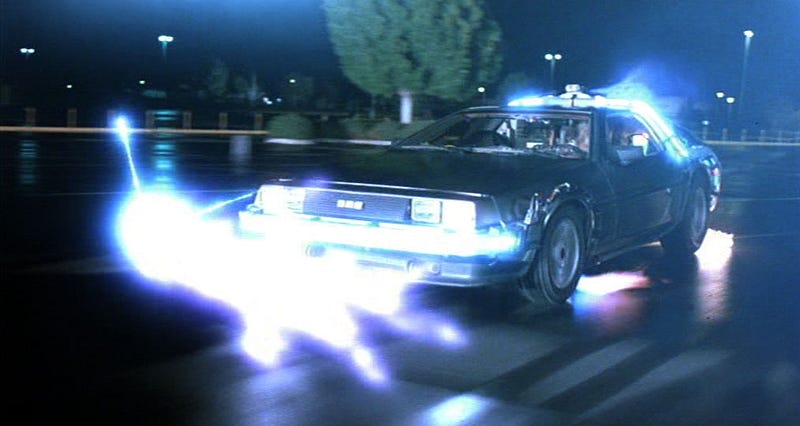
Quick aside regarding the DeLorean, quite simply the most iconic car ever featured on a screen — don’t come at me with your Kitts and General Lees, thank you. With its silver chassis and gull-wing doors, the DeLorean looks eminently futuristic. When Marty first arrives in 1955, Old Man Peabody mistakes the DeLorean for a spaceship and you can’t really fault him — we don’t even blink when the film ends with the car flying.
Marty McFly: “What the hell is a jigawatt?!”
The seed for Back to the Future came from the film’s screenwriter and producer Bob Gale, who was flipping through his father’s yearbook and wondered if they would’ve been friends in high school. I’ve never really had to wonder; if I’m George, my dad is Biff.
As children, our parents are monolithic. Large, constant, unchanging. We know that they haven’t always been as we know them, that they too were children once, and even further back — in the days of the cavemen — they didn’t exist at all. We know these things, yet we somehow can’t fully accept them as truth. Our parents age but they never really seem to change. There is a certain comfort in that, an assuredness, a rightness. So it can be surprising to discover that they weren’t always as we’ve known them. That they were once very different people.
Marty is shocked to discover that George writes science fiction stories. He literally laughs it off. The idea that his father once harbored dreams of his own is completely unthinkable. The George he knows is a hollowed out shell of a man who spends his evenings yuck-yucking at old television shows. He hasn’t a creative bone in his body.
None of us come to adulthood unscathed. Most trade the dreams of childhood for the realities of The Real World. There is also safety in conformity, in staying within the lines. Chasing something you may never catch risks the pain of failure. Is there anything more humbling than putting your heart into something and being told it’s not good enough? Better to not try at all than risk that sort of rejection.
It’s a mindset George already has as a teenager, so it’s no surprise that he eventually abandons his stories. Marty is more similar to his father than he first realizes. He dreams of being a rock star but is paralyzed by fear: “What if they didn’t like me? What if they told me I was no good?”
The son becomes the father.
After Marty leaves Lorraine’s house, her father says, “He’s an idiot. His parents are probably idiots too.” We laugh because we know who Marty’s parents are. But this hits at a different, perhaps uncomfortable truth – our identity is informed by our parents. We are products of nature and nurture, both.
I may feel like George but sometimes, sometimes, I am Biff.
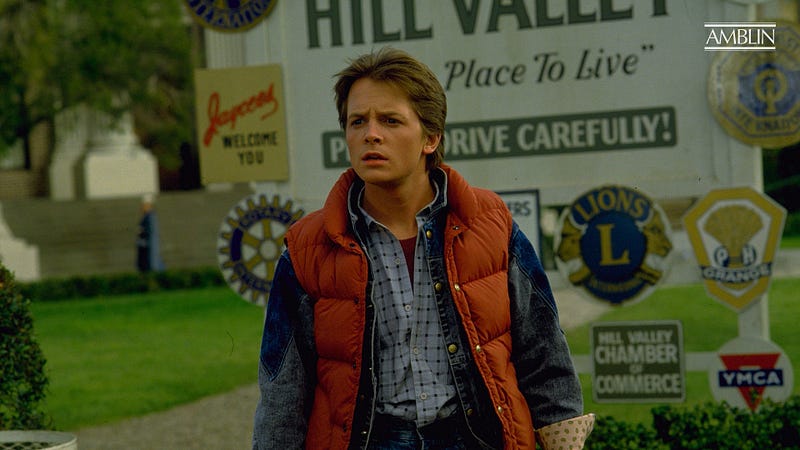
My favorite part of the movie is probably the first scenes of Marty in 1955. Who hasn’t wondered what it would be like to go back into some distant Before and wander around like a tourist? Even looking back from a futuristic-sounding but boringly mundane 2021, Hill Valley in 1955 still feels familiar. It is quant and idyllic in a way that the 1950s maybe never were, but remains recognizably small town U.S.A.
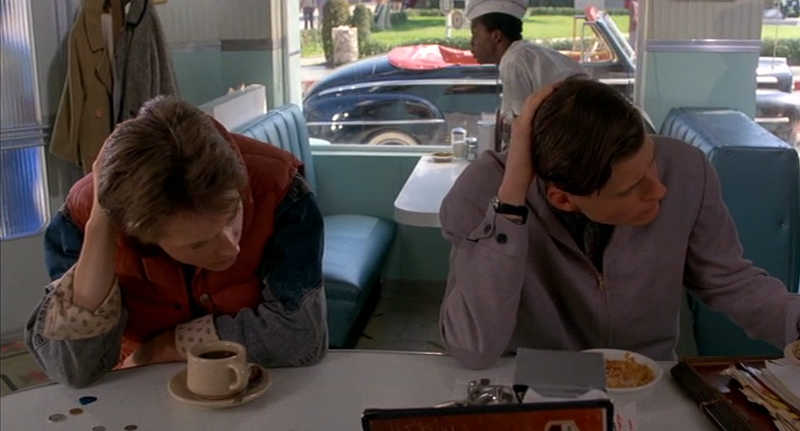
No 50s era town would be complete without a diner, and Back to the Future gives us two great scenes set inside Hill Valley’s. The first comes as Marty is still trying to get his bearings. Marty meets his teenage dad for the first time at the diner. And, shortly thereafter, Biff.
Watching George get picked on in front of his son plays different now that I’m a father, especially when Marty ends up coming to his rescue. Dads are supposed to be the protectors. We’re supposed to be the strong ones. When I was a kid, my friends and I used to brag about which of our fathers was the strongest or the best or the toughest, a problem we’d solve via the old metric: my dad could beat up your dad.
No father wants to appear weak in front of his children. I think most men entertain fantasies about heroically defending their families and homes from some hostile other. Who among us hasn’t chosen to sit facing the restaurant’s door so as to be better prepared in case something pops off? Never mind that we are probably out of shape and have never been in much of a real fight. Certainly not life-and-death stakes.
Doc Brown: “Why are things so heavy in the future? Is there a problem with the Earth’s gravitational pull?”
I like to imagine all sorts of things — it’s a large part of why I’m drawn to write — but I know that deep down, I’m a lover not a fighter. I avoid confrontation when at all possible. I will stand up and push back — I inherited my father’s temper, if nothing else of his temperament — but most times it’s just not worth it. Shakespeare wrote “the better part of valor is discretion,” which means caution is better than naked courage. I’ve never been in a fight even though several were in the offing. I needed only to reach out a fist and touch someone.
The threat of violence still shadows me, like dark clouds on the horizon. Bullies are mostly an artifact of the past but they’re still out there, they just do a better job of hiding. I fear one day they’ll find me and I’ll be ill-prepared. There’s nothing more terrifying than feeling like you can’t protect your family.
The lock on the back door of our previous house never worked reliably. You had to coerce the bolt into place, but at some point our gentle ministrations stopped working altogether. I propped a chair behind the door until I could swap out the lock. It was only like that for a week or so, but ten years later I still have recurring nightmares in which shadowy men circle the house, trying to find a way in, while I struggle to keep them out.
One of the most interesting things about Back to the Future is how Marty serves as the family’s father figure. He protects both his parents from Biff. He teaches and encourages George. He even lectures Lorraine about drinking and smoking. It’s a Freaky Friday-esque bit of role reversal.
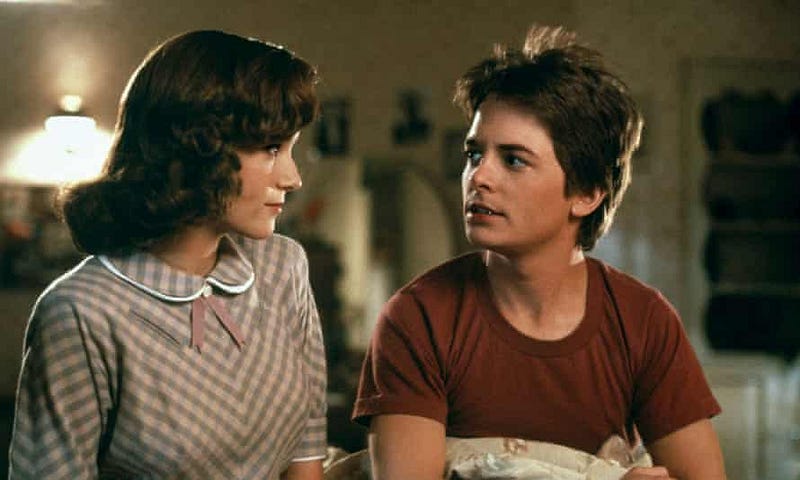
Marty’s sudden emergence in 1955 completely derails his parent’s love story, one predicated upon Lorraine’s dad hitting George with his car. How much of life is a series of random events, unfortunate or otherwise, connecting one day to the next, laying down a meandering line of breadcrumbs that can only been seen in hindsight?
I grew up in the Metro Detroit area. I loved basketball and rap. When I was in high school, my mom moved us to a tiny northern Michigan town, a one-light hamlet where people wore cowboy boots and blared country music. I hated it.
I met my wife in that little town. I started taking school seriously, following her lead, and graduated from college with honors. I have a career I enjoy. We have a family.
None of that would’ve happened if my mom hadn’t decided to get us away from the city and its bad influences. Or if my parents hadn’t gotten divorced. The best things in my life came about thanks entirely to the worst things that ever happened to me.
Marty: “There’s nothing to be scared of. All it takes is a little self-confidence. If you put your mind to it, you can accomplish anything.”
Time travel stories are really about our desire to fix the present by changing the past. If only we could go back, we could correct all our mistakes and everything would be just right, our own private version of happily ever after. But all those experiences culminated in the person I am today. Take any of them away and you start to erase me, like Marty disappearing from that photo. So I’ll keep the good and the bad alike. Even something that seems insignificant today can loom large in your story later on.
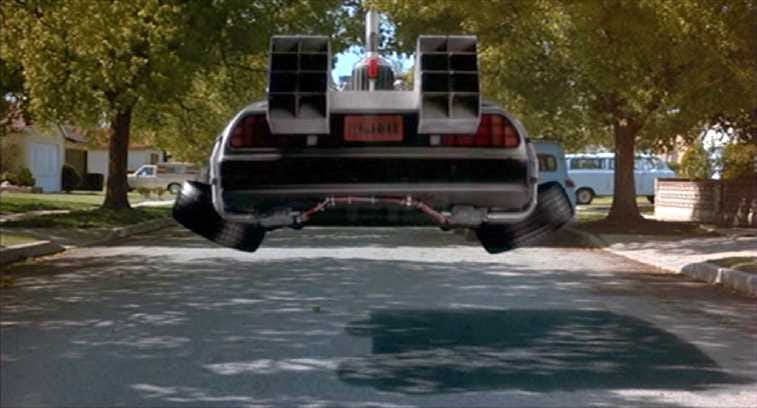
Back to the Future ends with a promise: To Be Continued…
This is meant as an assurance, I think, but as a kid it just made me antsy. Every time I watched the movie, I pestered my mom about when the story would continue. The sequel was released in 1989, four years after the original. It felt more like forty.
I think I was so anxious to see the story continue because I knew another movie might threaten the McFly family’s happily ever after. And if Marty McFly couldn’t have that, what hope did I have?
If I could time travel, I might go back to a certain Michigan town in the 80s, just to let a scared kid know it was all going to work out fine.
And maybe warn him that the other Back to the Future movies aren’t nearly as good.
Random observations in rough sequential order
- What the hell is Doc doing with that enormous speaker at his house, anyway?
- I know parents didn’t really care what their kids got up to in the 80s so long as it was Outside, but it still strikes me as odd that nobody questions why a 17 year-old is chumming around with a slightly(?) deranged scientist at all hours of the night.
- Elisabeth Shue is great but the original Jennifer is better.
- According to IMDB, the guy that plays Principal Strickland has had a lengthy career, but I only know him from Back to the Future and Top Gun. I could’ve used more of his no-nonsense authority in other films.
- The Power of Love may be the greatest theme song in the history of film.
- It looks hella cool when Marty cabooses onto cars while skateboarding but I can’t remember anyone ever trying that in real life, which is hard to believe considering how iconic the film is — and how impressionable and stupid kids are.
- Christopher Lloyd was 46 at the time of filming, only a few years older than I am now, which is a shocking and somewhat terrifying prospect as he is essentially the archetype for the ‘eccentric old man’.
- Marty meets Doc in the middle of the night to test his experiment, the only time a mall parking lot would’ve been empty in the 80s. If the same scene was shot today, it could probably be done in broad daylight.
- Testing the time machine while standing directly in its reentry path is the height of hubris, especially since Doc’s reaction to the DeLorean’s return confirms this was his first attempt.
- The movie is filthy with clocks. Clocks for days. It opens with dozens and dozens of clocks ticking away in Doc’s house. There’s Marty’s alarm clock and the mall’s digital clock and Lorraine’s clock and the clock at the dance. People frequently check their watches. And oh yeah, the film’s MacGuffin is a bolt of lightning that strikes the clock tower. This movie is obsessed with time.
- Shortly after Marty arrives in Hill Valley circa 1955, he stashes the stalled DeLorean behind a sign proclaiming Lyon Estates the ‘home of tomorrow’. Subtle.
- Having one TV was notable in 1955. Marty’s family has two in 1985. We have four at our house, plus all sorts of screens — iPads and phones and Switches. At this rate, my grandkids will come equipped with their own screen.
- Doc admiring the video recorder and saying, “no wonder your president is an actor — he’s gotta look good on television,” is a throwaway line, a good joke, and sadly prophetic; these days style is so much more important than substance.
- George has no game whatsoever but I am always a bit awed when he walks into the packed diner and says, “Lou — give me a milk. Chocolate.” And damned if it doesn’t come sliding down the bar.
- “My density has popped me to you,” is the sort of tongue-tied nonsense I get up to on the regular; it’s a miracle that I got married. By the by, does any girl really like hearing that you’re her destiny? Seems awfully presumptuous, Marty, even if technically true in this case.
- The jukebox quits the moment Biff walks into the diner and yells at George for being there, which means Lou was paying someone to kill the music whenever Biff showed up. I will accept no other explanations.
- Doc’s model of Hill Valley is amazing. I want to play with it.
- Come for the icky mother-son sexual connotations, stay for the McFly boys casually discussing sexually harassing Lorraine. I think Freud would have a lot to say about this film.
- I love the quiet confidence of George dancing by himself at the Enchantment Under the Sea dance.
- The transition from Marvin Berry asking if Marty knows someone who can play the guitar to Marty strumming on stage is chef’s kiss.
- “This is for all you lovers out there.” Johnny B Good gets all the attention but for my money, Earth Angel is the better song.
- When Marty returns to 1985, it’s interesting just how dingy the future looks. Our nostalgia for the past will always lessen the appeal of the present.
- One of my favorite effects is rather low-tech: I’ve always thought it was neat how aged and tattered Marty’s letter to Doc looks in 1985.
- ‘Great Scott!’ is one of the all-time great exclamations and I don’t think the pandemic would’ve happened if it hadn’t fallen out of the common vernacular.
We hope you enjoyed this edition of Retro Rewind! Come back next week as Danielle Loewen dives into the 16-Bit wonder that is The Legend of Zelda: A Link to the Past. Check-out our schedule for upcoming columns!Eric writes about pop culture here at Medium and would probably go back to some random day in the 80s if he could time travel. If you’d like to see what else he’s working on, check out his newsletter.
Related stories:


