avatarWojciech kowalczyk

Free AI web copilot to create summaries, insights and extended knowledge, download it at here

951

Abstract

only leaves the possibility of the integral being 0. Thus we have already solved for one case. From now, let us assume that n is odd. Consider the following:</p><figure id="420c"><img src="https://cdn-images-1.readmedium.com/v2/resize:fit:800/0*LnRZQgxy-P5inU-L.png"><figcaption></figcaption></figure><p id="9578">We would like to try to form some nice reduction formula which can represent I_n in terms of I_(n-1) or I_(n-2). However, notice that if we take I_(n+2) — I_n we get:</p><figure id="2778"><img src="https://cdn-images-1.readmedium.com/v2/resize:fit:800/0*ak-IPvOWEiGQRjPT.png"><figcaption></figcaption></figure><p id="ecf0">Which is nice since we have the following trigonometric relation:</p><figure id="8542"><img src="https://cdn-images-1.readmedium.com/v2/resize:fit:800/0*V2UuEcwWChPsGsY-.png"><figcaption></figcaption></figure><p id="3634">And thus we can rewrite our integral as:</p><figure id="9cf1"><img src="https://cdn-images-

Options

1.readmedium.com/v2/resize:fit:800/0*oUUO7H6LdI8q6lve.png"><figcaption></figcaption></figure><p id="19a8">Which very neatly simplifies to:</p><figure id="d301"><img src="https://cdn-images-1.readmedium.com/v2/resize:fit:800/0*tQdcvf_BWGZQi0KR.png"><figcaption></figcaption></figure><p id="4142">Therefore we have that I_(n+2) = I_n, the best case scenario! The only thing that is left is finding I_1 since we have already sorted out the even cases. That is,</p><figure id="0425"><img src="https://cdn-images-1.readmedium.com/v2/resize:fit:800/0*7xLKEu6gTueRCoQW.png"><figcaption></figcaption></figure><p id="9a42">We are now at the end of the integral. For odd cases, our integral is π and for even cases, our integral is 0. That is:</p><figure id="b997"><img src="https://cdn-images-1.readmedium.com/v2/resize:fit:800/0*wcBpqB4_NCPwY5fW.png"><figcaption></figcaption></figure><p id="8e2f">A beautiful solution to a famous problem.</p></article></body>

The famous sin quotient integral

This integral is extremely famous and it goes as follows:
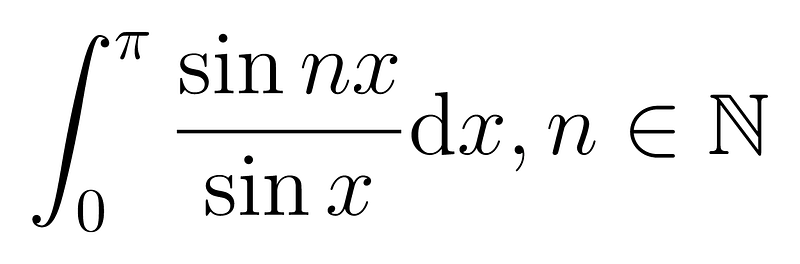
Can you figure out this integral that pops up surprisingly often?

.

.

.

First, we note that if we were to substitute π-x, then we would yield a very similar integral, namely:
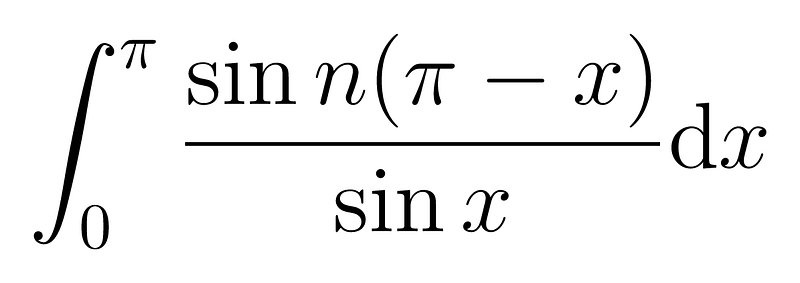
When n is odd, we get the exact same thing back. However, when n is even we get the following:
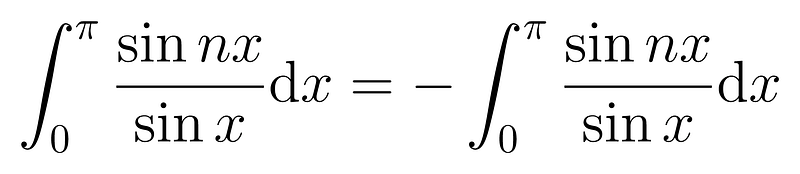
Which only leaves the possibility of the integral being 0. Thus we have already solved for one case. From now, let us assume that n is odd. Consider the following:
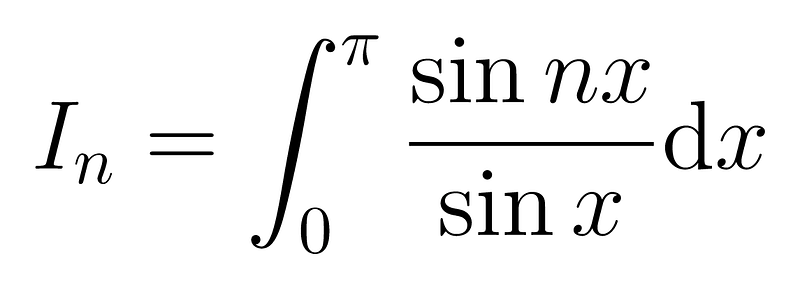
We would like to try to form some nice reduction formula which can represent I_n in terms of I_(n-1) or I_(n-2). However, notice that if we take I_(n+2) — I_n we get:

Which is nice since we have the following trigonometric relation:

And thus we can rewrite our integral as:

Which very neatly simplifies to:

Therefore we have that I_(n+2) = I_n, the best case scenario! The only thing that is left is finding I_1 since we have already sorted out the even cases. That is,
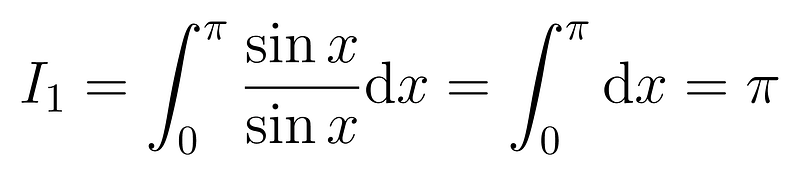
We are now at the end of the integral. For odd cases, our integral is π and for even cases, our integral is 0. That is:
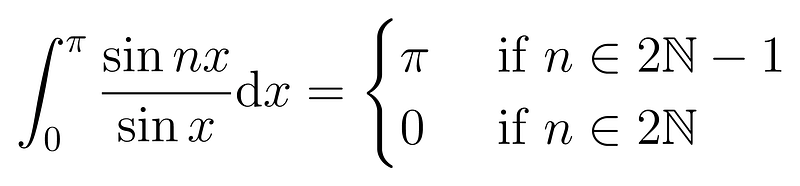
A beautiful solution to a famous problem.

Integration
Math
Mathematics
Hard Problems
Problem Solving
Recommended from ReadMedium