The Fallacy of the “American Dream”
A Propaganda Tool or A New Reality?
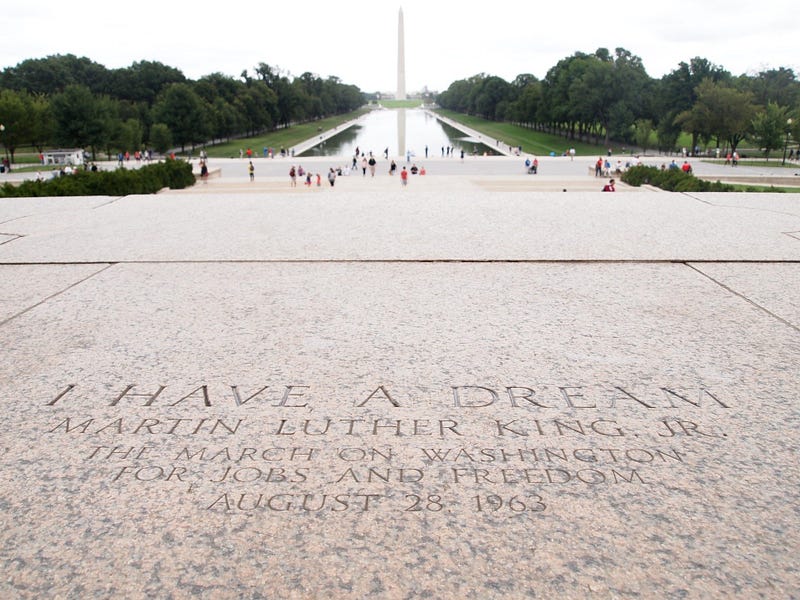
Dreams, Destiny and Pursuit of Happiness — for some or all?
Not all dreams are created equal.
The words, American Dream (coined by writer and historian James Truslow Adams in his best-selling 1931 book “Epic of America.”), have such an idealistic tone to them. Much like the words from the Declaration of Independence
“We hold these truths to be self-evident, that all men are created equal, that they are endowed by their Creator with certain unalienable Rights, that among these are Life, Liberty, and the pursuit of Happiness.”
As well as the term, Manifest Destiny, used to explain the spread of Americans across the entire US in the 19th century.
All of these tenets of the United States sound marvelous on paper. However, none of them were meant for all Americans.
When the Declaration of Independence and Manifest Destiny (around 1845) were coined, only white men could hold property. Women, Native Americans and slaves could not. By the time American Dream was coined, women had only had the right to vote for eleven years but still couldn’t hold property, and although African Americans had been given their freedom after the Civil War ended in 1865, they were still not treated as equals with white Americans. The 1921 Race Massacre in Tulsa OK proves how even when African Americans tried to be equals, their hopes were dashed over false allegations and rumors; furthermore, they were displaced and their property looted and burned by whites.
One would think that in nearly a century since the 1921 Race Massacre and the coinage of the American Dream, that we Americans would have achieved such dreams, but the sad reality is, we are as much a divided country with systemic inequality today as we were back then.
Where Does Hope Lie?
While there will always be those in the US and around the world who are slow to change — or downright opposed to it, I don’t believe we are completely without hope.
For me, I had to learn the hard lesson that change is inevitable
and those who do not succumb to change are stuck in a past that no longer exists — if it ever did in the first place. They are also stuck in old paradigms that are antiquated and no longer serve a diverse society. And whether or not some want to believe it, we are — as a nation and world society — becoming more diverse. Not only in nationalities and race, but also in social thinking and constructs. Simply put, we need to move along with the tides of society and not stifle change.
What Do My Ideals Look Like?
On Earth in a hopeful near future, I would want everyone to simply be known as a Human. Too often — especially in media — people are still separated by their race, gender, creed, religion, etc. Until that stops, we can never truly be One People. That’s not to say that we should neuter everything and no longer have individual labels. If someone still wanted to be know as White Christian Woman or African American Male/Woman or any other known labels in society, then they should have that right to identify as such.
Make it a personal badge of pride, not a reason to divide.
However, when we continue to make cliques and pile into them to separate ourselves from others, that’s when things tumble quickly into Us vs. Them. A simple recognition first that we are all Humans, brothers and sisters, and One People would go a long way to squelch a lot of this division in the US and the world.
There is also enough wealth and resources on this planet to lift everyone out of poverty, and feed, cloth and house everyone.
It is simply greed that prevents those who have the most to not share with those who have too little.
Somewhere in the development of our human brains, we got the idea that some people are entitled to the majority of the wealth than other people. That someone’s skin color affects their ability to be educated. That some people are dispensable, useless or undesirable and therefore not entitled to money, a decent place to sleep, or even food to eat. These useless people tend to be poor, mainly people of color, and/or different in some way from the “mainstream” — meaning wealthy, white, straight, healthy and Christian (especially in the US).
This needs to stop. We need to be giving everyone a hand-up, not another kick while they are down.
My Conclusions
We would go a long way toward building bridges if we just stopped and realized that the American Dream was and is still merely a propaganda scheme. Although I believe that Adams meant well when he coined the term, especially with his own descriptions of its meaning:
“that dream of a land in which life should be better and richer and fuller for everyone, with opportunity for each according to ability or achievement.”
“It is a difficult dream for the European upper classes to interpret adequately, and too many of us ourselves have grown weary and mistrustful of it. It is not a dream of motor cars and high wages merely, but a dream of social order in which each man and each woman shall be able to attain to the fullest stature of which they are innately capable, and be recognized by others for what they are, regardless of the fortuitous circumstances of birth or position.”
I am still inclined to believe that this dream was a way to get the proper mix of immigrants — Europeans — to want to come to American in pursuit of such dreams in the 1930s and beyond. We would not still have so much racism, inequality and division in this country if it had been meant for everyone. However, I do believe it can be for everyone and it could start now.
Since we are still pretty much in lock-down mode and kids are still out of school, we can be teaching our children about a better world — a world without hate, bigotry, racism, division, and inequality. It isn’t too late for older generations to learn new tricks either.
We need to implement these lessons into our education curriculum, our Sunday school lessons, and our conversations around the dinner table.
Finally, like with any ideal, it has to be a wanted change. And it has to be wanted now, not in some far off distant era on Earth.
©2020 Lori Carlson. All Rights Reserved.
I want to thank Øivind H. Solheim for this month’s Blue Insight’s Cultural Prompts. This is one of many articles I hope to write this month on the themes he laid out for us.
If you found this article interesting, please consider this one on some of my personal philosophies:
Lori Carlson is a poet of mostly dark and/or confessional poetry. She also writes Haiku, Senryu and Tanka. Lori writes micro-fiction, drabbles, flash fiction, short fiction and novellas in the scifi, mystery and horror genres. She also writes articles and personal essays on Spirituality, Mental Health, Self-Help and Life Lessons. Lori received her B.A. in English and MALS at Hollins University in Roanoke Virginia. Ravyne Hawke is Lori’s online persona — the dark soul, blackened heart, and melancholic muse. Lori resides in NE Oklahoma with her husband, two temperamental cats (Izzy & Shugs) and a Husky named Max.


