
The Faith of Militant Atheism
The Response No One Asked For

To be clear, no one asked me to write this essay. Dan Foster and The Backyard Church don’t need me to defend them.
I was reluctant to write this essay because I have little desire to read the inevitable follow-up, “The Feebleness of Eric Sentell’s Argument About My Argument.”
Nonetheless, I am writing a response to Benjamin Cain’s recent article in Interfaith Now, “The Feebleness of The Backyard Church’s Ten Arguments for Theism,” because certain tropes should not remain unchallenged.
I’ve read many of Cain’s essays since joining Medium. I followed him to get out of my echo chamber and learn from another perspective. I’ve enjoyed his philosophy writing and even some of his arguments for atheism.
This essay is not a “hit piece,” but an appeal to everyone to chill out.
Militant atheists — those who don’t just disbelieve in any deity or higher power but also advocate that others disbelieve also— often present their arguments as purely rational and logic-driven while also presenting theists as deriving ill-considered beliefs from emotion and social conditioning.
Intentionally or not, the message is condescending and off-putting: their rationality enables them to recognize the absurdity of theism, whereas the more emotional, socially conditioned masses remain blind to the truth.
Ironically, these atheists remain blind, perhaps willfully blind, to the amount of faith required to claim any certitude about God’s existence. They are religious fundamentalists in their certainty and desire for conformity.

The Faith of Atheists
Benjamin Cain begins his rebuttal by taking issue with Dan Foster’s number of arguments. Quality over quantity, Cain asserts.
Then he quotes Foster’s first argument for the existence of a higher power:
“The only rational answer is that there is, at the beginning of all things, an uncaused Cause capable of causing all things. Something had to create that point of infinite energy. Therefore the presence of a creator is required — someone or something outside of space and time. I suggest that God is that causeless cause capable of causing all things.”
Cain counters:
The universe we see evolved over billions of years from much simpler states, originating ultimately, as far as anyone can tell based on data and scientific theory, from a quantum fluctuation in a timeless state, somehow prior to the development of space and time. Foster says that that singularity must have had a “creator,” as in, presumably, a personal one. Says who? Why should anyone think the source had to be a person?
Why should anyone think the source wasn’t a person? Or a personal deity? Or some other type of entity that billions of people call God, Allah, Vishnu, etc.?
The bottom line is that we don’t, and can’t, know how the universe began with any certainty. We weren’t there, and science doesn’t know. Scientists have yet to penetrate the first nano-seconds of the Big Bang.
More importantly, we don’t, and can’t, know why it began. Theists and atheists, priests and scientists, we’re all making our best guesses.
Claiming certainty about atheism is a leap of faith. Acknowledge it as such.
Cain’s next rhetorical move brings me to my main objection to militant atheism:
Foster suggests that God caused the universe. I suggest that a vacuum fluctuation in quantum chaos did so. I further suggest that no one knows intuitively how that fluctuation could have happened, and that armchair speculation on the matter is asinine rather than being as reasonable as the scientific explanations which are methodically atheistic (naturalistic).
Belief is desire. Dan Foster wants to believe that an entity people call God created the universe through the Big Bang Singularity. Benjamin Cain wants to believe that the Big Bang Singularity “just happened.”
But don’t worry about how or why it “just happened,” and certainly don’t point out that Cain’s simply kicking the problems of “first causes” and creation down the road. “Armchair speculation on the matter is asinine.”
Cain and others would appeal to science here. They’d say that scientific evidence undergirds their beliefs, while spiritual beliefs have only fairy tales and magical thinking behind them.
They’d imply, if not say, that the religious mind can’t wrap itself around the mystery of a “vacuum fluctuation in quantum chaos” that compressed all known matter and energy into a point smaller than an atom, triggering a near-instant expansion into a basically infinite universe.
I would ask Cain et al., is it like not being able to comprehend the idea of a deity playing some role? What is Cain’s belief in a “vacuum fluctuation in a timeless state, somehow before the development of space and time” if not a robust faith in things unseen and unknown?
Claiming absolute certainty about atheism is a leap of faith. Acknowledge it as such.
Science asks questions and provides answers about the natural world. Religion asks questions and provides responses about the spiritual world.
By definition, science cannot test the supernatural. Therefore, science cannot disprove the supernatural.
Claims of certitude about the divine deny the basic premises of scientific inquiry and understanding.
If that’s what you want to do, then fine. But please don’t advocate that others join you, and certainly don’t do so with the arrogance and condescension of a fundamentalist.
The choir might enjoy the sermon, but few people will join the congregation.

The Feebleness of Certain Atheism
I’ll forgo responding to the rest of Cain’s rebuttal because the rest doesn’t matter.
Until scientists determine a way to empirically test the supernatural, and other scientists replicate their tests and results, then we’re stuck where we are: not knowing anything with absolute certainty.
All beliefs — religious, scientific, and cultural — depend on faith.
I believe the sky is blue because I place faith in my eyes and the reliability of their perception. I trust what my eyes tell me.
Speaking of which, what color is this dress?
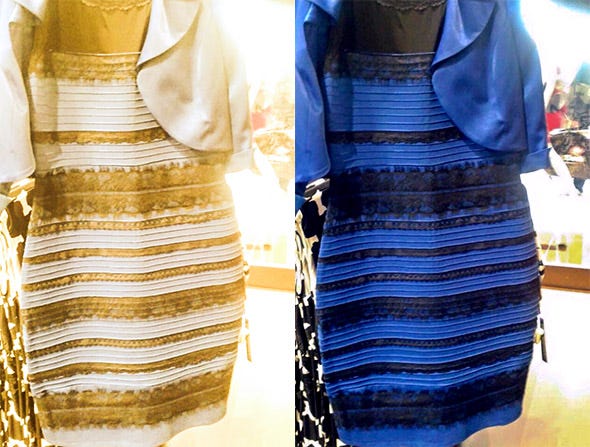
The first time I saw “The Dress,” it appeared white and gold to me. The second time, it appeared black and blue. Then, the colors actually morphed back to white and gold in real-time in my vision.
“The Dress” shows that our beliefs (the dress is blue) are only as good as the tools used to observe, measure, and perceive. To the extent we trust those tools, we place faith in them.
What about socialized beliefs?
I believe stealing is wrong, even if I’m certain of getting away with it because it harms others. Why do I care about others? Because I want to be a caring person. Why? Because I think compassion is moral, and I want to be moral.
Why? Because I was socialized with certain values. Why do I adhere to my socialization? Because I trust that life with those values will be better than life without them, that taking things will result in a worse life than not stealing. I exercise some faith in the value of my values.
Benjamin Cain seems to think that religious people lack any information to support their beliefs, that it’s all wishful thinking, superstition, and indoctrination. That’s a caricature as misleading as the “atheists are bad, unhappy people” trope.
I believe a higher power exists because I place faith in the idea that the Big Bang Singularity didn’t exist ex nihilo, fluctuate on its own, or fine-tune itself.
I study scriptures in their context and understand that Genesis is not literal. I trust that God can create through cosmological and evolutionary processes. I reason that God can’t stop evil. I reason that hell most likely doesn’t exist. I place faith in my personal spiritual experiences and those I’ve observed.
But I don’t know that any higher power exists, no more than any self-respecting scientist will claim to know that one does not exist.
Militant atheism uses scientific knowledge to argue that we should place our faith in the non-scientific claim that nothing exists beyond the material world. Militant atheism insists that it possesses “the Truth” that others need. It is religious fundamentalism.
There’s only thing we can be absolutely, 100% certain about — we can’t be absolutely certain about anything.
Conclusion
When it comes to the divine, none of us know anything with certainty. We’re all making our best guesses based on the evidence available and our trust in the methods of gathering and interpreting said evidence.
We’re all accepting some mystery on faith, whether it’s the mind-boggling nature of the Big Bang or the mind-boggling idea of a higher power.
We’re all exercising some faith in something.
None of us should exercise fundamentalism by asserting our beliefs as absolute truth and insisting everyone should agree with us or else they’re stupid.
Follow me on Medium or sign up for my newsletter.


