
The Faberge Wall
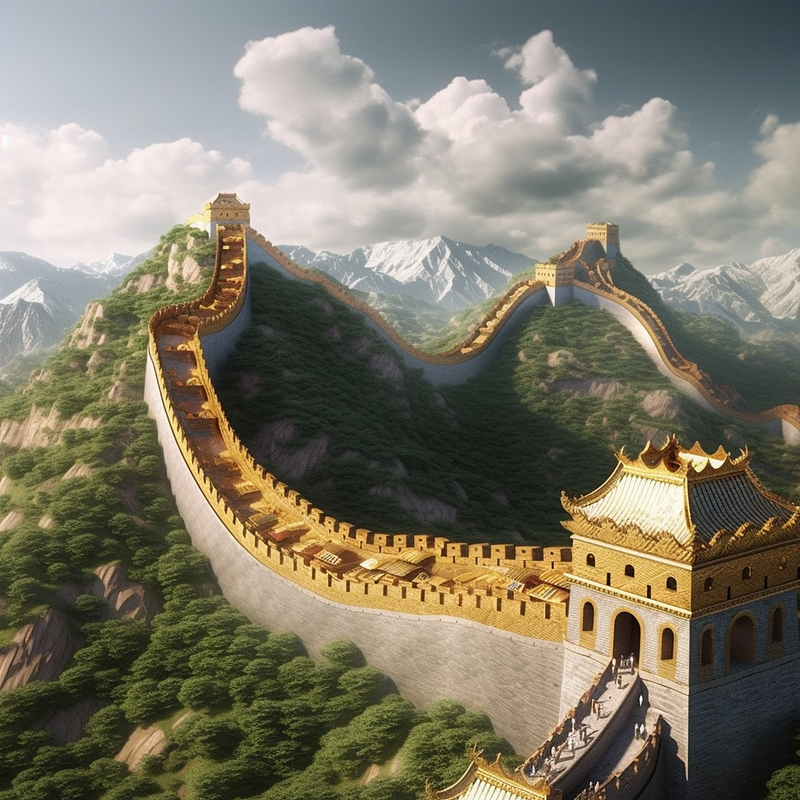
The building of massive walls has a long history. Usually these are used to delineate borders and act as a defensive line. The Great Wall of China is the most famous of these, and it’s quite large and long, although nowhere near large enough to be seen from space. I don’t know why that myth won’t die. They are often symbolic, although many of them also had practical purpose.
Totalitarian states love building walls, because it prevents their own citizens from seeing what life is like on the other side. The Berlin wall is the prime example of this, and together with the state controlled buildings along its length, it was marginally effective at keeping the soviets away from those debutante westerners.
More often, though, walls are built to keep people out, not in. Israel has the West Bank Barrier, meant not so much to prevent the Palestinians from seeing how the Israelis live in relative luxury, but to prevent them from accessing that luxury. The Great Wall of China made it difficult for the nomadic tribes north of the Empire to invade, slowing them down long enough that the Emperor could respond effectively. Hadrian’s wall marked the border between the civilized Romans and the barbaric Picts and Celts, at least from the Roman perspective. It was a checkpoint, even if it was one that was easy to climb over. Rather like the Trump Wall of the US southern border — more symbolic than effective. A great sign in the desert reminding people that “to the north of this wall are a bunch of racist lunatics with guns, better turn back”. Or something like that. Lots of walls to keep people out.
Then there are the walls that don’t work at all. The Maginot line is famous among military historians, and although not really a wall, so to speak, but the opposite of a wall — trenches. A line in the ground that was a reminder to their northern neighbors that “what’s behind this wall is ours, go away”. When the Maginot fortifications had their moment to shine the luster was found lacking, as the Nazis simply went around. The French had not been paying attention in the twenty years between World Wars, and had failed to realize that the world was now more maneuverable and much faster. Fixed fortifications are only useful when the enemy agrees to attack them, and only in the way that the defender wants the enemy to attack.
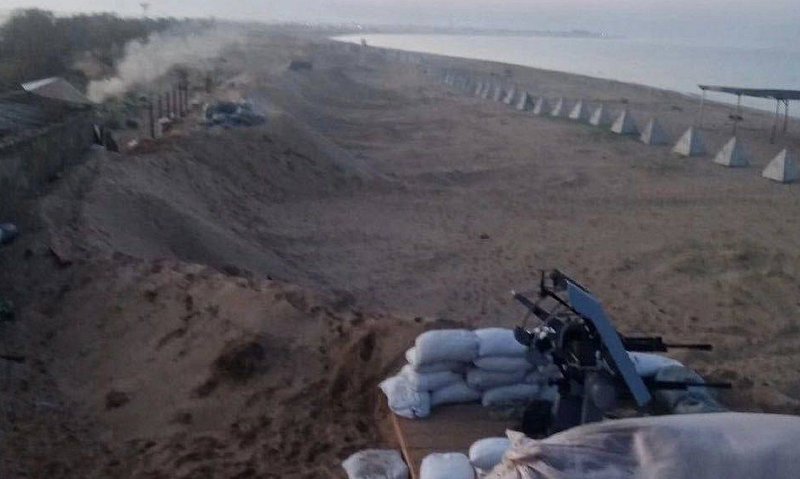
Thus is it with the Faberge Wall that Russia has built for itself in Ukraine. Like the Faberge eggs of 19th and early 20th century jewelry boxes, this wall is very pretty, very impressive, very expensive, but in the end utterly useless.
Crimea
The oddest parts are the fortifications on the beaches of Crimea. Why? For the love of all that is good and right in the world, WHY? Ukraine does not have a navy, and certainly doesn’t have the capability to launch an amphibious assault. What, pray tell, are the Russians thinking? I am confident that this is an artifact of the Russian command structure combined with Russian ingenuity. Russian ingenuity is to find a way to do what you are told without putting yourself in danger. The commanders told the units to build fortifications and prepare for an attack. The units thought to themselves, “well, I could dig a trench along that treeline, and wait for the Ukrainians to attack with their western tanks, or I could build it on the beach and watch the sunset. Those that could get to the beach chose the beach.
The Front
The front line makes a little more sense geographically speaking, at least. Ukraine does in fact have an army, and it will probably attack at some point along this 950km long line. The problems here are … many. First, Russia reportedly has around 140,000 troops in Ukraine right now, along the front line. This isn’t very many, considering how many they have supposedly drafted, which makes me wonder if Ukraine’s count might be a little low, but anyway. 140,000 troops for 950km of trenches. That’s about 150 soldiers per kilometer of trench, or about one soldier every 7 meters. This is nowhere near enough for many reasons.
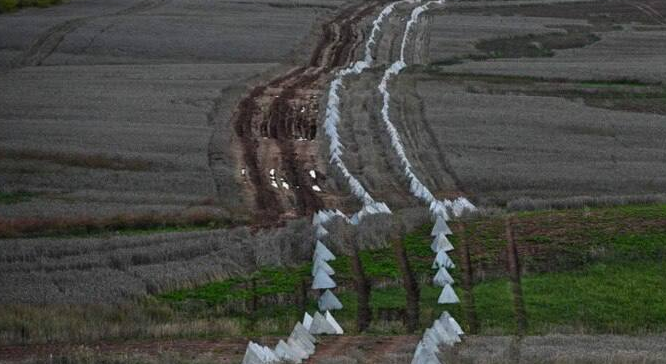
The obstacles that are in place consist of the following general plan. Trench, a double row of “dragon’s teeth”, minefield, a trench, and an anti-tank ditch (a wide, deep trench). Often there will be a natural obstacle built into the defenses as well, like a stream, river, or canal.
Manpower
Russia can’t rotate their men out, so the ones they have will be exhausted. Second, it’s just not enough. An attacking unit will attack over an area of about a kilometer, with another kilometer on either side playing a role as suppressive fire and longer range attacks. That’s only 450 soldiers at most, while an attacking force might consist of a hundred vehicles and a few thousand troops.
Accuracy
One problem with trenches in 2023 that they didn’t have in 1917 is that modern artillery is scary accurate. Like, accurate enough to fall into the trench itself, and fire adjustments are being made by drones hovering above the battlefield, not by officers with binoculars from two kilometers or more away, obscured by smoke, dust, and haze.
Mechanized
Second, Ukraine is highly mechanized now, and not with just the primitive tanks of 1917, but with modern armored vehicles of every size, shape, and configuration. They have bridge layers, mine field clearers, and all manner of training and experience using them. These obstacles are not going to form an effective barrier against modern mechanized maneuvers.
Supplies
Russia can’t get supplies to their trenches. Trench warfare is the purvue of the artillery corps, and artillery requires massive logistics. Shells are heavy, propellant is heavy and subject to environmental degradation, and spare barrels and extra guns are heavy, and Russia doesn’t have the vehicles or the roads to resupply their trench defenses. Ukraine has the long range strike capability, and long range reconnaissance to identify targets that prevents compex logistics by the enemy.
When the attack does come, this Faberge Wall is going to crack and fall quickly, and in many places simultaneously. There is nowhere for the retreating forces to run to, and they would be shot by their own commanders if they tried. Unless, of course, the commanders fled first. There is no escaping the system, though, and there is always another line of “friendlies” to make sure that the line in front of them stands and fights. Makes me almost feel sorry for them. But they do have the choice to surrender, and many of them are taking advantage of that. They should, it’s the safest path.


