
The F-Word, Kids and Movies
I swear a lot. And I mean a real xxxxing lot.
Yet, you’ll notice I didn’t actually fill in the blanks there. Why would someone, who swears constantly and extremely creatively (I’m British and we’ve got some absolute belters), elect NOT to include the actual word in a piece that covers the subject?
Because I’ve always believed there’s a time and place. It’s as simple as that.
Don’t get me wrong, there’s the odd f-word in my blogs, but they’re very rare, appropriate and used for comical effect when no other word seems to work quite as well as a good old fashioned hard-core curse.
But the point is I don’t (usually) swear in front of — or to — my parents, specific coworkers when I used to work in a cubicle based environment and certainly not any employees who worked for me at any of my companies over the years.
To me, it always felt like something you did routinely with your mates and in social situations, and yet as constricting as that may sound, I never had any problem adapting to each situation. In other words, I always seemed to naturally ‘click’ into each mode without even a second thought.
But how does this work with our kids? How is that part of transition to adulthood managed? It’s something I have given a lot of thought to, and have also noticed very different viewpoints from other parents.
I think it comes down to what your objective is. Mine has always been that I consider part of my responsibility as a dad to ensure that my children have a fantastic childhood, full of play, imagination and innocence for as long as possible. This doesn’t mean sheltering them (no topic is off limits and all questions will always receive an honest answer), but it does mean acting as a sort of ‘defender’ of unnecessary ‘adultness.’
They will grow up and become their own people in time of course. They will make their own mistakes, find their own paths, fall off those paths, be idiots, do stuff I disapprove of, struggle with their own demons and do all the other things that we did (and still do) as we try to find our own ‘grown up’ way in life. But my point is that they have their whole lives as adults to deal with all that crap. All of us only get a few blissful years of childhood, and part of being a parent, surely, is ensuring that they get that for as long as they can.
So how do these two worlds of effin and blindin’ and childhood innocence meet?
Well, we joke about it mostly.
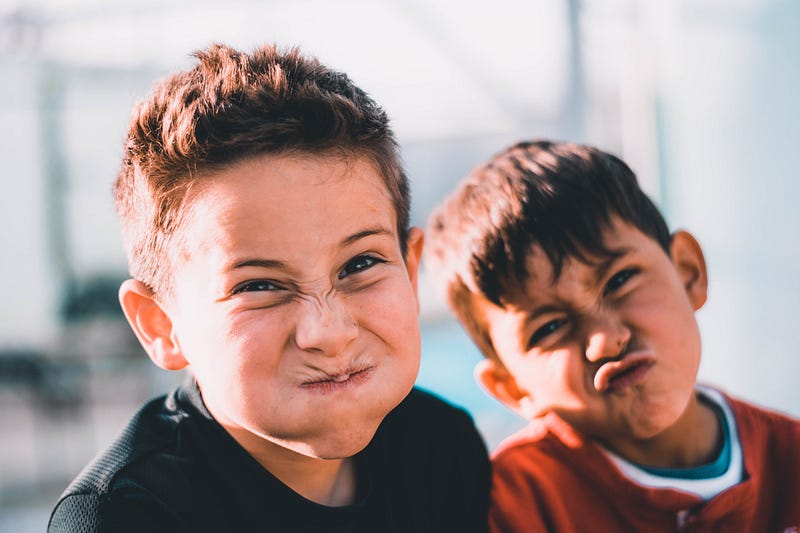
My kids, now 11 and almost 13, are aware of the words — at least most of them — and they are aware than I am aware of that and we talk about it openly. They know how I feel about using language when it’s not appropriate, but at the same time I’ve made it clear that use of these words in general is absolutely fine … but not right now. Just save it for later, you’ve got your whole life to use them.
The thing is, I don’t want them to worry about it, think it’s unnatural or taboo, or something that mustn’t be done ever. And if, when they’re adults, they’re comfortable using language in front of me (not AT me — that’s a different story!) then that’s fine too, subject to appropriateness as usual.
Personally, I think this is more important now than at any time previously. When I grew up — in the seventies — the world was very different, both in terms of attitude and control. Our three TV channels were heavily censored and any movies where bad language was present were overdubbed with sometimes hilarious and poorly fitting alternatives with classics such as:
“Did you (voice tone and background sound changes completely) fun (background sound and voice changes back) my wife?”
There was no internet, no mobiles and, in fact, no outside influence at home that could be exerted beyond my parents’ control. These days that’s not true at all. Not only can you not stop it even if you wanted to, it now seems to be more acceptable for young people to swear, even though I personally don’t agree with it.
And the biggest evidence for this? One simple thing: The changes in movie classification.
I go all ‘old man shouts at TV’ on this point, so I’ll reign it in for you and keep it short.
Why allow the use of a single F-word in a 12A movie? What — exactly — is the point of that? Who decided that one is ok, but two or more isn’t? Here’s a mad idea, why not make it NONE — y’know like it has been for years.
It used to be the case that a single utterance of this word instantly put any movie into the ‘15’ category and rightly so. It sent the message to anyone younger: “yes, we know YOU know all the words anyway, but you’re not old enough to appreciate, enjoy or use them properly yet. Wait until you’re 15.”
Worse, move makers have now taken to using their single use of the F-word in 12A (this is a UK classification similar to the US PG-13) movies as something they must do.
Look at La-La Land, Oblivion or Ready Player One as recent examples that stick in my mind. ALL of them contain a single F-Bomb as permitted, but none of these movies actually needed the word at all to make any particular point and the rest of the movie was perfectly suitable for family viewing with kids around the age of 12. Therefore, what exactly is the point they’re trying to make?
Of course, there’s hundreds of other movies that suffer from the same problem, but I use imdb.com (a site I’ve been a member of since 1997, long before I was even remotely responsible enough to be a father) to double check every movie we watch. And I do. And because I’ve been doing it — and explaining why — since they were tiny, they utterly respect my decision in a way that still astounds me, even when their friends have seen it.
And to this day, we have never had a family squabble or pre-teenage tantrum involving language.
Yet.
I don’t know the point at which it will suddenly be openly acceptable to release these words freely into the family home (after all being a dad is a job you learn as you go) but that day will come.
And that’s OK.
Childhood must end sometime.
Which is a damn xxxxing shame if you ask me.
If you enjoyed this article, you might also like these: