avatarEsteban Thilliez

Free AI web copilot to create summaries, insights and extended knowledge, download it at here

1612

Abstract

sms work in the interest of other organisms. The last three chapters of the book were devoted to this.</p><p id="3ca0">Dawkins says that genes can have an impact beyond the organism, or vehicle, containing them. For example, why do termites spend their lives creating termite mounds when they could be using this energy to reproduce more efficiently? It’s because the termite mound can be seen as an extension/additional organ of the termites, ultimately enhancing their ability to reproduce, even if it’s not in their body. He goes even further, saying that the termite genes could instead be genes for the termite mound, and that termites, in fact, constitute a single genotype shared between several individuals, the genotype of the termite mound, like cells in an organism.</p><p id="3b0a">It also deals with the case of parasites. Indeed, one might wonder how one organism can so successfully manipulate another, as in the case of the fluke and the snail. The fact is that the fluke’s genes, even if contained within its own organism, have an influence on the snail. If we think of the snail as a mere vehicle for genes, it serves to transmit not only snail genes, but also fluke genes. We must therefore distinguish the snail’s genes from the snail itself, and not even call its genes “snail genes” as they benefit to the fluke too.</p><p id="4198">In short, Dawkins explains how genes present in one organism can influence different organisms, just as genes present in different organisms can have common interests and thus make organisms cooperate.</p><p id="e8ea">Dawkins’ point of view is not easy to gr

Options

asp, but as he explains it, it seems perfectly logical, and has the merit of offering us a new perspective on evolution.</p><h2 id="a7a0">To Read or Not to Read</h2><p id="6327">I highly recommend this book to anyone who wants to understand a bit better evolution, but first, you should read “The Selfish Gene” as you need the knowledge of this book to understand the ideas of “The Extended Phenotype”.</p><p id="8689"><b>Thanks for reading! </b>Here are some links that may interest you:</p><ul><li><a href="https://readmedium.com/book-reviews-index-f13ece864538">📕 My books library</a></li><li><a href="https://readmedium.com/about-me-d63607c8c341"><i> Know more about me and my articles</i></a><i>!</i></li><li><a href="https://medium.com/subscribe/@estebanthi">🔔<i> Become an email subscriber</i></a><i>!</i></li><li><a href="https://medium.com/@estebanthi/membership">🤝<i> Support me by subscribing with my referal link</i></a><i>:</i></li></ul><div id="cdcb" class="link-block"> <a href="https://medium.com/@estebanthi/membership"> <div> <div> <h2>Join Medium with my referral link — Esteban Thilliez</h2> <div><h3>Read every story from Esteban Thilliez (and thousands of other writers on Medium). Your membership fee directly…</h3></div> <div><p>medium.com</p></div> </div> <div> <div style="background-image: url(https://miro.readmedium.com/v2/resize:fit:320/0*IoN4BofrwCNWA_bS)"></div> </div> </div> </a> </div></article></body>

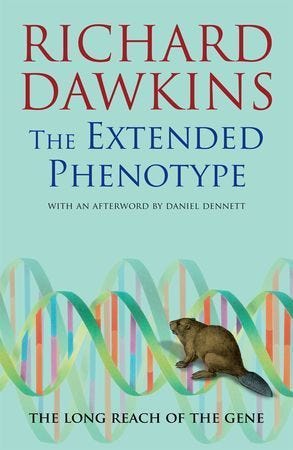
The Extended Phenotype — Richard Dawkins

The Long Reach of the Gene
Quick Summary

“The Extended Phenotype” explores the idea that genes can have effects beyond the physical boundaries of an organism’s body and argues that the phenotypic effects of genes can extend into the environment and influence other organisms.

Dawkins proposes that traits displayed by organisms can be seen as extensions of their genes, and these traits can have an impact on the survival and reproductive success of genes.

My Thoughts

This book follows one of Dawkins’ greatest works: “The Selfish Gene”. I loved this book and the proposed ideas already sounded crazy, but wait until you read “The Extended Phenotype”.

Dawkins is both an exceptional biologist, who knows how to think differently from everyone else, and a master at making us understand his ideas.

According to him, genes are the fundamental unit of natural selection. Any organism is just a vehicle in order to pass them down and preserve them. Genes don’t care about the survival of organisms, they care only about their survival. This leads to a situation where all individuals should be selfish. This idea was detailed in “The Selfish Gene” and reexplained in the first part of “The Extended Phenotype”.

However, we have to explain why some organisms work in the interest of other organisms. The last three chapters of the book were devoted to this.

Dawkins says that genes can have an impact beyond the organism, or vehicle, containing them. For example, why do termites spend their lives creating termite mounds when they could be using this energy to reproduce more efficiently? It’s because the termite mound can be seen as an extension/additional organ of the termites, ultimately enhancing their ability to reproduce, even if it’s not in their body. He goes even further, saying that the termite genes could instead be genes for the termite mound, and that termites, in fact, constitute a single genotype shared between several individuals, the genotype of the termite mound, like cells in an organism.

It also deals with the case of parasites. Indeed, one might wonder how one organism can so successfully manipulate another, as in the case of the fluke and the snail. The fact is that the fluke’s genes, even if contained within its own organism, have an influence on the snail. If we think of the snail as a mere vehicle for genes, it serves to transmit not only snail genes, but also fluke genes. We must therefore distinguish the snail’s genes from the snail itself, and not even call its genes “snail genes” as they benefit to the fluke too.

In short, Dawkins explains how genes present in one organism can influence different organisms, just as genes present in different organisms can have common interests and thus make organisms cooperate.

Dawkins’ point of view is not easy to grasp, but as he explains it, it seems perfectly logical, and has the merit of offering us a new perspective on evolution.

To Read or Not to Read

I highly recommend this book to anyone who wants to understand a bit better evolution, but first, you should read “The Selfish Gene” as you need the knowledge of this book to understand the ideas of “The Extended Phenotype”.

Thanks for reading! Here are some links that may interest you:

Books
Book Review
Reading
Biology
Science
Recommended from ReadMedium