
The expanding ecosystem of the FAAMGs
The Five Big Techs have maintained their hegemony over the years with their high-profile acquisitions
Tech powerhouses of Facebook, Amazon, Apple, Microsoft & Google (FAAMG) have kept the innovation spirit alive. With a market cap of well over $4.4 trillion, the massive financial weight of these companies has enabled them to maintain a firm grip on the tech as well as the business scene.
We will be looking at some of the biggest acquisitions of these Tech powerhouses which extended their influence beyond their niche markets. In total, Google’s parent company Alphabet has the lead with 236 acquisitions followed by Microsoft (225), Apple (109), Amazon (85) & Facebook (79).
Not all these acquisitions have been successful, however, while some have extended the reach of these big techs, others have failed to give them any traction. The infographics below look at the individual acquisitions of these Big techs & how they fared.
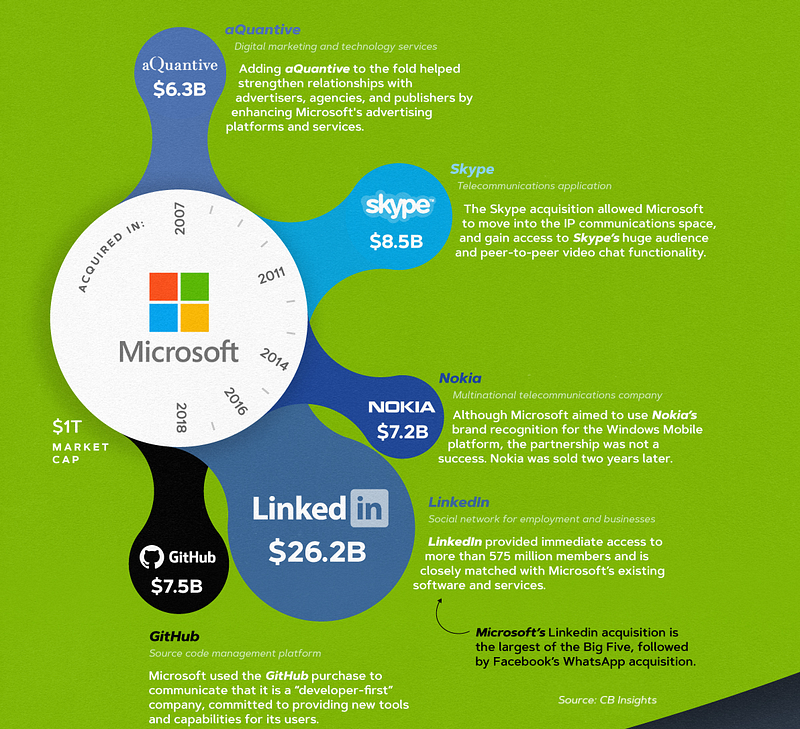
Microsoft is one of the oldest & most popular software companies which has ruled the Personal Computers with its trademark Windows operating system over the years. It’s biggest acquisitions have come in the last decade or so as it began to move out of its niche to be a part of the broader internet economy. Here are the top 5 companies it acquired:
- LinkedIn — $26.2 billion, Social Media (2016)
- Skype — $8.5 billion, Telecommunications (2011)
- GitHub — $7.5 billion, Software (2018)
- Nokia — $7.2 billion, Telecommunications (2014)
- aQuantive — $6.3 billion, Marketing (2007)
The most important & noteworthy acquisition was of LinkedIn for $26.2 billion — giving Microsoft access to a professional networking platform with a huge user base of 575 million members. However, acquiring the Finish telecom giant of Nokia turned out to be a disaster for the software giant.
The $7.2 billion buyout of Nokia’s Nokia’s Devices & Services business seemed like a good decision at the time with the company commanding 41% share of the global handset market. Microsoft sold the business for a paltry $350 million two years later shifting the focus back on a narrow niche market.
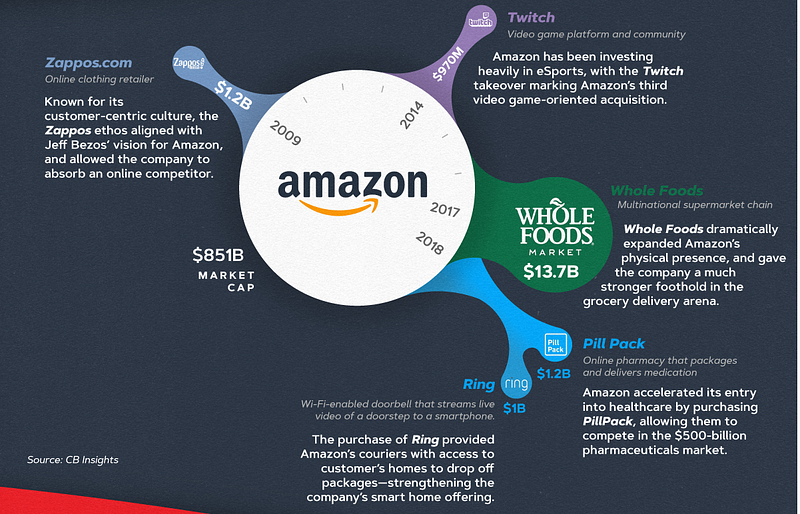
The e-commerce giant has been on a buying spree for the past couple of years — 2017 alone saw the company close deals for $20 billion. Amazon has been spreading its wings far & wide, strengthening its presence in people’s homes with smart devices like Alexa & Ring, etc. The top 5 acquisitions for Amazon were as follows:
- Whole Foods — $13.7 billion, Retail (2017)
- Zappos — $1.2 billion, Retail, (2009)
- Ring — $1.2 billion, Technology, (2018)
- PillPack — $1 billion, Pharmaceuticals, (2018)
- Twitch — $970 million, Social Media, (2014)
To extend its home offerings, the most important acquisition from Amazon was that of Whole Foods for $13.7 billion, in an attempt to provide an ‘All under one roof’ experience to its customers. To allure the customers, Amazon started offering discounts to its prime members when they shopped at Whole Foods.
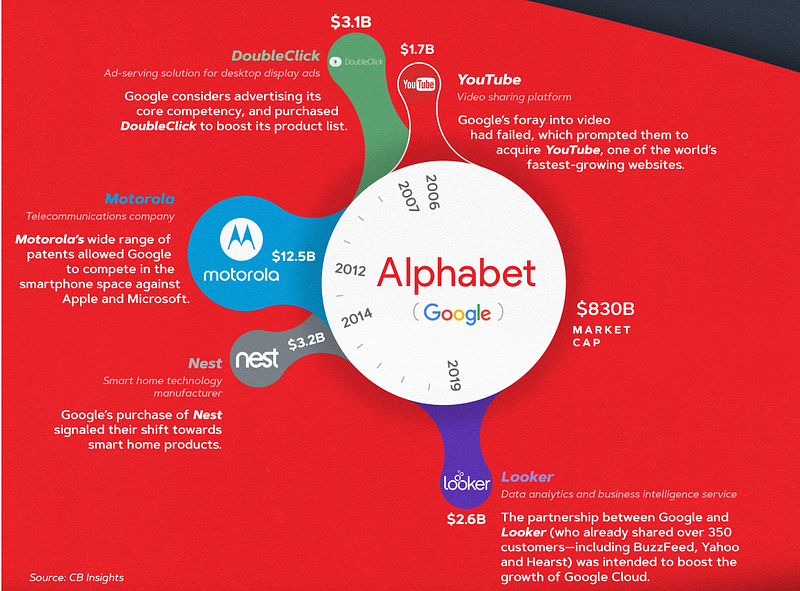
From its humble beginnings as a basic search engine to a household name two decades later, Google has seen an astronomical rise as it devised a whole ecosystem around its search engine niche. Google continues to expand while building a simple organizational structure. Here are the top 5 businesses that Alphabet (Google’s parent company) has devoured on its way up:
- Motorola — $12.5 billion, Telecommunications (2012)
- Nest — $3.2 billion, Technology (2014)
- DoubleClick — $3.1 billion, Marketing (2007)
- Looker — $2.6 billion, Software (2019)
- YouTube — $1.7 billion, Social Media (2006)
Alphabet suffered a similar fate to Microsoft’s high profile acquisition in the telecom sector. The deal to buy Motorola for $3.2 billion proved unprofitable as the company sold off the business for less than $3 billion two years after its acquisition.
Buying the Popular video streaming platform YouTube has been a big feather in its cap, as it gained more than a billion users and a growing & strong presence of the social media platform.
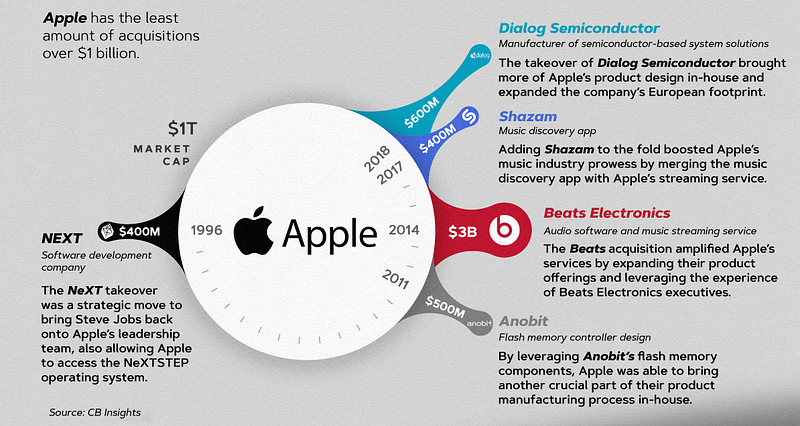
The original smartphone giant has seen the fewest acquisitions above the $1 billion mark. As the smartphone market becomes more competitive & saturated, the Cupertino tech giant is shifting its focus to the service side of the business, focusing on music streaming. Here are the top 5 companies Apple acquired over the years:
- Beats Electronics — $3 billion, Music (2014)
- Dialog Semiconductor — $600 million, Manufacturing (2018)
- Anobit — $500 million, Manufacturing (2011)
- Shazam — $400 million, Music (2017)
- NeXT Computer — $400 million, Technology (1996)
Apple’s push towards music streaming business is evident from its biggest $3 billion acquisition of Beats in 2014 followed by Shazam for $400 million in 2017. Apple seems to be moving closer to building all its devices in-house with the recent announcement of acquiring the majority of Intel’s smartphone modem business.
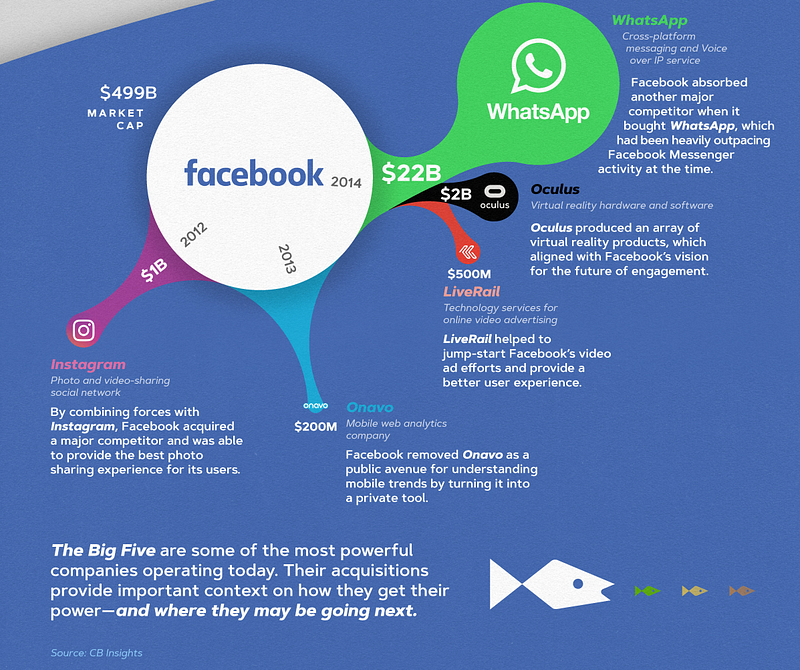
The social media giant has been the least active when it comes to acquiring companies. Apart from wallopping the competition, FB is setting foot in external ventures not related to its market niche — Virtual Reality & Mind-reading devices are a couple of examples. Here is a list of Top 5 companies FB acquired:
- WhatsApp — $22 billion, Social Media (2014)
- Oculus — $2 billion, Technology (2014)
- Instagram — $1 billion, Social Media (2012)
- LiveRail — $500 million, Marketing (2014)
- Onavo — $200 million, Analytics (2013)
WhatsApp acquisition for $22 billion was the second-highest amount paid by any of the big techs for any deal, second only to Microsoft’s LinkedIn acquisition. Over 1 billion users of both Instagram & WhatsApp have given Facebook a unique edge — giving access to the younger demographic with the former & messaging platform prowess with the latter.
Do all these acquisitions by the Big techs exhibit an effort to extend their corporate prowess or to provide the fuel for the next cycle of growth… Maybe both?