
The Existence of God as Professed by the Nobel Laureates
Is God real or myth?
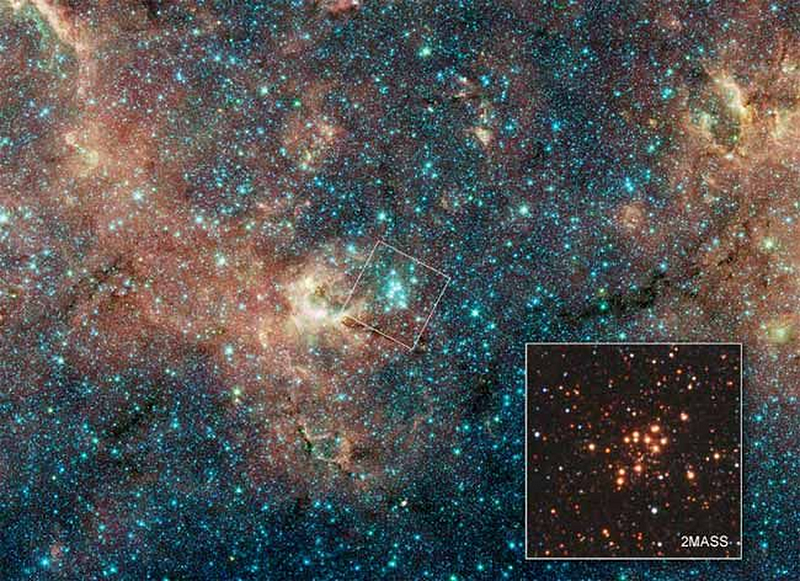
The Spitzer Space Telescope shows ‘The stellar firework’, the region in the Scutum constellation where a massive star cluster containing red supergiants (inset) was discovered [1].
The concept of God:
Theists believe God is immortal. He is omnibenevolent (super benevolent), Omnificent (super creator), omniscient (Super awareness), omnipotent (Super powerful)….. The scales of his qualities are enormous, in astronomical units.
Human quest is never-ending. The pursuit of the ancient zeal to realize the mysteries of our life in the universe continues with equal vigor to date.
Who are we and why are we here, born and die? What is the purpose of our lives and around us? Several subtle natural observations intrigued the human mind like day, night, seasons, clouds, rain, thunder, lightning, earthquakes, eclipses, etc…
Humans have gazed with astonishment and reverence at the celestial events, stars, wondering what they are, why do they appear in dark and how many are in the sky?
Human aptitude demands to unravel the observed and concealed mysteries around their life.

https://pixabay.com/illustrations/dna-analysis-research-3539309/
The microscopic DNA (Deoxyribonucleic acid) is a molecule in every cell of life that contains our unique genetic code. Molecular biologists have been stunned by the intricately sophisticated coding within DNA. What does the DNA coding reveal and who designed it?
The existence of God has been a subject of intellectual conversation in cultural, empirical, logical, metaphysical, philosophical, religious and scientific debates.
Nobody has seen the god. So to prove or disprove is not possible.
If a question is asked in a crowd, do you believe in God? Some people will say ‘yes’ God exists would imply theism, and some will say ‘no’ means atheism, and some will say ‘don’t know or I’m not sure’ would imply agnosticism …
Let us talk of Theist: Belief in the existence of God may arise based on the religion, culture, practiced by those dear to us or from divine experience that has touched the lives of the believer.
Atheists: Atheists are on the opposite side of theists.
Agnostics: Agnosticism is the view that the existence of God, the divine, or the supernatural is not known or knowable with any certainty.
Since the subject involves deep thinking, I thought to check how the scientific minds have perceived God? Some of the outstanding physicists selected are from the beginning of the 20th century (because physics is my favorite subject*).
In the 20th century, science and development have attained progress that was never seen in the past allowing us to learn many aspects of the creation of the universe than known earlier.
What is more notable is, the last decades have introduced new hypotheses, theories, techniques, space research from micro to astronomical scale, to understand the life and nature of the universe.
For the above-said reasons, the earlier scientists who were strong theists like Galileo Galilei (1564–1642), Isaac Newton (1643–1727), Gregor Mendel (1822–1884), etc. who made fascinating and fundamental inventions are not included in this discussion. In addition, during their period, religion was prominent and one could argue, they were biased towards religion.
According to Wikipedia, a review of 100 years of Nobel Laureates between 1901 to 2000 reveals that the winners have identified as Christians or had a Christian background; 78.3% in Peace, 72.5% in Chemistry, 65.3% in Physics, 62% in Medicine, 54% in Economics, etc…
Some of the famous Physicists (limited to 5) were theists [2].
1. Joseph John Thomson (1856–1940): English, 1906 Nobel prize in Physics, credited with the discovery and identification of the electron; and with the discovery of the first subatomic particle.
2. Guglielmo Giovanni Maria Marconi (1874–1937): Italian, 1909 Nobel Prize in Physics with Karl Ferdinand Braun “in recognition of their contributions to the development of wireless telegraphy.
3. Wilhelm Röntgen (1845–1923): German, 1901 Nobel Prize in Physics. He produced and detected electromagnetic radiation in a wavelength range known as X-rays or Röntgen rays.
4. Robert Millikan (1868–1953): American, 1923 Nobel Prize in Physics for his study of the elementary electronic charge and the photoelectric effect. He wrote about the reconciliation of science and religion in ‘Evolution in Science and Religion’.
5. Hideki Yukawa (1907- 1981): Japanese, 1949 Nobel prize for Physics for research on the theory of elementary particles.
In his view, natural forces could reasonably be viewed as a somewhat random product of chance or pure contingency in mathematical terms, similar to Hindu and Buddhist notions of karma.
These scientists did not go in search of God but derived/associated/sensed the existence of God during their mission. The proof of God’s existence follows the same logical structure as proofs in science.
The laws of physics are the same as the laws of the universe since the universe is filled with matter. A recent study on Quasar revealed that billions of lightyears away the laws of physics are different from the ones on Earth [3].
How can our universe emerge from a singularity (a point of infinite energy and mass) 13.7 billion years ago as postulated in the Big Bang? If, space and time did not exist before that event, how did the big bang happen? How can the universe begin where the laws of the universe break down?
Some of the famous Physicists (limited to 5) were atheists [4].
- Niels Bohr (1885–1962): Danish, 1922 Nobel Prize in Physics. 1. His foundational contributions are to understanding atomic structure and quantum mechanics.
- Louis de Broglie (1892–1987): French physicist, 1929 Nobel Prize for Physics. He made groundbreaking contributions to quantum theory.
- Erwin Schrödinger (1887 –1961). Austrian, 1933 Nobel Prize in Physics (jointly with Paul Adrien Maurice Dirac). He developed several fundamental results in quantum theory.
- Subrahmanyan Chandrasekhar (1910–1995): Indian-American, 1983 Nobel Prize in Physics. He is known for his theoretical work in astrophysics on the structure and evolution of stars.
- Peter Higgs (1929-): British, 2013 Nobel Prize in Physics (jointly with François Englert) for discovering the Higgs boson the theoretical discovery of the mechanism that explains how the universe’s elementary particles obtained their mass shortly after the Big Bang.
The discussion on atheism is incomplete without the comment on God by the recent well-known physicist Stephen Hawking (1942–2018). A British theoretical physicist, cosmologist, author, etc.
According to him; One can’t prove that God doesn’t exist. But science makes God unnecessary. The laws of physics can explain the universe without the need for a creator. I believe the simplest explanation is, there is no God. No one created the universe and no one directs our fate [5].
Referring to Hawking, Pope Benedict XVI said, “Scientists did not create the universe; they learn about it and attempt to imitate it.”
Some of the famous Physicists (limited to 5) were agnostics [6].
- Albert Einstein (1879–1955): American, 1921 Nobel Prize in Physics for his contribution to photoelectric effect.
- C.V. Raman ( 1888–1970): Indian-American, 1930 Nobel Prize in Physics for the discovery of the “Raman Effect” which has its use in chemistry to provide a structural fingerprint by which molecules can be identified.
- Enrico Fermi (1901–1954): Italian-American, 1938 Nobel Prize in Physics. He is known for the development of the first nuclear reactor and his contributions to the development of quantum theory and nuclear physics.
- Marie Salomea Skłodowska Curie (1867–1934): Polish-French, 1903 Nobel prize in Physics (jointly with Pierre Currie and Becquerel) for their work on spontaneous radioactivity. She also won in 1911 for the 2nd time in Chemistry for the discovery of the elements radium and polonium leading to treatment of cancer.
- Eugene Wigner (1902–1995): Hungarian, 1963 Nobel Prize in Physics for his contributions to the theory of the atomic nucleus and the elementary particles.
Einstein commented on God: We see a universe marvelously arranged, obeying certain laws, but we understand the laws only dimly. Our limited minds cannot grasp the mysterious force that sways the constellations.
We too are divided in our opinion about the existence of God.
If you are a Theist, go ahead with your belief. God is your mentor, he helps you in your need, guides you, etc. Such belief gives strength in disguise. In your troubled time, you are not alone.
If you are Atheist/Agnostic, move with your belief.
Some experiences in life shift our opinion from one belief to another.
Now, I’m a theist who changed from being a strong atheist. Life taught me, I have a divine mentor, God.
However, I can’t understand why thousands of devotees while praying to God as the protector are killed……
If God exists, why is still evil alive? This is a debate in itself.
On December 18, 2021, the world’s most complex infrared telescope “The James Webb Space Telescope” with a price tag of $10 Billion is expected to be launched from French Guiana (www.webb.nasa.gov).
JWST is expected to discover planets that have potential life. It’s also capable of observing the earliest stars and galaxies that were formed during the Big Bang over 13 billion years ago. So more exciting scientific discoveries and results are anticipated soon.
In conclusion, the progress of science in every faculty is accelerating beyond our imagination.
Based on the present knowledge, let us conclude,
We do not know whether proof for the existence/nonexistence of God is possible.
Ultimately, God is a matter of faith requiring no proof.
Whatever belief one opts for, To be a true human being at peace with self and the surroundings, Wrapped with compassion, dedication, generosity, loving, loyal, selflessness etc.
Makes everyone a loving person……
Views are personal. Thanks for reading Tara Desai
Recently I read several excellent articles on consciousness, God, karma, spirituality, and related topics which inspired me to embark on the topic. I thank the authors notably;
Adan Mendez Adan Mendez, Alireza Zare Alireza Zare, Alberto García 🚀🚀🚀 Alberto García 🚀🚀🚀, Alex Godley Alex Godley, Amy Marley Amy Marley, Anthi Psomiadou Anthi Psomiadou, B.R. Shenoy, Dan J Dan J, Dan Foster Dan Foster, Darrin Atkins Darrin Atkins, David Gerken David Gerken, David Rudder David Rudder, Dr Mehmet Yildiz Dr Mehmet Yildiz, Edy Nathan Edy Nathan,Gurpreet Dhariwal Gurpreet Dhariwal, Glenn Stok Glenn Stok, Haiku Poetry Haiku Poetry, Hollie Petit, Ph.D. Hollie Petit, Ph.D., James Raven James Raven, Jenine Bsharah Baines Jenine Bsharah Baines, Jodie Helm Jodie Helm, Abhishek katare Abhishek katare, L.A. Justice L.A. Justice ,Denise Larkin, Lanu Pitan Lanu Pitan, Marcus Marcus, Marine Dondy Marine Dondy, nandkishore Nandkishor Shingne ,Rebecca Romanelli Rebecca Romanelli, Ruchi Thalwal Ruchi Thalwal, Sahil Patel Sahil Patel, Shameem Anwar Shameem Anwar, Terry Terry Mansfield, Thief Thief, Upasana Sharma Upasana Sharma, Varun Jain Varun Jain, warren Brown Warren Brown, Yana Bostongirl Yana Bostongirl,
References:
[1]. https://www.space.com/1955-source-space-fireworks-discovered.html
[2]. https://www.famousscientists.org/25-famous-scientists-who-believed-in-god/
[4]. https://en.wikipedia.org/wiki/List_of_atheists_in_science_and_technology
[6]. https://www.wondersofphysics.com/2019/11/famous-agnostics-in-physics.html