
The Exceptional World-Class Statesman
International Media Tributes to Lee Kuan Yew
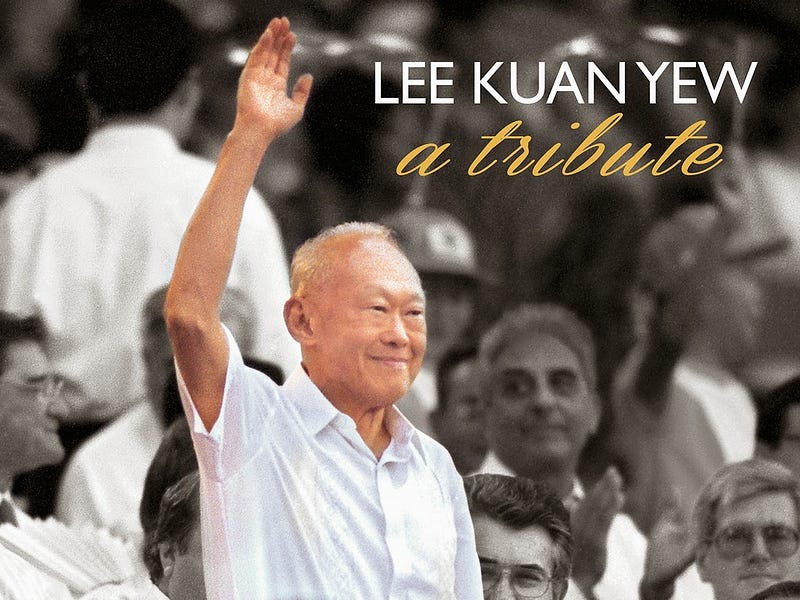
Lee Kuan Yew died on 23 March 2015 at 91 years old. A week-long mourning period (23–29 March 2015) was declared, and I celebrate today again his remembrance during this “Lee Kuan Yew Week”, with his Obituary on 23 March 2022.
For over 60 years, Lee Kuan Yew influenced, shaped, and molded my life through the social, political, and economic transformation of a Third World Singapore into the “First World” nation par none; characterized by economic prosperity, law and order, national security, housing for all, world-class education and full employment with social justice. He was my Prime Minister from 1959 to 1990, stayed in the government as Minister Mentor till 2011, and was thereafter appointed Senior Advisor to the Government of Singapore Investment Corporation.
As the sun arose to awake the world to the passing of its greatest exceptional Statesman 7 years ago, many news media paid their respect to Lee Kuan Yew in their publications.
The following are 9 selections of the foreign media on Lee’s death, mourning the loss not just to Singapore and Singaporeans, but to the entire world of the most exceptional world-class statesman of the 20th century.
(1) The New York Times — Lee Kuan Yew, Founding Father and First Premier of Singapore, Dies at 91
The nation reflected the man: efficient, unsentimental, incorrupt, inventive, forward-looking and pragmatic. “We are ideology-free,” Mr. Lee said in an interview with The New York Times in 2007, stating what had become, in effect, Singapore’s ideology. “Does it work? If it works, let’s try it. If it’s fine, let’s continue it. If it doesn’t work, toss it out, try another one.” The formula succeeded, and Singapore became an international business and financial center admired for its efficiency and low level of corruption
(2) Foreign Policy — Long Live Lee Kuan Yew’s Lion City
Lee was stubborn, but not afraid to change course. From socialism to libertarianism, he flip-flopped pragmatically until the country found a model that works: a freewheeling nanny state. He believed that one cannot be afraid of contradictions in a complex world. “I always tried to be correct, not politically correct,” goes another of his memorable aphorisms. Even if Lee found it hard to let go of power — first to Goh Chok Tong, who served as prime minister from 1990 to 2004, and then to Goh’s replacement (and Lee’s son), current prime minister Lee Hsien Loong — he would prefer the world focus on this system rather than himself. Indeed, it only mattered whether you think Lee was a strongman or a visionary (or both) while he was alive. Now the yardstick is not personality but institutions. Lee Kuan Yew-ism, not Lee Kuan Yew. This is why the 21st century belongs to him more than to icons of Western democracy like Thomas Jefferson or even Jean Monnet, the founding father of the European Union.
(3) The Guardian — Lee Kuan Yew obituary
Lee has been described as many things. To Chinese, particularly during his days fighting Chinese chauvinism in the name of a multiracial Singapore identity, the Cambridge-educated lawyer brought up to believe in English education if not in British institutions, Lee was a “banana” — yellow on the outside, white inside. However, later in life, as Chinese identity and Confucian attitudes emphasising education, discipline and hierarchy became more important, he would be criticised for presenting himself as a fount of wisdom, a convincing articulator of modern Asia to western audiences, while actually behaving with all the intolerance of a Chinese emperor. At his worst, he could combine imperial hauteur with extraordinarily petty spite, relishing the destruction of irritating but unthreatening critics. At his best, he had an incisive mind and clear political judgment. For an avowed elitist, he had a remarkable ability to talk to a crowd.
(4) The Economist — Commander of his stage
In some ways, Mr Lee was a bit of a crank. Among a number of 20th-century luminaries asked by the Wall Street Journal in 1999 to pick the most influential invention of the millennium, he alone shunned the printing press, electricity, the internal combustion engine and the internet and chose the air-conditioner. He explained that, before air-con, people living in the tropics were at a disadvantage because the heat and humidity damaged the quality of their work. Now, they “need no longer lag behind”. Cherian George, a journalist and scholar, spotted in this a metaphor for Mr Lee’s style of government, and wrote one of the best books about it: “The air-conditioned nation: Essays on the politics of comfort and control”. Mr Lee made Singapore comfortable, but was careful to keep control of the thermostat. Singaporeans, seeing their island transform itself and modernise, seemed to accept this. But in 2011 the PAP did worse than ever in a general election (just 60% of the vote and 93% of the seats!). Many thought change would have to come, and that the structure Mr Lee had built was unsuitable for the age of Facebook and the burgeoning of networks which it can no longer control. They began to chafe at the restrictions on their lives, seemingly no longer so convinced of Singapore’s fragility, and less afraid of the consequences of criticising the government.
(5) BBC — Singapore’s founding father Lee Kuan Yew dies at 91
The city-state’s prime minister for 31 years, he was widely respected as the architect of Singapore’s prosperity. But he was criticised for his iron grip on power. Under him freedom of speech was tightly restricted and political opponents were (purportedly but unproven) targeted by the courts.
(6) The Wall Street Journal — Singapore Prepares for World Without Lee Kuan Yew
Under the younger Mr. Lee (Hsien Loong), who took office in 2004, the government has attempted to shake off Singapore’s fusty image and rebrand it as a cosmopolitan center for culture and commerce. It recently started introducing higher taxes on the wealthy and greater welfare spending, part of a longer-term push to remold the country’s economy and adjust to changing social demands. “With profound changes in Singapore’s economic context and a more plural political environment, some of Lee Kuan Yew’s policy ideas and style may have become less relevant,” said Yeoh Lam Keong, an economist and adjunct professor at the Lee Kuan Yew School of Public Policy.
(7) CNN — Lee Kuan Yew: Modern Singapore’s founding father, dead at 91
While Lee has been lauded for his economic accomplishments, he also created a Singapore bound by stringent laws and regulations that dictated most, if not all, aspects of society — including media and political freedoms, censorship and even the selling of chewing gum. The country ranks 150th in Reporters Without Borders’ 2014 Media Freedom Index, putting it just above the Democratic Republic of Congo, Mexico and Iraq. The New York Times, The Economist, the International Herald Tribune and the Asian Wall Street Journal have all been targeted with the “judicial harassment” employed by the Lee family, according to the media watchdog.
(8) The Washington Post — Lee Kuan Yew, who led Singapore into prosperity over 30-year rule, dies at 91
Critics also charged that Mr. Lee’s administration permitted detention without charge or trial, censored the press, harassed political opponents and turned a blind eye to police mistreatment of suspects. Some Singaporeans complained that the avowedly “paternalistic” government treated them like children, forbidding private citizens to own home satellite dishes, fining and humiliating people caught failing to flush public toilets, and even imposing a nationwide ban on chewing gum. When a BBC reporter once suggested to him that allowing people to chew gum could help spur creativity, Mr. Lee retorted: “If you can’t think because you can’t chew, try a banana.”
(9) Time — Singapore’s Lee Kuan Yew Made Modern Asia
But that didn’t mean that Lee Kuan Yew was stuck in the past. In fact, during (our) interview he offered up his views on some of the most newsworthy issues of the day, from the rise of China to the threat of radical Islam. And though he admitted some faults — he should have fostered free enterprise more, he said — he was defiant in the face of other criticisms: “I’m not guided by what Human Rights Watch says. I am not interested in ratings by Freedom House or whatever. At the end of the day, is Singapore society better or worse off? That’s the test. What are the indicators of a well-governed society? Look at the humanities index in last week’s Economist, we’re right on top,” he told TIME.
Please enjoy my recent Articles.
You can also subscribe to my stories and social media posts via your email. Enjoy more interesting Articles by signing up to Medium here: https://thefuturistoracle.medium.com/membership


