
The Exact Moment Stephen King Realized He Was No Longer Poor
The real-life story of how a horror novelist ascended above his meager existence.

I’m not an emotional guy — but there’s a moment from Stephen King’s life that punches me right in the gut.
Within a split second, the struggling writer realized, “This changes everything. Our lives will never be the same.” He’d saved his family from squeaking by in life.
It was the early 1970s
Long before King became a ~$400 million net worth superstar, he was just another wannabe writer.
King had a family to support and struggled to make ends meet. He worked as a high school English teacher and scraped together the energy to write at night.
King earned small commissions selling horror stories to magazines. He sold The Glass Floor for $35 in 1967 and other commissioned pieces for $25-$40 when he could. His family faced huge financial pressure. The side hustle paid off in a big way.
For example, when his daughter Naomi was born, he and Tabitha (his wife) were short on cash. When Naomi got an ear infection, Tabitha turned to him, and smiled, “Can you think of another monster?” It was her way of telling him to crank out another commission.
The big moment that changed everything
King was agonizing through a draft of his first book, Carrie.
It was about a teenager who is bullied relentlessly. She finally snaps after classmates dump pig blood on her after she wins prom queen (a title which was planned as part of the prank). She unleashes her telekinetic powers, setting the building on fire, trapping her classmates inside, killing 73.
Most of King’s horror novels are inspired by something he saw in real life. Pennywise (from IT) was inspired by Ronald McDonald. Carrie was inspired by a strange girl from his high school who was bullied and a story he read about telekinesis.
The book nearly got deleted
At one point, King was so distraught with the state of his Carrie draft that he set the manuscript on fire and put it in the trash.
His wife was cleaning the house when she found the partially scorched Carrie manuscript. She read it over and brought it back to him, saying “You should stick with this. There’s something there.”
King finally put together enough of a sample and got a $2500 advance from his publisher.
His wife was thrilled and asked if he should consider quitting teaching. It wasn’t a possibility at that point. They were barely getting by on his salary and he couldn’t risk losing a stable paycheck.
King chipped away at the story and continued teaching, frustrated with difficult students. His children were small and a complete handful at home, full of energy and raising hell. His mother was sick and starting to show signs of cancer. She also had limited healthcare coverage. He was feeling the pressure to write.
King would be paid based on what his publisher, Doubleday, got for Carrie’s republishing rights to a big distributor (to book stores).
His wife asked, “How much could you get?”
King said, “If it goes great? Between $10,000 and $60,000.” He reminded her that he’d need to split half with his publisher. This completely stunned her because he only made $7500 a year teaching.
He finally submitted his finished manuscript:
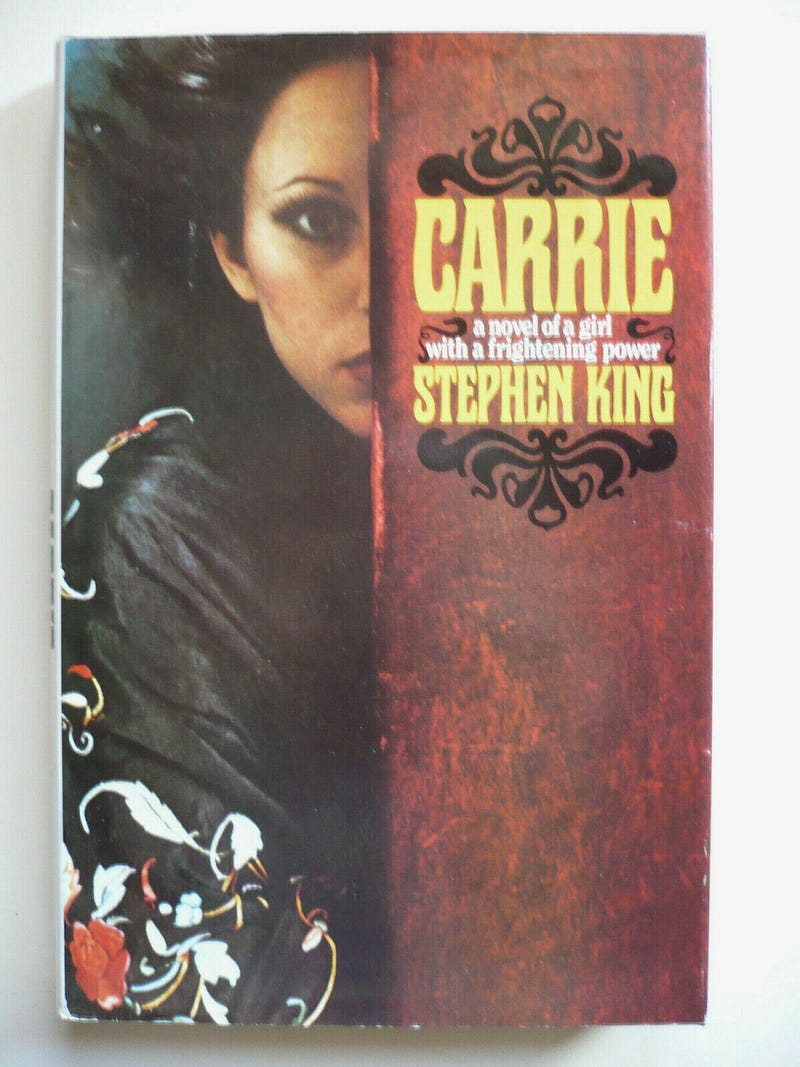
King went back to his teaching job. A few months later, he got a call over the intercom to go to the principal’s office. Someone was on the phone.
It was his agent. He told King the rights to Carrie had been sold for $400,000. It guaranteed him $200,000 — which was more than 25 years' worth of teacher pay.
And of course, per the strange laws of the universe, King couldn’t get ahold of his wife all day to give her the news.
Finally, he got home. She was gone. He was jittery so he went for a walk.
When he came back she was in the kitchen. He took her by the shoulders and told her the news. Her face was blank so he said it again.
She looked over his shoulder at their crap apartment — then began to cry.
The book wasn’t an immediate success because the original Jaws novel was released 2 months prior which sucked the air out of the market.
However, the subsequent Carrie movie became a smash hit at the box office, raking in $33 million (over $150 million in today’s dollars) on a $1.8 million budget. The movie launched King’s books to massive sales, kicking the door wider for King to quit his job and write more hit novels.
King’s moment in the kitchen with his wife hit home: It reminded me of my experience with my partner Laura.
I’d gone through a huge career change, walking away from a safe finance career to become a professional writer. I’d said, “I’ll give this six months. If it doesn’t work out, I’ll go back to finance.”
I’ve failed so hard at so many things and been left heartbroken. I was terrified that I’d let myself down again and disappoint people, and have other people saying, “Told ya so. Shouldna quit your job.”
It was the opposite. Every two weeks, some big thing fell out of the sky and into my lap. I was pacing in my house, excited, praying that Laura would answer the phone.
I’d get her on the phone and say, “You won’t believe what just happened.” Great projects and commissions kept coming through. I didn’t feel deserving. Everything was going my way.
And I got to share it with the one person who believed in me the entire time, the person who’d been loyal and encouraging.
There’s a level of failure with any new endeavor that we need to push through. However, when the dominos all keep falling in the right direction, that is fate telling you that you’re on the right path.
I hope each of you experiences these homerun career moments. The best part isn’t just the elation you feel. It’s being able to share it with the most important person in your life. You’ve won security (for a time). You’ve extended your dream a little longer.
Source/Further Reading: “On Writing” by Stephen King