
The Evolution Of An Airline
The Delta Air Lines story as told through route maps
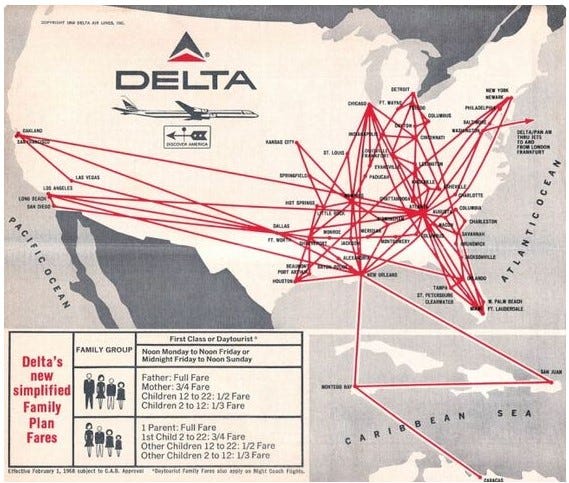
Today, kids, we’re going to talk about one of my favorite subjects — airlines! This might bore some of you to tears, but I find it quite fascinating. And it’s mostly pictures!
You might find it interesting, too, if you’ve ever wondered why there’s not much of choice in airlines when the flight attendant says, “we know you have a choice of airlines when you fly!”
There once were probably 25–30 smaller airlines plying the U.S. skies in the 1960s. I’ve never stopped to count, but that might be a fun thing to do sometime. For me, anyway.
Airlines have ancestries too. For now, we’re going to look at how Delta became the behemoth that it is today through route maps of the airlines it swallowed…er, acquired, or merged with. It’s the story of how some 15 airlines came together as one.
A Little Background on Delta
Delta began as a crop dusting operation, founded in Macon, Georgia, then moved to Monroe, Louisiana. The name was coined from the Mississippi Delta region. It began carrying passengers in 1929 and was incorporated in 1930. They moved their headquarters again in 1941 to Atlanta, along with the bulk of their operations.
Eastern Airlines also had significant service in Atlanta, eventually becoming the airlines’ primary hub, going head-to-head with Delta. So at this time, you did have a choice of airlines, as both of them basically served the same routes with robust hub-and-spoke systems.
“When you die, whether you go to heaven or hell, you have to change planes in Atlanta” — Time Magazine, 1980
After the airline industry was deregulated in 1978, airlines began looking at international routes to grow to worldwide dominance. Before deregulation, only a few airlines had the authority to fly to Canada and Mexico, but no further.
The now-defunct CAB (Civil Aeronautics Board) awarded Pan American World Airways and Trans World Airways (TWA) the authority to fly over both oceans, as well as Northwest Orient Airlines, which had Pacific route authority, and later Atlantic as well. With its merger with Panagra (Pan American-Grace Airways), Braniff International Airways earned the right to serve Central and South America.
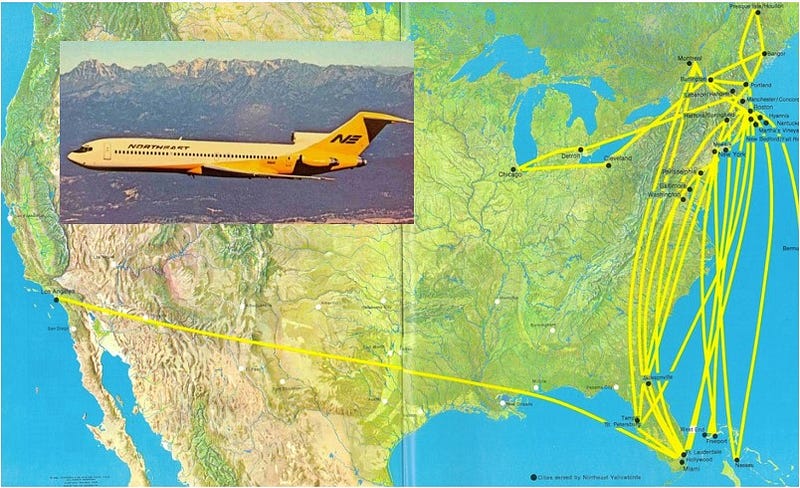
But long before deregulation, Delta made its first chess move by buying Boston-based Northeast Airlines. Their routes blanketed the East Coast from Miami to Presque Isle, Maine, as well as a stray route to Los Angeles. Painted in bright yellow, their jets were called “Yellow Birds.”
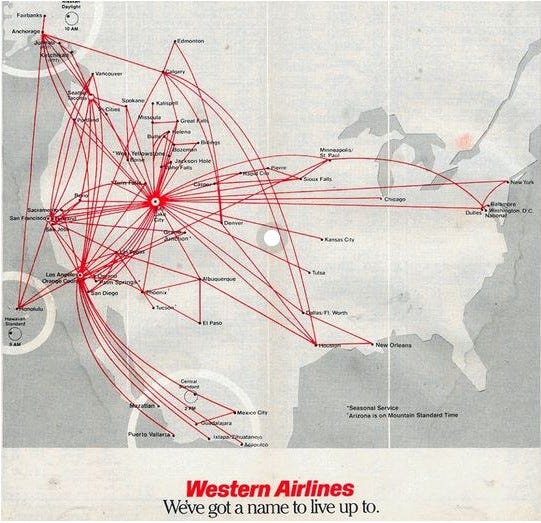
Delta grew organically, establishing vital hubs at Dallas/Fort Worth and Cincinnati. But without a presence in the fast-growing West, they would not be able to attain the kind of dominance they wanted. So they began looking in that direction and found a willing partner in Western Airlines, with which they merged in 1987.
With Western’s primary hub in Salt Lake City, the merger gave Delta a presence in all of the most important airports in the West, including service in cities where they were formerly weakly positioned: Los Angeles, San Francisco, and Seattle.
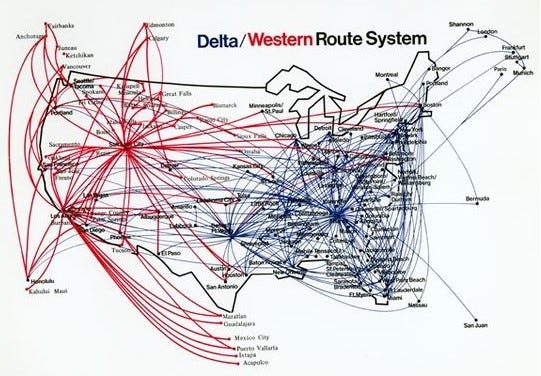
Here’s what the Delta route map looked like after the merger:
North Central Airlines
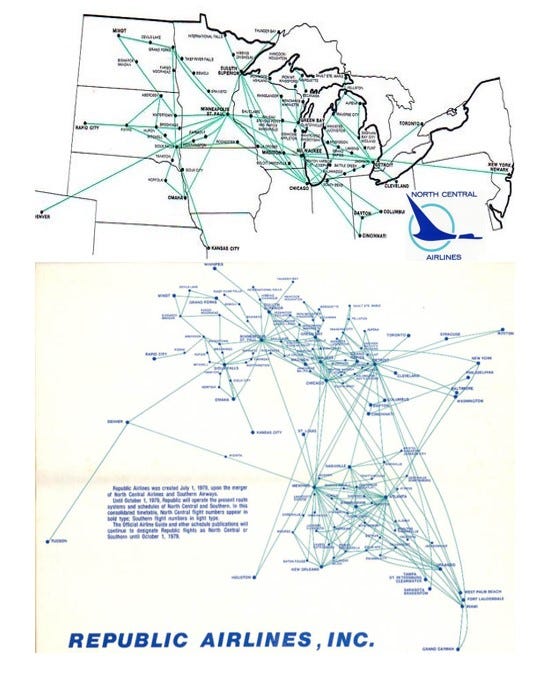
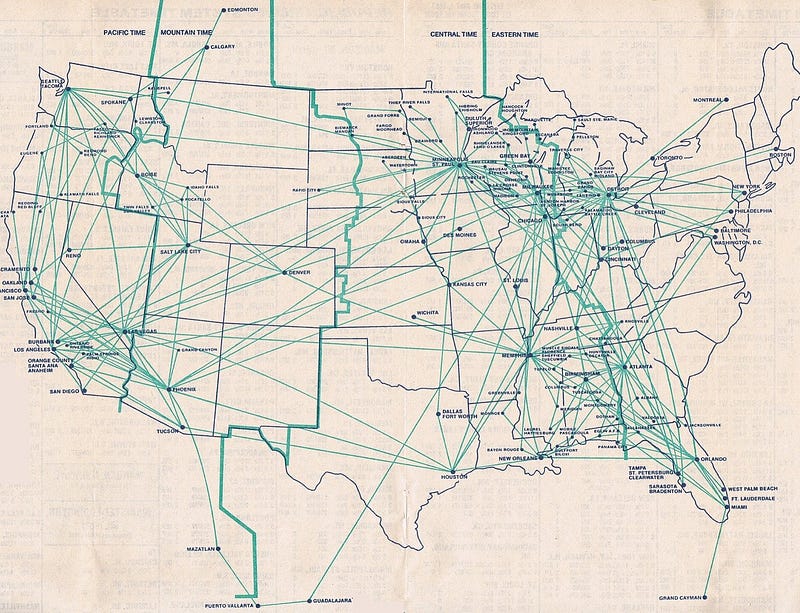
Years earlier, there was a dinky little puddle-jumper airline called Wisconsin Central Airlines. Once they decided to get out of their comfort zone and offer service to Michigan and Minnesota, they became North Central Airlines. Their routes served primarily small cities in the Upper Midwest, eventually spreading as far as Denver to the West and New York to the East. They chose to locate their headquarters and main hub at the Minneapolis/St. Paul airport, the same as Northwest Orient Airlines, which we will get to in a moment.
After deregulation, North Central was allowed to grow, and it acquired Southern Airways, another regional carrier, in 1979. Southern, with headquarters in Birmingham and hubs in Atlanta and Memphis, was ripe for a takeover. Many of their routes lost money as the price of fuel increased, and passengers opted to drive on new Interstate highways on the short hops.
Meanwhile, Out West…
A separate airline story is brewing which would eventually bring several players together into one.
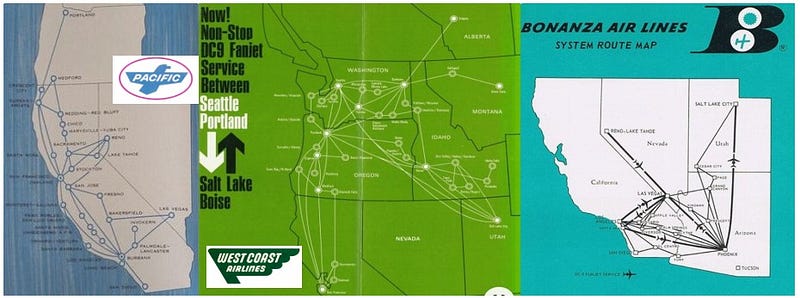
With the unification of Pacific, West Coast, and Bonanza Airlines, the newly formed Air West became a formidable western U.S. carrier. Delta has one small tie to TWA in this conglomeration: Howard Hughes gave up control of TWA in the 1960s, but he still wanted to be involved in the airline business. So in 1970, he purchased Air West, which was eventually renamed Hughes Airwest.
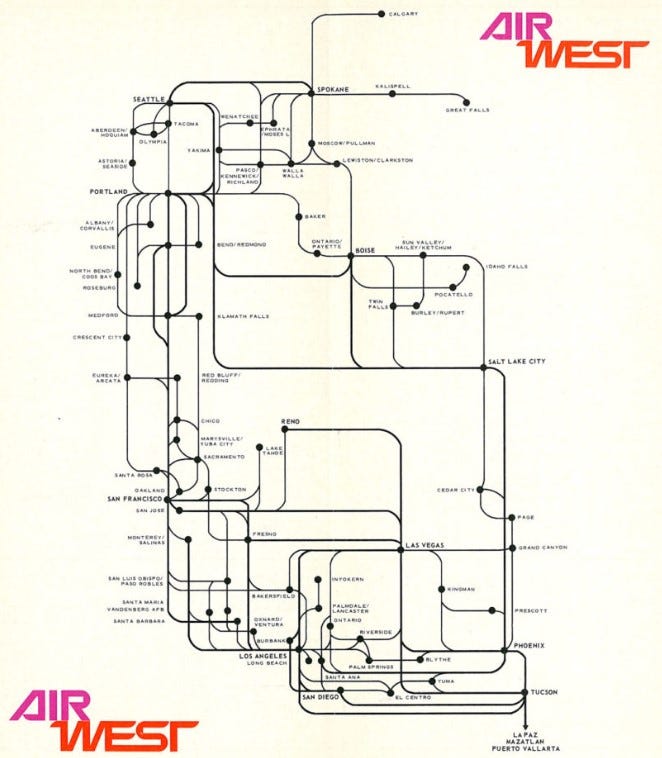
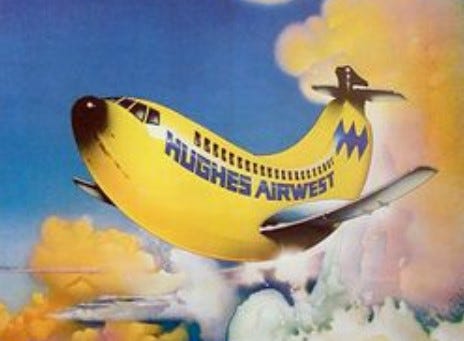
In 1980, after protracted labor issues at the airline, Hughes Airwest became the target of a takeover, which Republic succeeded at doing in 1980.
By this time, Republic had become a formidable national carrier and proclaimed to serve more airports in the U.S. than any other airline.
Then There Are Pan Am and National Airlines
Are you confused yet?
As mentioned earlier, Pan American World Airways was one of the two original U.S. airlines with authority to fly overseas. They were America’s unofficial flag carrier and, at one time, offered service to 86 countries on every continent. They flew to Europe and Africa from their New York hub, South America from Miami, and the Pacific from Los Angeles and San Francisco. However, their domestic network was practically non-existent. They relied on feed from the smaller airlines to fill up their international flights.
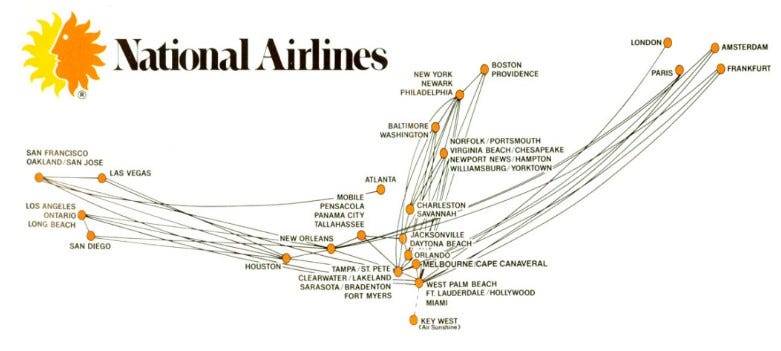
As deregulation matured, Pan Am found itself in the unenviable position of lacking that feed, so they purchased National Airlines, which had hubs in New York and Miami as well as Houston. But the move did little for their Pacific routes, and Pan Am sold those to United Airlines. They then started bulking up their domestic network with flights to New York from many major cities to fill their transatlantic routes, where they competed primarily with TWA. But it wasn’t meant to be, and they eventually sold almost all of their transatlantic flights to Delta, giving them a brand new market to exploit.
Sadly, PanAm went into bankruptcy in 1991, never to be resurrected. TWA was purchased by American Airlines in 2000 and ceased to be. The bigger they are, the harder they fall.
Northwest Orient Airlines
Now we come back to Northwest. By this time, Northwest was reluctantly sharing its hub at Minneapolis with Republic, which had grown through its acquisitions and mergers. Holdovers from those, they still had hubs in Atlanta, Memphis, Detroit, Chicago, Milwaukee, and several strong stations in the West. It was a lot to manage.
Eventually, Republic divested most of its routes acquired from Hughes Airwest, even its hub in Phoenix. It was hemorrhaging money from the acquisitions and the aircraft it had inherited. Seeing an opportunity to grow its international routes from Republic’s hubs in Minneapolis and Detroit, Northwest bought Republic in 1986, securing those two “fortress” hubs and gaining a third in Memphis, which remained primarily a domestic hub.
Enter Delta Air Lines
Does the big guy always swallow the little guy? Northwest, the world’s sixth biggest airline by this time, was not exactly small when it merged with Delta in 2008, making Delta the largest airline in the world. (That title would be short-lived after the American/USAirways merger in 2013.)
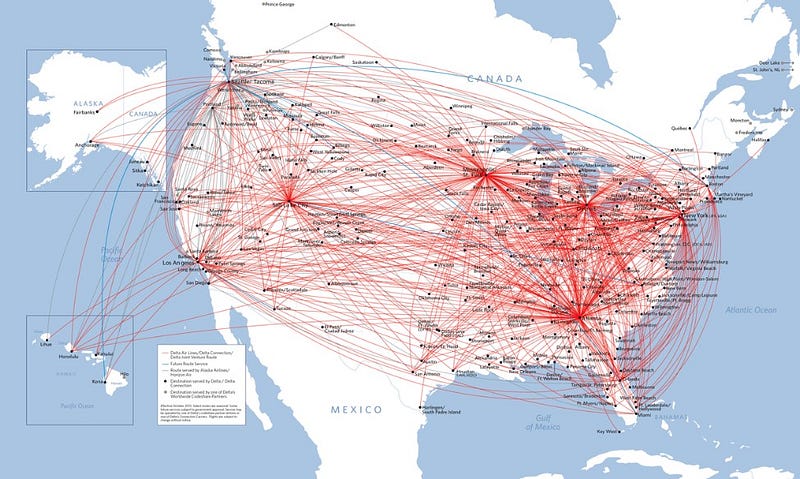
In The End
In the U.S., your choice of carriers is down to four in most instances (American, Delta, Southwest, and United). Of course, there are others, but these carry the majority of passengers.
And if you have stayed with this story this long, I applaud you. Thanks for indulging me!
Here are a couple of other stories about the business:
If you like to read, consider subscribing to Medium. For the price of a monthly magazine ($5/month), you’ll have access to all of my stories and thousands of other writers. And I’ll get a wee bit! Just click the link below.