Ethics, Opinion, Self-driving Cars
The Ethics of AI and Autonomous Vehicles
In a perfect world, AI should be developed to avoid unethical issues, but that may be unlikely since those issues cannot always be predicted. In an automated society, human beings will have the responsibility to support and protect each other more than today.
In the most diverse society sectors, artificial intelligence ( AI) is assuming a significant role.
We have no return point, and artificial intelligence will be incorporated into our daily life, professionally or socially, into our future.
With the crescent adoption of technology, some ethical concerns are posed by the notion of “thinking computers” to make decisions like humans.
A practical approach to AI adoption must be researched and examined, and this article starts to explore ethical guidelines for the use of intelligent and autonomous systems.
Artificial Intelligence ( AI) has been applied widely among us, with potentially great benefits to humanity, but at the same time, several concerns regarding AI’s unethical use are growing.
In an ideal world, one should configure the AI to avoid unethical tactics, but this could be impractical because it can not be defined beforehand. Research can be used to help regulators, enforcement workers, and others identify problem-sensitive solutions that may be lost in a massive strategy room.
It also indicates that rethinking how AI works in vast strategic spaces could be appropriate to reject unethical outcomes during the learning process explicitly.
From Asimov and beyond
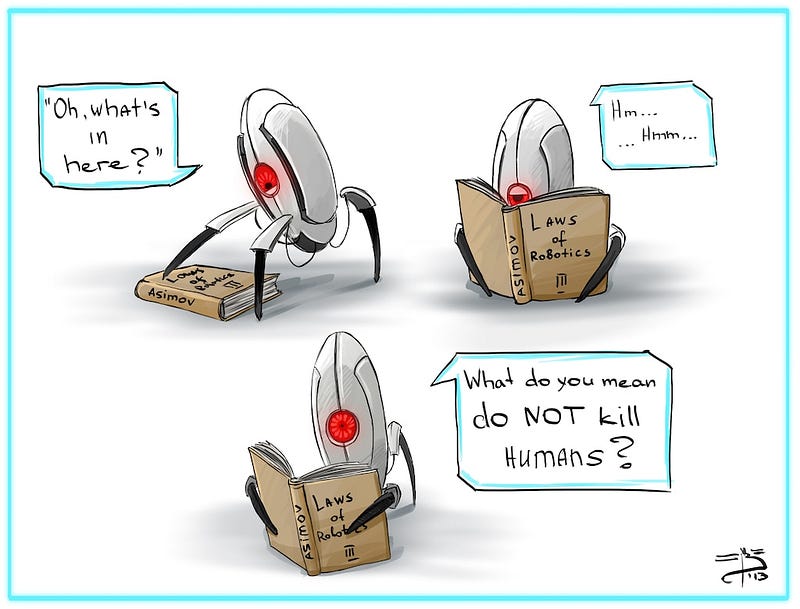
With the development of artificial intelligence, it is increasingly being applied and used in various fields, giving us enormous potential to enhance our environments, change our lives every day, and make the earth more successful. Simultaneously, as Artificial Intelligence is becoming more mainstream, it is difficult to ignore the ethical and moral experts' questions in robotics. When AI was only an idea present in science fiction works, many questioned its application's limits. Throughout his thesis, the famous writer and philosopher Isaac Asimov created the “Three Laws of Robotics” intending to make the coexistence of human beings and intelligent robots possible:
First Law: A robot may not injure a human being or, through inaction, allow a human being to come to harm.
Second Law: A robot must obey the orders given it by human beings except where such orders would conflict with the First Law.
Third Law: A robot must protect its own existence as long as such protection does not conflict with the First or Second Law.
Asimov later added “Law Zero,” which is above the others and specifies that:
A robot may not harm a human being, unless he finds a way to prove that ultimately the harm done would benefit humanity in general!
The discussion about how to “talk” Artificial Intelligence in the face of ethical and moral problems is very comprehensive. In a perfect world, AI should be developed to avoid unethical issues, but that may be unlikely since those issues can not be predefined.
Some examples of ethical issues and self-driving vehicle dilemmas
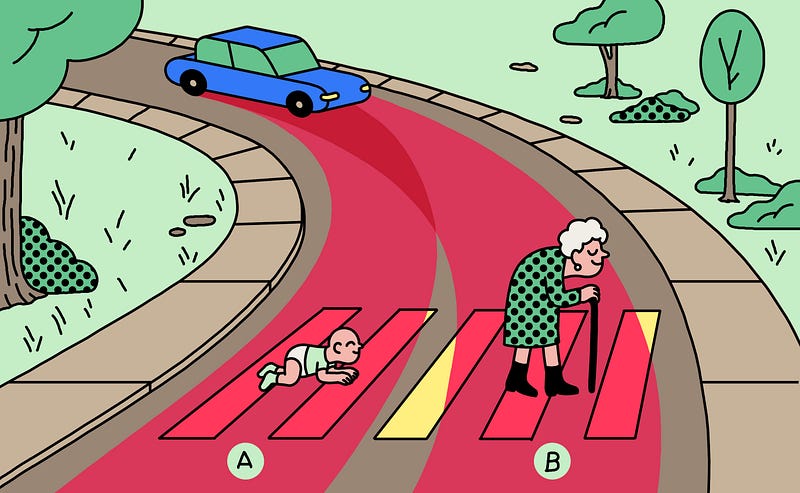
What should a self-driving vehicle do if there is any possibility that leads to some people's death? The only other option is a cliff, so what is this car doing? For years, philosophers have been discussing a similar moral dilemma. Still, the discussion has a new practical application with the advent of self-driving vehicles expected to become standard on the road in the coming years.
Another much-discussed issue is The Trolley Problem: Imagine that a given autonomous vehicle has six or five passengers, and you must pull a lever to switch to another lane, where only one person will be in the car’s path. Would you kill to save five of them?
Other situations can compound this moral imperative. For example, you are on a pedestrian bridge across the road, and you can see a five-person vehicle. There’s a huge man behind you, and you know that his weight is enough to stop the car. Is it a moral thing to drive him off the bridge to save the five?
These are not easy-answered questions, I know. When non-philosophical individuals are asked how driverless cars should deal with a situation where either passenger or driver death is imminent, most of them said cars should be designed to prevent passengers' injury. You can read more about it here…
Researchers, led by the Toulouse School of Economics psychologist Jean-François Bonnefon, in their The Moral Machine experiment, an on-line experimental platform designed to explore the moral dilemmas faced by autonomous vehicles.
The platform gathered 40 million decisions in ten languages from millions of people in 233 countries, showing that these differences correlate with modern institutions and deep cultural traits.
When it comes to autonomous vehicles, the experiment presented a series of crash scenarios to more than 900 participants concluding that 75% of the people thought the car would always deviate and destroy the passenger, even if only to save one passerby.
I believe that good activity generates the highest amount of people’s happiness. Based on this logic, any action possible to save the maximum number of people should be taken.
When it comes to autonomous vehicles, if a significant number of people are at risk due to an imminent crash, it may be an ethical and rational decision to proceed on its route, even though it means injuring an innocent pedestrian.
Some philosophers who opposed the Trolley issue argue that this approach is too simplistic in front of such a complex problem that required an extensive assessment of the consequences of the action and its moral ownership.
As Helen Frowe, Professor of Practical Philosophy at the University of Stockholm, once said, the autonomous vehicles manufacturers must build vehicles to protect innocent passengers, considering that those in the car should be anyway considered “more” responsible in case of incidents since they were in charge to decide to where the car should go and when, for instance.
What about children and autonomous vehicles?
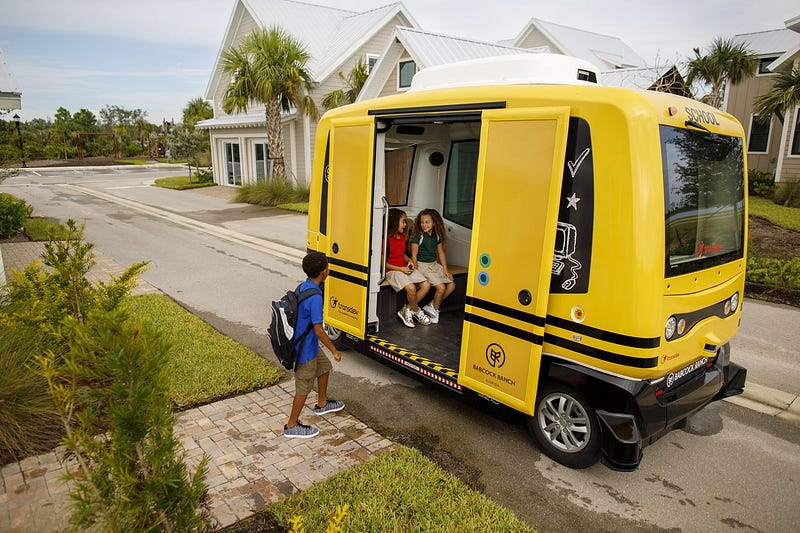
This is a hot topic, I know. Let me put one more ethical issue here: Let’s consider that a self-driving car can hold four passengers or two children in the rear seat. According to my previous thought, if all the vehicle passengers are adults, they should be responsible for avoiding a pedestrian.
But what happens if the only passengers inside the car are children going to school in the morning? Can we consider those children as morally responsible in case of a fatal incident using this same logic? Or inverting the parts, should we find ethically acceptable killing one older person in the street to save two children’s lives, for instance?
Some people should argue that, in cases where only adults are in the vehicle, we should have to save a vast number of people to make the death of one Passenger ethical, moral, and acceptable.
Are humans predictable?
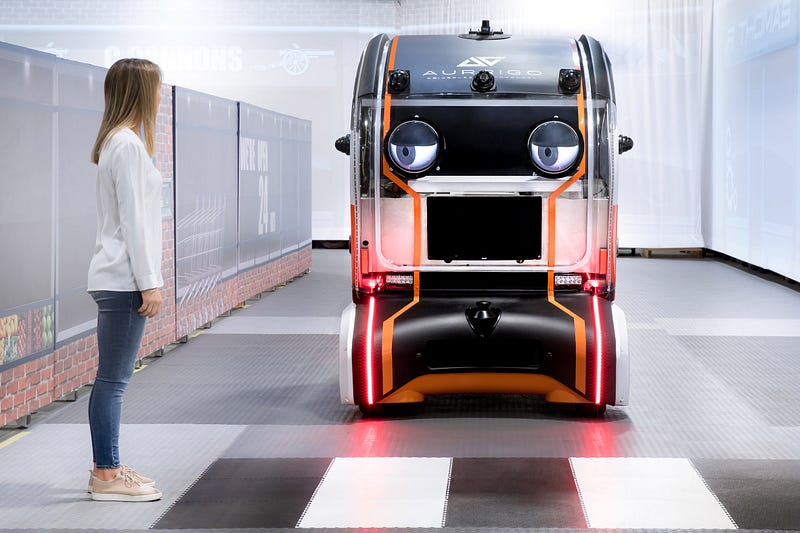
What if a pedestrian behaves irresponsibly, placing himself in front of an autonomous vehicle with the intent to cause him to deviate, resulting in the death of a passenger? Considering that self-driving vehicles do not judge cyclists and bikers' actions, this legal aspect would be difficult to take into account.
Despite hundreds of articles dealing with every little ethical detail, philosophers are far from finding a solution. Is it more unethical, for example, to deliberately divert the car from an alone passerby than actually to do nothing and cause the vehicle to reach a group of people, following a normative notion that morality should optimize satisfaction?
Honestly, I believe that human beings have a responsibility to support and to protect others. Behaviors that intentionally cause injuries or deaths are ethically worse than any action that may prevent them.
Self-driving cars can only meet very rarely in conditions where there are only two courses of action. It is far from unlikely that one day the system will have to choose whether to harm a passerby or a driver.
Of course, cars can only meet very rarely in conditions where there are only two courses of action, and the vehicle can conclude, with 100 % confidence, that any decision will lead to death. But those vehicles may one day have to choose whether to harm a passerby or the driver. We must design new software, systems, and algorithms that consider these questions and make ethical decisions.
Carmakers probably have the most significant responsibility on this topic. Most of the top players in the global market are still “waiting” to express their views on these ethical issues, probably because it seems complicated to find a satisfactory answer given the lack of unanimity on these issues.
The AI ethic issues and our responsible future.
The decision-making of computers leaves room for legal contradictions and errors.
There are several issues in the AI (artificial intelligence) legal controversy. Many countries hurry to develop industrial and military technologies in several ways, in contrast with ethical committees and institutions deputed to put restrictions and regulations in AI to keep it under control.
Specialized panels can review and, in some instances, block proposals by academics and private companies, but a reasonable way to tackle new technologies' threats without hindering technological advancement is by Congressional expert consensus.
Recently, the European Union published a document revealing that the society is considering banning facial recognition in public areas for three to five years. This year, Microsoft and IBM have agreed to follow this path. Meanwhile, I hope more rigorous rules are required.
Conclusion
Humanity is starting to use Artificial Intelligence ( AI) extensively, potentially with significant benefits. Yet questions about AI’s unethical use are on the rise.
In a perfect world, AI should be developed to avoid unethical issues, but that may be unlikely since those issues can not be predefined.
Research on Ethics can help policymakers, compliance officials, and other institutions find problem-sensitive approaches that lack in large areas of our society.
Self-driving cars are expected to become standard on the roads in the coming years, and this technology is not immune to regulatory contradictions and ethics issues.
In an automated society, more than today, human beings will have the responsibility to support and protect each other, and AI-powered behaviors that intentionally causes injury or death will be considered ethically worse than any action that might prevent them. We need to start thinking about it now!
Jair Ribeiro