
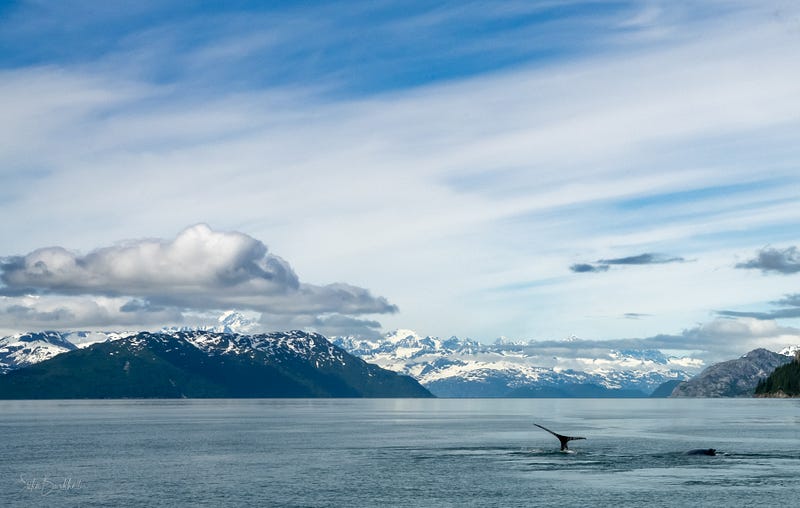
Nature, Travel
The Ethereal Experience of Listening to Humpback Whales Bubble-Net Feeding
Beneath the surface, a level of communication we couldn’t have even imagined had been taking place
“We sent whale song into interstellar space because the creatures that sing these songs are superlative beings that fill us with awe, terror, and affection. We have hunted them for thousands of years and scratched them into our mythologies and iconography. Their bones frame the archways of medieval castles. They’re so compelling that we imagine aliens might find them interesting — or perhaps understand their otherworldly, ethereal song.” ― Nick Pyenson, Spying on Whales: The Past, Present, and Future of Earth’s Most Awesome Creatures
Otherworldly kreens and yips, vacuous and yet tenacious in the rising and gathering of pitch, flooded our tiny catamaran cabin from the loudspeaker in the ceiling. Unable to control myself, tears began to spill from my eyes.
These were the calls accompanying the Humpback Whale bubble-net feeding display we’d witnessed just hours before. We’d been mesmerized by the delicate dance of orchestrated coordination of arching backs and fluking tails. But beneath the surface, a level of communication we couldn’t have even imagined had been taking place.
Captain Eric and his Hydrophone
We’d been roaming the waters in and around Alaska’s Inside Passage aboard The Alaskan Dream, a thirty-two-person catamaran. Captain Eric called it “The Floating Toaster,” but he liked it because it was small and maneuverable, and he could take it to where he knew the whales were.
And he did know, with a certain amount of surety, where particular pods of whales liked to hunt. He also understood these whales with a level of intimacy that few people on the planet possess, because he’d been listening to their conversations for years.
While we’d been so enraptured by what was happening on the surface of these frigid waters, he had lowered a hydrophone into the water to record what was happening underneath.
Bubble-Net Feeding Comes in Two Forms
In the late afternoon of the second day of our cruise, my husband and I had been up on deck, taking photographs of endless skies and icy waters slicked with a silvered sheen. We’d seen quite a few whales already. But we had not yet seen any bubble-net feeding.
Before we left home, we’d watched a National Geographic special, “The Secrets of the Whales.” It described a curious whale behavior, unique to Alaskan Humpbacks.
Bubble-net feeding is a cooperative feeding technique. It’s not something that Humpbacks know how to do instinctually. It is a learned behavior.
The whales use vocalizations, which we don’t yet understand, to round up schools of small fish, such as krill. They circle the school of fish, then work together to disorient and corral the fish into a ring, or “net,” of bubbles.
One whale begins the hunt by exhaling out of their blowhole towards the school of fish. The other whales begin to circle their prey and blow more bubbles.
The size of the “net” ranges from nine to ninety-eight feet in diameter.
“Bubble-netting” can either evolve up towards the surface, with whales jumping out of the water. Or it can descend down towards the depths through double loops.
This photo, taken in a different part of Alaska, shows a whale “lunging” up through a school of krill.
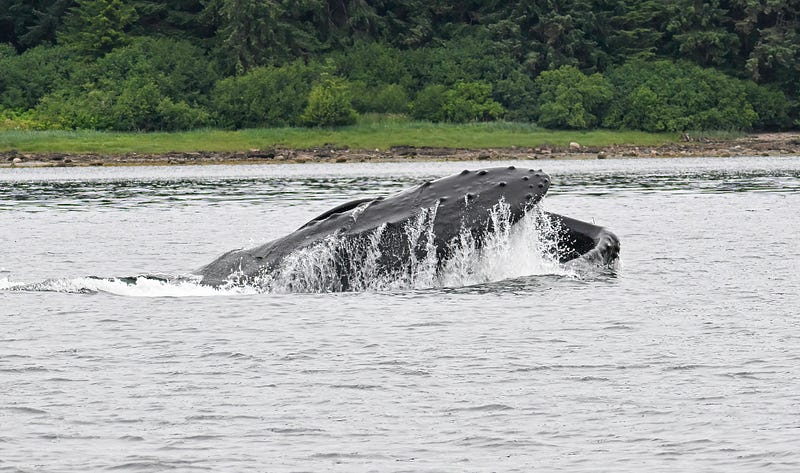
As the whales swim up to the surface to feed, they can hold up to fifteen thousand gallons of seawater in their mouths. The whales have fourteen to thirty-five throat grooves that run from the top of the chin all the way down to the navel, allowing their throats to expand.
The water is filtered through their baleen (teeth-like filters), trapping the fish.
The Second Form
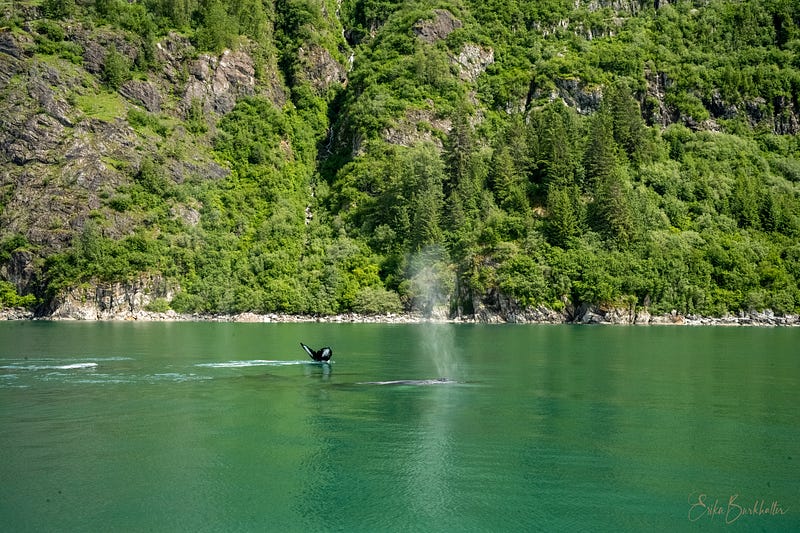
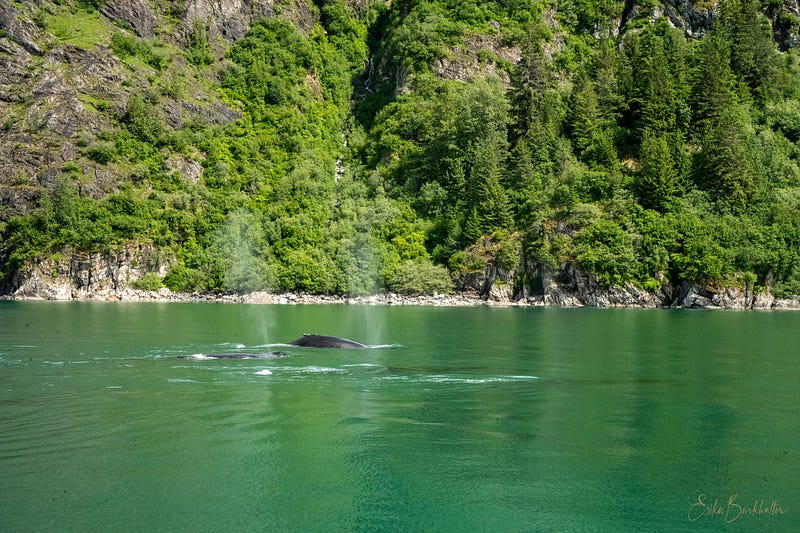
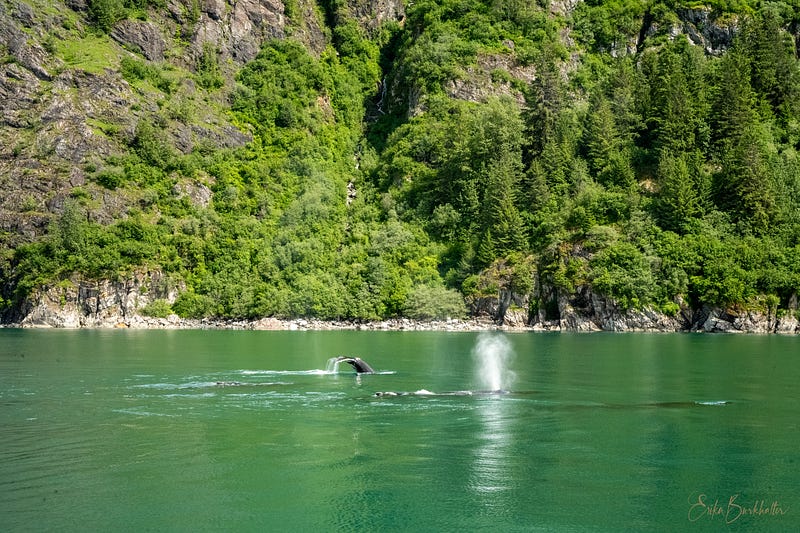
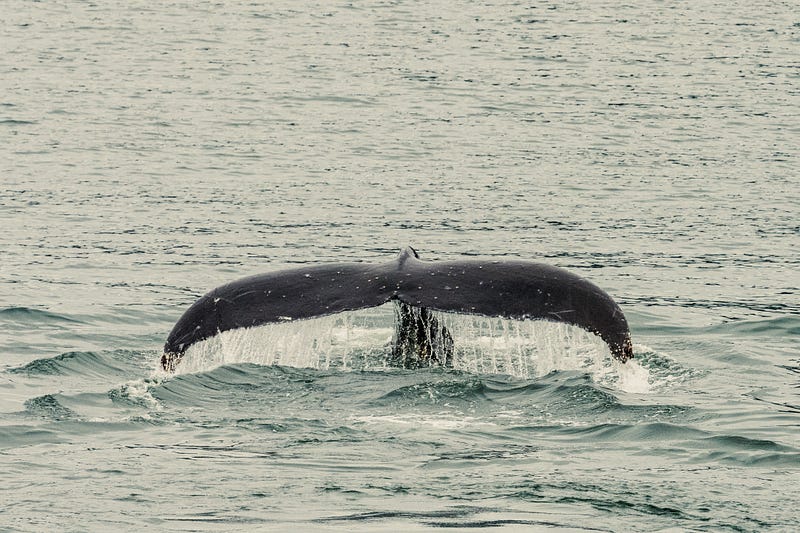
The second type of bubble-net feeding consists of the whales creating double loops of deep bubbles that herd the prey. They then slap the water with their tails to stun the fish before they all dive.
What we witnessed was the second type. And these whales did it over and over and over again, right before our eyes. It was one of the most incredible things I’ve ever seen.
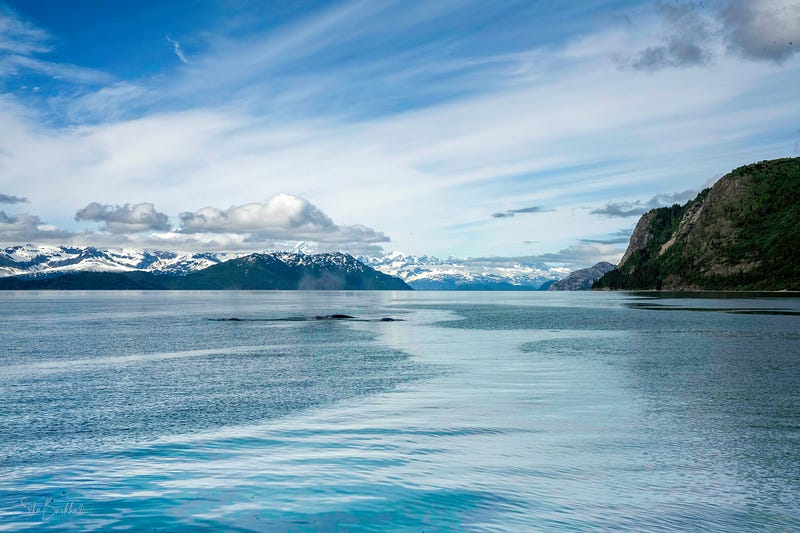
You can see the “tail slap” here.
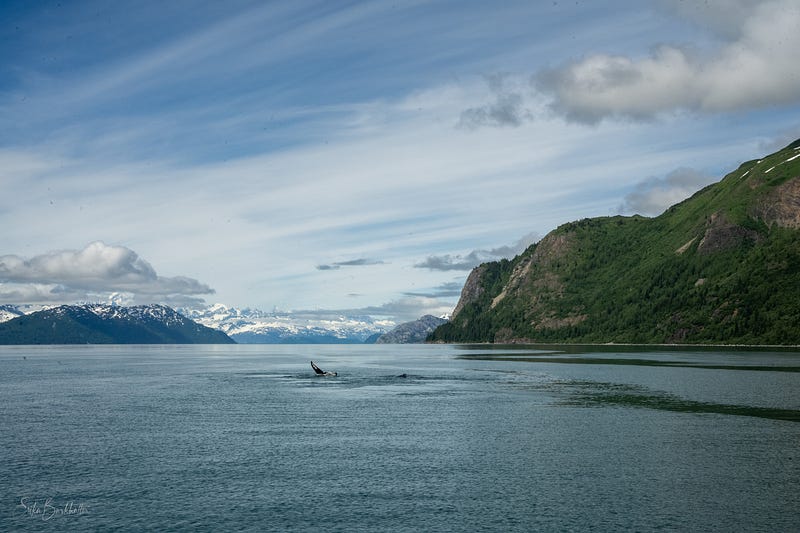
The same whales then dove under the boat and popped up close to shore on the other side, a little closer to us. Here you can see them circling and blowing and tail-slapping.
A Long Migration
Humpback whales migrate towards the equator in the winter, where they bear their calves. I was amazed to learn that they only eat for six months out of the year, while they are in cold water. Once they reach the warmer waters, there are no krill.
They must store enough fat reserves in the summer to live through their breeding season. Gestation lasts eleven-and-a-half months, and females reproduce every two years. Mothers typically give birth in mid-winter, usually to a single calf.
The calves suckle for about a year but can eat adult food at six months. Humpbacks mature, sexually, at five to ten years. Once grown, they are approximately forty feet in length. They can live as long as fifty years.
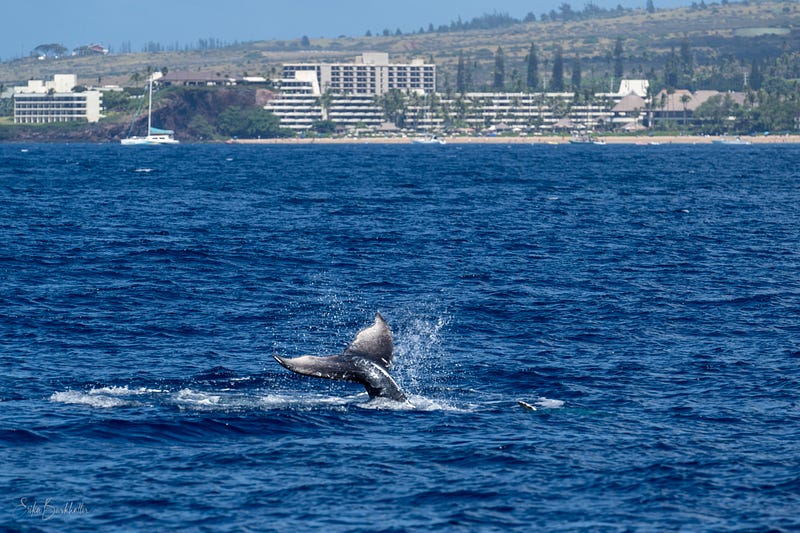
My husband and I normally take a trip to Maui in the winter. And we always do a whale-watching trip while we are there. It is always such a delight to see the baby whales.
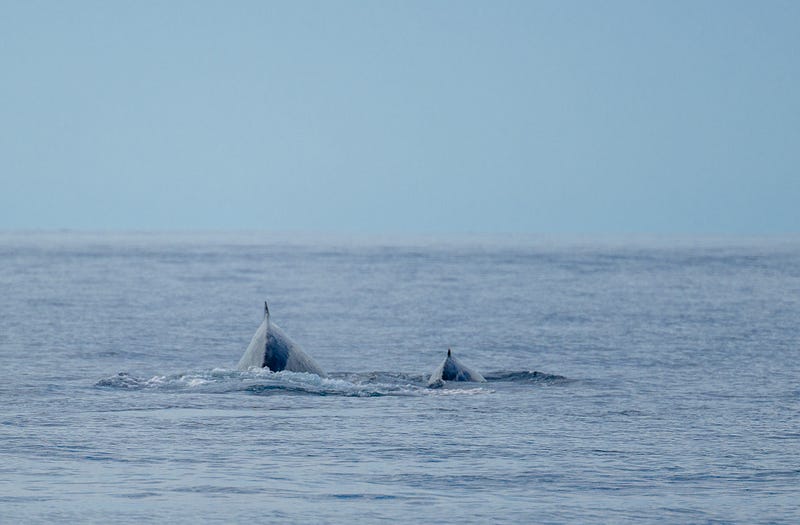
Whenever I see mother and baby whales in Alaska (we’ve done three summer trips) I wonder if they might be the same whales that we saw in Maui. I love the idea of these little babies, who are just learning to slap their tails, putting it all together in a bubble-net fishing hunt in Alaska.
Singing the Songs of the Ancients
Listening to the chirps and the lingering gutteral groans and the high-pitched response of another whale, I couldn’t help but wonder what they were saying to each other. This was more than a few words. This was a language. And it was complex.
Male humpback whales create songs during the winter breeding season. The melodies can travel at least six miles. These melodies might last from four to thirty-three minutes. In Hawaii, humpback whales have been recorded vocalizing for as long as seven hours.
But the sounds they make while they are diving are purely the vocalizations of communication, of group effort.
The grandmothers have taught the mothers, who have taught the calves, how to bubble-net feed. It is a wisdom passed down through the ages.
Just knowing this brings me a sense of peace. We, humans, have so much yet to learn about the animal kingdom. Part of me would love to know what the whales are singing about. But there is also a part of me that would love to just linger in the mystery of their world.
Erika Burkhalter is a yogi, neurophilosopher, cat-mom, photographer, and lover of travel and nature, spreading her love and amazement for Mother Earth’s glories, one photo, poem or story at a time. (MS Neuropsychology, MA Yoga Studies).
Thank you to the editors at Globetrotters (JoAnn Ryan, Anne Bonfert, Jillian Amatt — Artistic Voyages, Adrienne Beaumont, Michele Maize) for this month’s challenge — Wildlife:
September Monthly Challenge — Wildlife
What animals have you encountered on your travels?
medium.com
I also really enjoyed Adrienne Beaumont’ story:
And Michele Maize’s:
If you enjoyed this piece, you might consider subscribing to my stories. You’ll get an alert whenever a story gets published.
Photos and story ©Erika Burkhalter. All rights reserved.


