
The Escalating Opioid Epidemic in the United States
Exploring data about drug overdose from the Centers for Disease Control and Prevention

Patrik Radden Keefe is one of the best non-fiction writers of all time, and the way he delivers a meticulously researched story is otherworldly.
Two years ago, I read his book Empire of Pain (4.55 on Goodreads!), and it blew my mind. The book describes how the Sackler family built a fortune selling painkillers and how that led to an opioid epidemic in the United States, killing tens of thousands yearly.
It’s a book filled with facts you can’t put down because it’s so well written.
So, when I found that the Centers for Disease Control and Prevention have a public dataset on drug overdoses in the United States, I just had to explore the numbers.
Let’s take a look.
(If you enjoy learning through data exploration, make sure to check out my free newsletter, Beyond the Bytes)
Is there an epidemic?
You may have heard about the opioid epidemic, but if you’re like me, you probably don’t know the details.
But since we don’t want to live in darkness and not understand the world around us, it’s high time to take a closer look.
It turns out that in 2021 and 2022, more than 100,000 (110,759 in 2022) people died of a drug overdose in the United States, an increase of 107% compared to 2015. And the percentage where opioids are involved has gone from 64% to 77%.
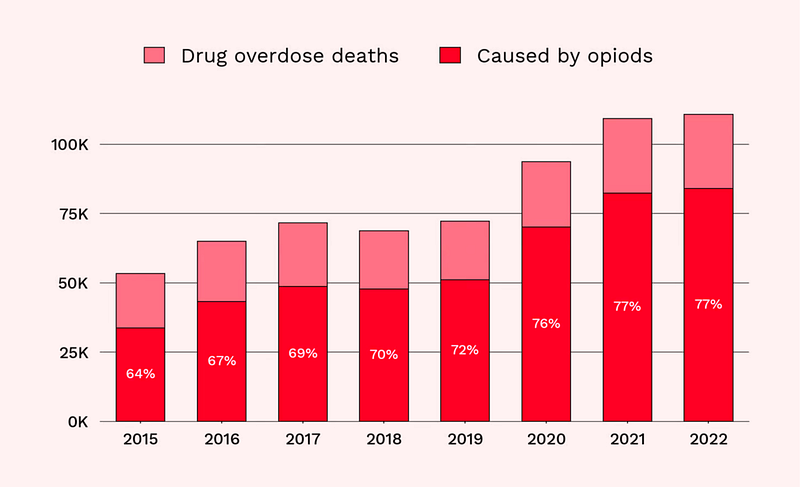
So how many are 110,759?
Well, given a population of 333 million, it’s roughly 33 out of 100,000. In 2020, there was an article in Sweden (where I live) stating that we had the highest rate of deaths caused by overdose in Europe at 8.1 per 100,000.
That’s a big difference.
Of all the deaths in the United States, drug overdose accounts for over 3%!
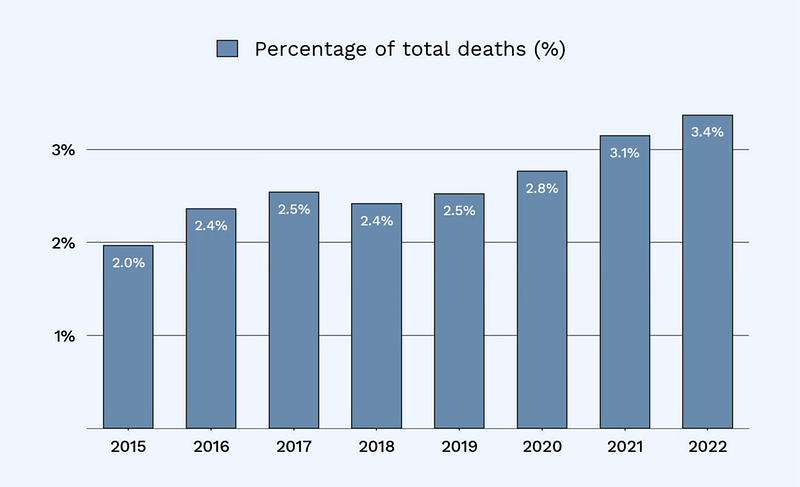
I can’t grasp my head around these numbers. Over 3% of all deaths in the United States are caused by drug overdose.
And so far, it doesn’t look better for 2023, where the latest values (from May) show an increase of 1.14% compared to December 2022.
Epidemic sounds like the correct word.
Which drugs are the problem?
Drug overdoses often include multiple substances. Apart from opioids, common maladies include amphetamine, cocaine, and heroin.
The following chart shows the change for the most common drugs between 2015 and 2022, where synthetic opioids have increased by over 600%.
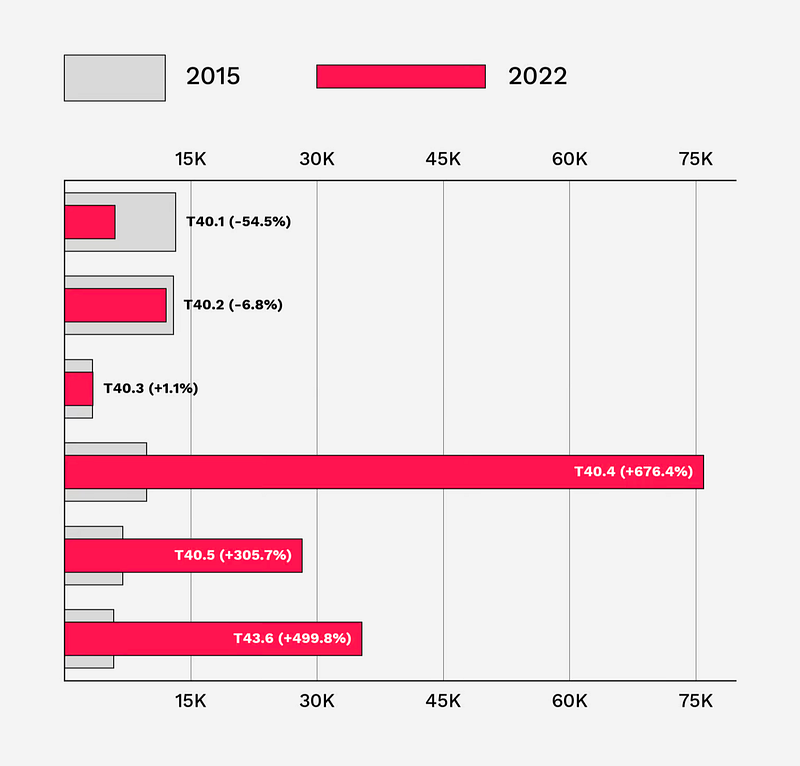
- T40.1 — Heroine
- T40.2 — Natural & semi-synthetic opioids
- T40.3 — Methadone
- T40.4 — Synthetic opioids, excl. methadone
- T40.5 — Cocaine
- T43.6 — Psychostimulants with abuse potential
Psychostimulants with abuse potential that has increased by almost 500% include drugs such as methamphetamine, amphetamine, and methylphenidate.
Is it the same in all of the US?
We can say with absolute certainty that the numbers won’t be precisely the same across the country, and some places are likely far worse off than others.
I want to look at individual states and see which ones suffer the most and if some are doing okay.
Here’s a hexagon map showing the change in cases between 2015 and 2022. Several states have had an increase of over 150%.
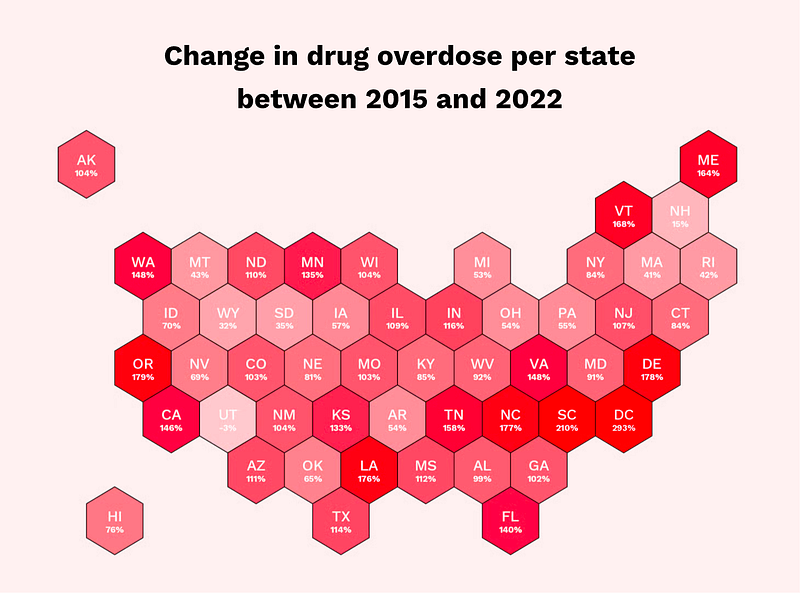
Perhaps even more surprising, given the dreadful scale of the problem, is that Utah has had a decrease of -3%. Finally, some good news, although that’s about it.
The change in cases is a great way to measure how well a state deals with a country-wide issue, but it doesn’t tell me where the population suffers the most (and least).
I think the ratio between deaths caused by drug overdose and total deaths is the perfect metric for that.
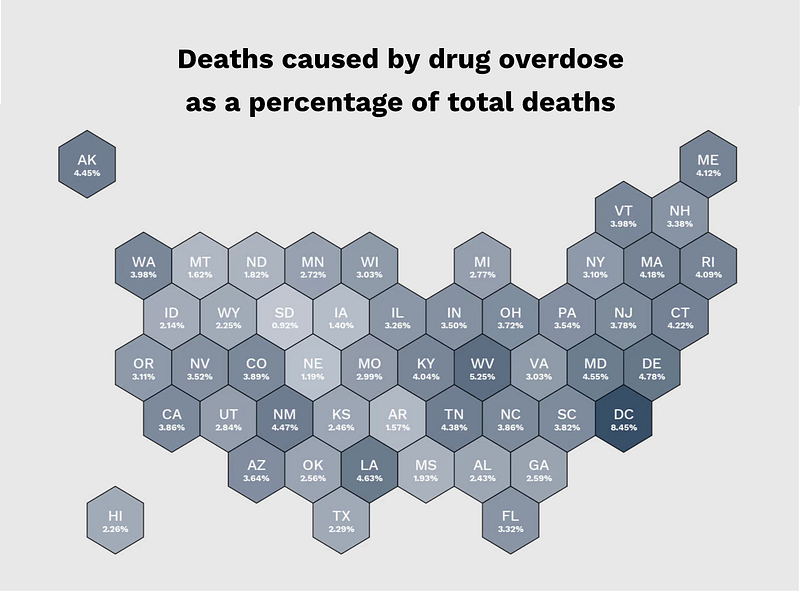
It seems that South Dakota, Iowa, and Nebraska suffer less compared to the other states, and they did have a relatively small increase in the previous chart.
District of Colombia is not technically a state, but it’s often included as a separate entity in visualizations like these, and here it stands out at 8.45%.
Can you imagine that the reason for 8.45% of all deaths in a population of over 700 thousand is drug overdose!?
I can’t.
Conclusion
The numbers in this dataset blow my mind, and they paint a horrendous picture. I can’t imagine the suffering behind these bytes, and I don’t want to.
I have yet to see any positive news on the development of the opioid epidemic, but the downtrend can’t continue forever.
Hopefully, books such as Empire of Pain and Netflix series like Dopesick put pressure on companies that earn profit from selling dangerous substances to people with minor health issues.
It’s evident that companies such as Purdue Pharma (the Sackler family) are the primary reason behind this development, and that’s just wrong.
Thank you for reading, and see you next time.


