
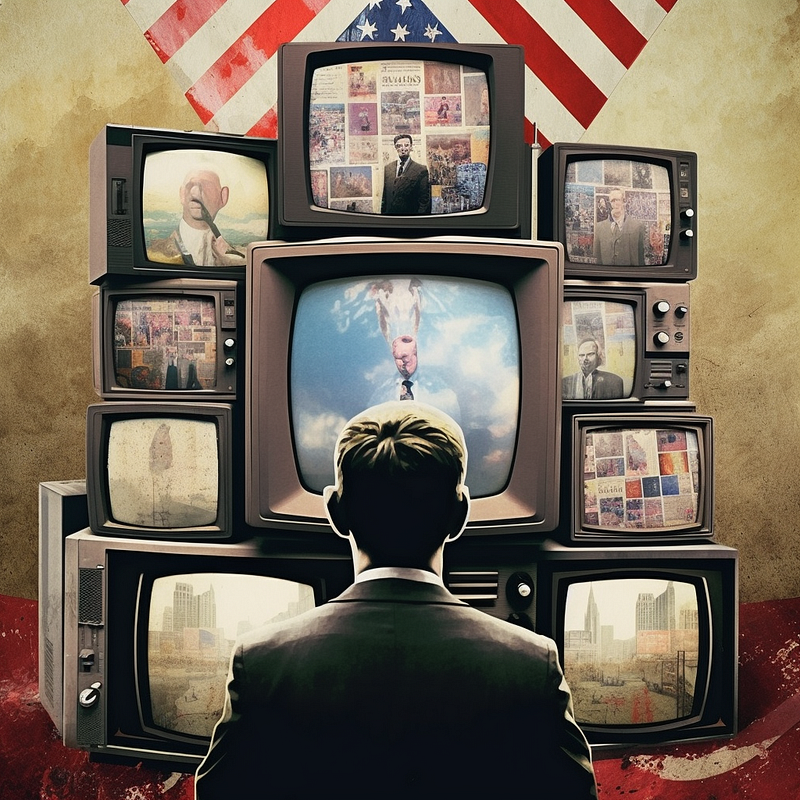
The Erosion of Media Regulation: From Public Interest to Corporate Influence
Picture this: You’re standing in a bustling city square at the dawn of the 20th century. Newsboys are shouting headlines from every corner, their voices competing with the clamor of streetcars and the chatter of passersby. Radios blare from open windows, broadcasting the latest news and entertainment to eager listeners. It’s the birth of mass media, a new era where information is becoming more accessible than ever before.
In this vibrant landscape, the government steps in. The year is 1934. It’s the year the Federal Communications Commission, or FCC, is born. The government recognizes the need for regulation to ensure that this powerful new tool serves the public interest. The FCC is tasked with maintaining a balanced and equitable media landscape, a public square where every voice can be heard.
But as we journey forward in time, the scene begins to change. The clamor of the city square fades into the background, replaced by the hum of servers and the glow of screens. The media landscape has expanded beyond anything the early regulators could have imagined, and with this expansion comes new challenges.
Next we’ll trace the evolution of media regulation in the United States, from its early days of serving the public interest to its current state, where corporate influence is increasingly prominent.
We’ll explore how these changes have shaped the media we consume and the impact they have on our perception of reality. In an era of media consolidation and digital disruption, who truly owns the media, and how does it shape our thoughts, feelings, and way of life?
The Federal Communications Commission (FCC) and Its Influence
In the heart of the Great Depression, as the nation grappled with economic hardship, a beacon of regulation emerged in the form of the Federal Communications Commission. Established in 1934, the FCC was a response to the rapid growth and influence of radio and telephone industries. Its mission was clear: to regulate interstate and international communications in the public interest.
The FCC’s influence was far-reaching. It held the power to grant and revoke licenses, and it enforced laws that shaped the very fabric of media ownership and content. One of the key laws enforced by the FCC was the Communications Act of 1934, which laid the groundwork for the regulation of telephone, telegraph, and radio communications.
The FCC also played a pivotal role in shaping the television landscape. The 1941 National TV Ownership Rule, for instance, limited the number of television stations that a single entity could own. This rule was designed to prevent monopolies and ensure a diversity of voices on the airwaves.
But perhaps the most influential policy enforced by the FCC was the Fairness Doctrine. Introduced in 1949, it required broadcasters to present contrasting views on controversial issues of public importance. This policy was a testament to the FCC’s commitment to fostering a balanced and equitable media landscape.
Reflecting on the FCC’s role in media regulation, it’s clear that its influence has been profound. From radio to television to the internet, the FCC has been at the forefront of ensuring that the media serves the public interest. But as we’ll see, this regulatory landscape would undergo significant changes in the decades to come.
The Fairness Doctrine and Its Impact
During the 20th century, a policy emerged that would significantly shape the media landscape: the Fairness Doctrine. Formulated by the FCC in 1949, the Fairness Doctrine required licensed radio and television broadcasters to present fair and balanced coverage of controversial issues of interest to their communities, including by granting equal airtime to opposing candidates for public office.
The Fairness Doctrine was more than just a policy; it was a commitment to maintaining a balanced and equitable media landscape. It ensured that diverse perspectives were heard, fostering a rich and robust public discourse. Broadcasters were not just providers of entertainment; they were custodians of the public interest, responsible for facilitating informed debate on issues of importance.
The effects of the Fairness Doctrine extended beyond the content of broadcasts. It shaped the very nature of public discourse, promoting a culture of balanced reporting and informed debate. It was a bulwark against the rise of partisan media, ensuring that all voices, no matter how controversial, had a chance to be heard.
But in 1987, the FCC formally repealed the Fairness Doctrine, although it maintained both the editorial and personal-attack provisions until 2000. More than 80 media rules maintained language that implemented the doctrine until they were finally repealed by the commission in 2011. The repeal of the Fairness Doctrine marked a significant shift in the media landscape, one that we will explore in the next section.
It’s hard not to feel a sense of nostalgia for a time when balance and fairness were not just ideals, but enforceable standards. A time when the airwaves were a public trust, not just a platform for profit. But as we stand here in the digital age, with the world’s information at our fingertips, we find ourselves at a crossroads.
The media landscape has changed dramatically, and with it, the rules of the game.
How do we uphold the principles of fairness and balance in a media landscape that is constantly evolving? How do we ensure that the voices of all members of our society are heard?
The Shift Toward Deregulation
As we approach the latter half of the 20th century, we witness a significant shift in the FCC’s policy. The 1970s and 1980s marked a period of deregulation, a departure from the FCC’s traditional role as a guardian of the public interest.
This shift was driven by a belief in the power of the free market to regulate itself. The FCC began to relax its rules, paving the way for greater media consolidation. The impact of this deregulation was profound. It led to a wave of mergers and acquisitions, transforming the media landscape. A handful of corporations began to dominate the airwaves, raising concerns about the diversity of voices in the media landscape.
The effects of this shift toward deregulation are still felt today. Media consolidation has continued unabated, with a few major corporations controlling a significant portion of the media we consume. This has raised concerns about the concentration of media ownership and its impact on the diversity of voices and perspectives in the media landscape.
The research suggests that media consolidation can lead to a shift in the focus of local news outlets. As conglomerates take control, local stations may begin to focus more on national politics at the expense of local issues, reshaping public discourse from the top down.
What is the impact of this consolidation on our media landscape? And more importantly, what does it mean for the future of media regulation? These are questions that we will explore in the next section.
The Telecommunications Act of 1996 and Its Consequences
The Telecommunications Act of 1996 was a landmark piece of legislation that significantly altered the media landscape in the United States. It was the first major overhaul of telecommunications law in over sixty years, paving the way for a new era of competition and innovation.
One of the key provisions of the Act was the relaxation of media ownership rules. Prior to the Act, a company could only own a limited number of radio and TV stations. But with the passage of the Act, these restrictions were significantly relaxed, allowing for greater consolidation in the media industry.
The consequences of the Telecommunications Act of 1996 were far-reaching. It accelerated the trend of media consolidation, reducing the diversity of voices in the media landscape. It also increased the influence of corporate interests in the media, raising concerns about the ability of the media to serve the public interest.
The Act had significant implications for the internet. It laid the groundwork for the digital age, promoting competition and innovation in the telecommunications industry.
It also raised new challenges for media regulation, as the internet blurred the lines between different types of media and disrupted traditional business models.
How has this legislation shaped our media landscape? And more importantly, how can we ensure that our media continues to serve the public interest in the digital age? These are questions that we will explore in the next section.
The Rise of Social Media and Its Regulatory Challenges
As the new millennium appeared, a new player entered the media landscape: social media. Platforms like Facebook, Twitter, and Instagram have grown exponentially, transforming the way we communicate, consume news, and engage in public discourse .
These platforms have given voice to the voiceless, democratized information, and reshaped our public sphere. They have allowed us to connect with others in unprecedented ways, breaking down barriers and fostering a global conversation.
The rise of social media has also raised new regulatory challenges. These platforms have become powerful gatekeepers of information, raising concerns about their role in shaping public discourse. Moreover, they have been implicated in a range of controversies, from the spread of fake news to the misuse of user data.
How can we regulate these platforms to ensure that they serve the public interest? How can we balance the need for free expression with the need to prevent the spread of harmful content? And how can we ensure that these platforms are held accountable for their actions?
The Future of Media Regulation
The future of media regulation remains a hotly debated topic. The advent of social media platforms, the surge in digital content, and the growing clout of corporate entities have all contributed to the complexity of this debate.
The role of corporate interests in shaping media regulation is a contentious issue. On one hand, these entities possess the resources and technical know-how to devise and enforce effective content moderation policies. On the other hand, their growing influence raises concerns about potential censorship and manipulation of public discourse.
Government regulation, too, has a pivotal role to play. However, it needs to be delicately balanced to safeguard free speech, curb the spread of harmful content, and ensure that the media serves the public interest. This is a daunting task, requiring a nuanced understanding of the intricacies of the digital media landscape.
Public advocacy is another key player in shaping the future of media regulation. By raising awareness about these issues, advocating for policy changes, and holding corporations and governments accountable, we can help ensure that our media landscape serves the public interest.
The path forward is uncertain, but one thing is clear: the decisions we make today will shape the media landscape of tomorrow.
The recent changes in Twitter’s leadership and the ensuing discussions about workforce and content moderation are a testament to this. The fact that the leader of Twitter also owns Starlink, a company that controls an increasing portion of internet access, and Neuralink, a company focused on developing implantable brain–machine interfaces, raises important questions.
At what point is it acceptable for one person to control such a vast amount of information and technology? How do we navigate the balance between innovation and the potential for misuse or abuse of power?
A recent development that underscores the evolving nature of this debate is the statement by France’s Digital Minister, Jean-Noël Barrot. He threatened to ban Twitter from the European Union if it refuses to comply with the incoming European Digital Services Act, which aims to curb disinformation and regulate digital platforms.
This raises the question: How do we ensure the proper flow of information when the control of that information is in the hands of a few?
Looking ahead, we must consider potential strategies for improving the role of social media in news dissemination and information sharing.
This could involve promoting media literacy, encouraging fact-checking, increasing transparency in algorithms, diversifying news sources, regulating political advertising, implementing robust user verification processes, involving the public in decision-making processes about content moderation policies, supporting quality journalism, and updating laws to hold social media platforms accountable for the spread of misinformation and harmful content.
These strategies could help improve the quality of news and information on social media, but they would require the cooperation of multiple stakeholders, including social media companies, governments, educators, and users themselves.
How can we ensure that the right information trickles down to the people when the control of that information flow is concentrated in a few hands? How can we navigate the balance between regulation and freedom of expression in the digital age?
The Media Landscape Today and Tomorrow
From the birth of the FCC in 1934, through the era of the Fairness Doctrine, the shift towards deregulation, and the rise of digital media, we’ve seen how media regulation has evolved and shaped the landscape of information dissemination. We’ve witnessed the shift in control, from the hands of the public to the grip of corporate interests, and the profound effects this has had on the diversity of voices and the quality of discourse.
Today, we stand at a crossroads, where traditional media is increasingly consolidated and digital platforms are disrupting the norms. The question of who truly owns the media is more complex than ever. Is it the corporations that control the airwaves and the digital platforms, or is it us, the users, who generate the content and engage with it?
How does this concentrated control of media shape our thoughts, feelings, and way of life? How does it influence our understanding of the world, our perceptions of truth, and our interactions with each other?
Consider the slow, steady flow of a river, gradually carving out a canyon over time. In the same way, the influence of these corporations, subtly and persistently, can erode the landscape of public discourse, shaping it in ways that serve their interests.
In this era of media consolidation and digital disruption, who do you believe truly owns the media? And why do you think they seek to control it? How does this control shape our thoughts, feelings, and way of life?
Before we proceed further into the implications of the media landscape, it’s important to understand a philosophical concept that can shed light on our current situation.
This concept is Plato’s allegory of the cave, a profound philosophical parable that illustrates the difference between the world of appearances and the world of reality. In this allegory, Plato invites us to imagine a group of people chained in a cave, facing the wall, and unable to turn their heads. Behind them, a fire burns, casting shadows on the wall.
The chained people can only see these shadows, which they perceive as reality. When one of them is freed and sees the fire and the world outside the cave, he realizes that what he thought was reality was merely a shadow of the truth.
This allegory is a metaphor for the human condition: we are often chained to our own limited perceptions, mistaking them for reality. In the context of our discussion, the cave can be seen as the media landscape, the shadows as the information we consume, and the freed person as someone who critically evaluates and seeks the truth beyond the presented narratives.
In the spirit of Plato’s allegory of the cave, we must strive to see beyond the shadows on the wall, to question the nature of the images presented to us, and to seek out the source of the light. For it is only by doing so that we can truly understand the world around us, and play an active role in shaping the media landscape of the future.
Thank you for reading all the way to the end! Your engagement is what makes this journey worthwhile for me, and I truly value your thoughts and opinions.
👉 Let’s Keep the Conversation Going:
- What was your biggest takeaway from this article?
- Is there a point you agree or disagree with? I’d love to hear your perspective.
- Do you have a personal experience that relates to the topic? Your stories make these discussions richer.
- Are there any questions or topics you’d like me to cover in future posts?
🙏 Your Voice Matters: By taking a moment to comment, you’re helping to elevate this conversation and make these discussions more dynamic and accessible to a broader audience.
So, let’s keep the dialogue alive and flowing! Your interaction is not just welcomed — it’s encouraged!
Thank you for being an integral part of this community. I’m eager to hear your thoughts!