
The Erase of a People
A look at intergenerational trauma.
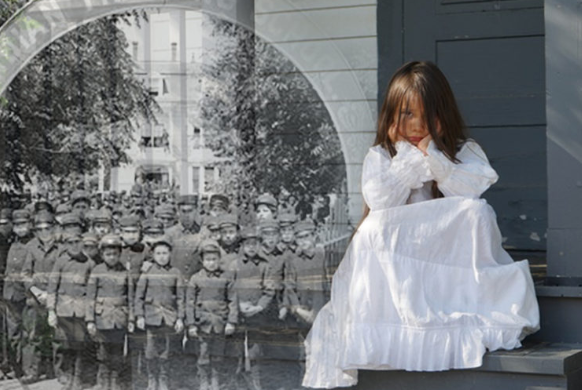
How easy it is to wipe away the things we don’t like. That drippy nose from a lingering cold, the headache after a night of bar-hopping, the smear of peanut butter on your toddler’s face… How easy it is to take for granted these things. Let’s not think about those who were before us. Those who were here before us, were just as easily wiped away.
Those who were here before us, you know, the ones who didn’t look like us, didn’t speak like us, didn’t pray to the “one true” God. The God we will later use to legitify the largest genocide in American History. All in the name of Manifest Destiny. The belief that taking over a foreign land, expanding territories God has clearly blessed us with because after all, we did find it — didn’t we? Did He not lead us here to conquer and kill under the guise of Christianity?
I recently watched the documentary, “The Wellbriety Journey to Forgiveness” a film that starts with the harsh prophecy of elders foretelling a time to come when devils will multiply this land, bringing with them destruction, tremendous suffering, mass relocations, babies ripped from mother’s arms, the poisoning of our land and our minds, the depletion of our resources, the sterilization of our women, the killing of our culture. They warned that four mind changers were coming — Liquid. Black Book. Song and Card. In the video it was mentioned so quickly, I only caught it the second time through.
Immediately I assume alcohol is “Liquid” and “Black Book” most likely the Bible, but I wondered what “Song” represents? Perhaps the Nation Anthem, or the hymns sang from the church pews. “Card” could be a tribal identification card, or maybe a social security card?
The film covers trauma that was inflicted upon Native American families who were torn apart during the times of relocation camps and boarding schools. Trauma is a word often heard in counseling. It is something I talk about with clients very often. Trauma can be passed down from generation to generation if it is never healed. In this film, what is addressed is intergenerational trauma.
This is a culture that was steep in history and spirituality. In the time of today, it can be taboo to refer back to a time when “men were taught to be men and women were taught to be women.” That is a direct quote of the film. I think it’s important to understand the Native American culture and history of its people in relation to that quote.
The men and women who were interviewed in this film, spoke of a time of harmony and families who loved and respected one another. Every member was encouraged to find their place in the home and community. Spirituality was their centering point and recognizing the earth as a gift. When their spirituality was taken, replaced with forced Christianity, their harmony was lost, and they began to kill and resent each other.
Children who had been removed from their families and placed to live in boarding schools were most often physically and sexually abused, whipped for speaking their native language, tortured for giving prayers to the earth and to their elders, their hair was cut, their names were changed to Americanized names and their moccasins were replaced with white men’s shoes.
The impact of boarding schools cannot be dismissed. These children lost their identities. Lost their homes, their sense of safety. They were not allowed “best friends” and were isolated, thus had difficulty forming healthy relationships later in life. They were told their whole lives were wrong. They of course had low self-esteem.
The families left behind were often relocated. Parental power was lost. The sanctity of extended family was nearly disintegrated. Tribal communities lost traditions and ceremonies. Their very languages forbidden. Tribal nations suffered weakened cultural structure, which depleted numbers for enrollment.
Most of those children never returned home. Ones who did were traumatized beyond recognition. These are children who were physically abused for mourning, for crying, for missing their mothers. These pains were never acknowledged or allowed to even be felt.
Addiction and Alcoholism was rampant… still is. Native Americans have the highest suicude rates to this day. Youth suicide snd PTSD rates are 3x that of the general public — the same rates as Iraqi Veterans. These self-destructions have passed from mother to daughter, from father to son and so on…
Bounties were placed on Natives heads. Genoicide was sanctioned under the watch of 24 United States Presidents. From 1830 through 1933. By 1920 99% of the Native American population was gone. Just gone.
Watching this video is not for those who may be in a melancholy mood. If you are able to hold off until the end of the film without tears you are one of few. But their story does not end here. You will be touched by the spirit of a forgotten and lost people, the strength of the community and the lingering desire to move forward.
The point of the movie is ultimately forgiveness and to find and help others. It is a purpose driven call. A purpose driven life. That is what their culture derived from and what the majority seek to remain close to.
This is a culture who only asks for acknowledgement. Every other atrocity committed against a culture or race in history seems to have an acknowledging force to affirm them. For someone to say that they are sorry this has happened to them and to fight alongside one another so that it never happens again.
To simply ask to not be wiped away.
*photo courtesy of the National Native American Boarding School Coalition


