avatarLucianoSphere (Luciano Abriata, PhD)

Free AI web copilot to create summaries, insights and extended knowledge, download it at here

4154

Abstract

numbers and their cosmic implications. While Tesla’s exact reasoning behind this sentiment remains a topic of debate, and might never be unveiled, it underscores the mystical aura that numbers hold in human consciousness -even if you are a hardcore scientist or engineer.</p><h2 id="2925">Seeking Your Place in π’s Digits</h2><p id="08de">Perhaps you’ve wondered whether your own identity could be embedded within the digits of π. Astonishingly, the answer is yes, albeit with a twist. The infinite and non-repeating nature of π ensures that every finite number sequence will eventually appear within it. This includes your phone number, street address, and even your favorite pizza recipe. However, direct observation of this phenomenon is unfeasible due to the endless nature of π’s expansion.</p><p id="a1b9">While unproven by observation, logic dictates that a proven transcendental number like π will encompass any finite integer at some point. Yet, intriguingly, it remains uncertain whether π’s sequence of digits is sparse or exhaustive. Imagine an infinitely long sequence without ‘9’s — it’s a possibility that adds to the mystique of this extraordinary constant.</p><p id="2fb8">But… you can always go and dig up inside π’s bowels. For example, around digit number 800,000 I find my day, month and year of birth:</p><figure id="da92"><img src="https://cdn-images-1.readmedium.com/v2/resize:fit:800/1*wYBb11Dn3PXP_PWh_WP8UA.png"><figcaption></figcaption></figure><p id="9175">I’m quite sure you will find interesting numbers in there. Either private, or of mere curiosity; for example, near the end of the first million digits, you can also find “23456789”. And you will find 12345 within the first million digits, but not 123456.</p><p id="2857">Go explore this “numerical library of Babel” <a href="https://www.piday.org/million/">here</a> and let me know in the comments what you found.</p><h1 id="d188">A never-ending source of curiosities</h1><p id="cc11">For over 250 years, the symbol π has stood as the mathematical embodiment of a circle’s essence, introduced by Welsh mathematician William Jones in 1706 and later popularized by the esteemed Leonhard Euler. Yet, the quest to unveil the precise value of π remains elusive, rendering exact calculations of a circle’s area and circumference an unattainable feat. Aware of this and the never-ending curiosities that the number evocates, every March 14th, math enthusiasts around the globe unite in celebration, marking Pi Day as a nod to the first three digits of this infinitely enduring number, 3.14. A convergence of mathematical curiosity and cultural revelry, the day speaks to the enduring fascination with π.</p><p id="ee47">But π’s influence extends far beyond mere festivities. From Rajveer Meena’s extraordinary recital of 70,000 decimal places, cloaked in a blindfold, to the intricate connection woven into the architecture of the pyramids of Giza, π’s numeric mystique permeates various realms. Its legacy extends even into the digit-structured language of Pi-lish, where lengths of words mirror the sequence of its digits, while William Shanks’ painstaking calculation effort and the record-breaking Swiss scientist’s 22 trillion digits computation highlight humanity’s unyielding quest to fathom this enigma.</p><p id="a271">Spanning scientific trials, mathematical discoveries, and cultural milestones, π’s allure is undeniable. Whether it’s Albert Einstein’s coincidental birth on March 14, or the stark realization that the number 123456 curiously eludes the first million digits, π’s journey is one of perpetual fascination. This infinitely long number finds its place in Egyptian myths, digital stress tests, linguistic innovation, and within the heart of circles themselves, where corners seem to stretch to infinity, mirroring the boundless nature of π itself. As mathematicians and enthusiasts continue their tireless pursuit, celebrating its marvels on Pi Day, π remains an emblem of both human curiosity and the timeless allure of numbers.</p><p id="d05f">As we journey through π’s infinite digits, we uncover not only the mysteries of numbers but also the bound

Options

less creativity that these mysteries inspire.</p><h1 id="ca32">Liked this? Then don’t miss…</h1><div id="ae4a" class="link-block"> <a href="https://readmedium.com/endless-afternoons-playing-four-fours-and-other-math-games-1c2a9245bf17"> <div> <div> <h2>Endless afternoons playing “Four fours” and other math games</h2> <div><h3>Rediscovering old books that communicated science and mathematics over a century before the internet; and recalling…</h3></div> <div><p>medium.com</p></div> </div> <div> <div style="background-image: url(https://miro.readmedium.com/v2/resize:fit:320/1*u9kJtUCOD4aLUPxbN01qPw.png)"></div> </div> </div> </a> </div><div id="7f41" class="link-block"> <a href="https://readmedium.com/the-knowledge-keeper-ac665a9d205a"> <div> <div> <h2>The Knowledge Keeper</h2> <div><h3>Novel about an AI version of Borges’ Library of Babel, that predicts what the future of information could look like.</h3></div> <div><p>medium.com</p></div> </div> <div> <div style="background-image: url(https://miro.readmedium.com/v2/resize:fit:320/1*17bsR4pT7UArXV9v96YNSw.png)"></div> </div> </div> </a> </div><div id="6b06" class="link-block"> <a href="https://readmedium.com/browsing-readable-books-in-borges-library-of-babel-with-chatgpt-1ac1344e77f"> <div> <div> <h2>Browsing readable books in Borges’ Library of Babel with ChatGPT</h2> <div><h3>An article blending fiction with real technology, about how to simulate access to books with readable content in the…</h3></div> <div><p>medium.com</p></div> </div> <div> <div style="background-image: url(https://miro.readmedium.com/v2/resize:fit:320/1*PlTHB75_PziWG84a9wZx0Q.png)"></div> </div> </div> </a> </div><div id="bc0b" class="link-block"> <a href="https://readmedium.com/the-animal-that-can-live-forever-27ce3d72d297"> <div> <div> <h2>The animal that can live forever</h2> <div><h3>It can reverse its own aging!</h3></div> <div><p>medium.com</p></div> </div> <div> <div style="background-image: url(https://miro.readmedium.com/v2/resize:fit:320/1*yY7NB2AJ_3pviX3IV6uPVw.png)"></div> </div> </div> </a> </div><div id="d5f6" class="link-block"> <a href="https://readmedium.com/new-antibiotics-are-hard-and-expensive-to-develop-so-scientists-are-trying-these-alternatives-b4af09ff22f8"> <div> <div> <h2>New antibiotics are hard and expensive to develop, so scientists are trying these alternatives</h2> <div><h3>Including things such as water activated with reactive species, repurposing medicaments that are already used for other…</h3></div> <div><p>medium.com</p></div> </div> <div> <div style="background-image: url(https://miro.readmedium.com/v2/resize:fit:320/0*ezPZZzURSAkXJEbC)"></div> </div> </div> </a> </div><p id="d214"><a href="https://www.lucianoabriata.com/"><b><i>www.lucianoabriata.com</i></b></a><i> I write and photoshoot about everything that lies in my broad sphere of interests: nature, science, technology, programming, etc. <a href="https://lucianosphere.medium.com/subscribe"><b>Subscribe to get my new stories</b></a><b> by email</b>. To <b>consult about small jobs</b> check my <a href="https://lucianoabriata.altervista.org/services/index.html"><b>services page here</b></a>. You can <a href="https://lucianoabriata.altervista.org/office/contact.html"><b>contact me here</b></a><b>.</b></i></p></article></body>

The enigmatic number π and Feynman’s fascination with it

Feynman’s point and other curiosities
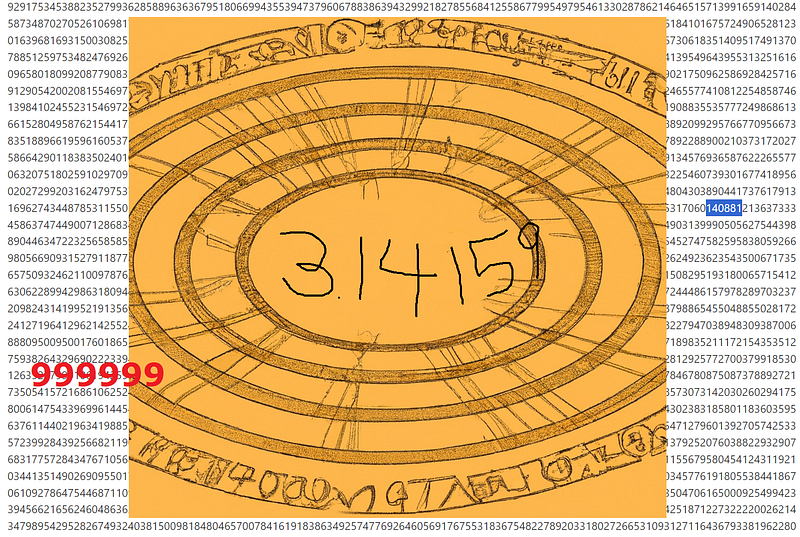
Figure created by the author from Dall-E-2 generations and custom edits.

In the realm of the science that brings us together here, there are some enigmatic constants that hold an allure for both scholars and enthusiasts alike. Among these, none captures the imagination quite like the illustrious π (pi), the mathematical constant representing the ratio of a circle’s circumference to its diameter. However, there’s more to this transcendental number than its geometric significance. Delve deeper, and you’ll uncover the fascinating world of recreational mathematics, where even a sequence of digits can spark curiosity and creativity; from plain people like us to geniuses like Richard Feynman.

The Feynman Point: A Jest in the Digits

Tucked away within the decimal expansion of π lies an intriguing landmark known as the Feynman Point. At the 762nd digit after the decimal point, a sequence of six consecutive nines emerges:
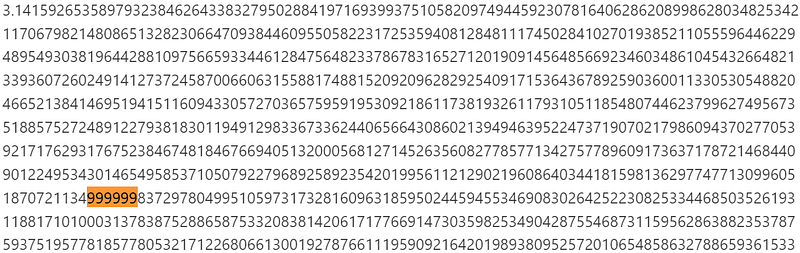
Screenshot from https://www.piday.org/million/. Trivia you can check right in that page: 999999 appears twice in the first million digits; and all other six-fold repeats of a single digits are there, in fact, 555555 appears three times!

Legend has it that Feynman humorously proposed memorizing the digits of π up to this point, so that he could then conclude its recitation with a “and so on” as if π were a rational number with an end. This whimsical notion aptly showcases Feynman’s playful approach to mathematics, a quality that endeared him to both colleagues and students.

The occurrence of the Feynman Point at such an early stage in π’s expansion is statistically significant, defying expectations of randomness. It’s a mathematical marvel that underscores the intricate beauty of numbers. Look at the caption of the above figure for more trivia.

Feynman effortlessly recited π up to 32 decimal places during one of his lectures. Not really very impressed by this, as we humans can easily train for memorization of numbers and words -think of addresses or phone numbers before smartphones arrived… an average human would recall tens of 6–8 digit-long numbers extremely easily. For reference, the record for reciting the most number of decimal places of π (by Rajveer Meena in India in 2015) reached 70,000 decimal places (evidence here at Guiness’ World Records). I myself learned by heart for a high school exam the first 9 digits of π, e, square roots of 2, 3, 5, and 7, and a few other numbers, as I wasn’t going to have a scientific calculator at hand (no, of course I didn’t need all those decimals, but hey, I was just less than 17 years old and needed some motivation!).

But Feynman’s relationship with π went beyond mere recitation. He was known for his unconventional methods of approaching π, demonstrating his creative problem-solving approach. His endeavors exemplified how recreational mathematics can be a playground for exploration, encouraging individuals to view numbers from a fresh perspective.

The Mystique of Numbers: The Significance of 9

Curiously, the sequence of consecutive nines at the Feynman Point isn’t the only connection to this intriguing digit. Nikola Tesla, another legendary mind, was captivated by the significance of 9 in the universe. Tesla’s famous quote “If you only knew the magnificence of the 3, 6, and 9, then you would have a key to the universe.” resonates with those who believe in the inherent harmony of numbers and their cosmic implications. While Tesla’s exact reasoning behind this sentiment remains a topic of debate, and might never be unveiled, it underscores the mystical aura that numbers hold in human consciousness -even if you are a hardcore scientist or engineer.

Seeking Your Place in π’s Digits

Perhaps you’ve wondered whether your own identity could be embedded within the digits of π. Astonishingly, the answer is yes, albeit with a twist. The infinite and non-repeating nature of π ensures that every finite number sequence will eventually appear within it. This includes your phone number, street address, and even your favorite pizza recipe. However, direct observation of this phenomenon is unfeasible due to the endless nature of π’s expansion.

While unproven by observation, logic dictates that a proven transcendental number like π will encompass any finite integer at some point. Yet, intriguingly, it remains uncertain whether π’s sequence of digits is sparse or exhaustive. Imagine an infinitely long sequence without ‘9’s — it’s a possibility that adds to the mystique of this extraordinary constant.

But… you can always go and dig up inside π’s bowels. For example, around digit number 800,000 I find my day, month and year of birth:
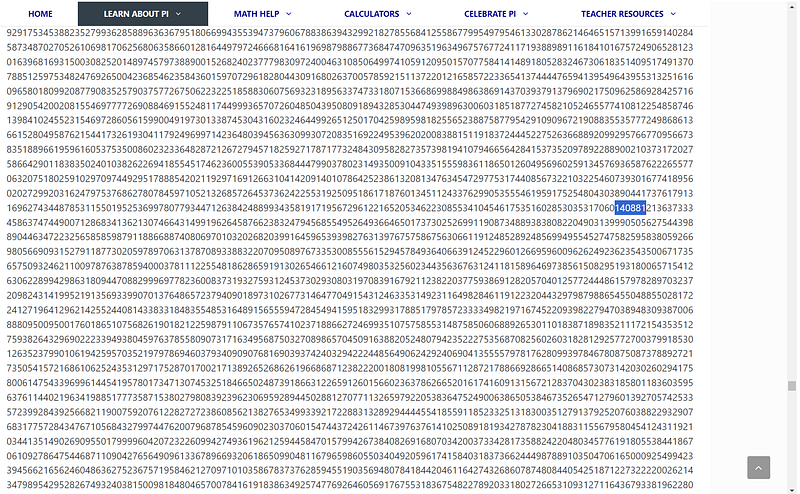
I’m quite sure you will find interesting numbers in there. Either private, or of mere curiosity; for example, near the end of the first million digits, you can also find “23456789”. And you will find 12345 within the first million digits, but not 123456.

Go explore this “numerical library of Babel” here and let me know in the comments what you found.

A never-ending source of curiosities

For over 250 years, the symbol π has stood as the mathematical embodiment of a circle’s essence, introduced by Welsh mathematician William Jones in 1706 and later popularized by the esteemed Leonhard Euler. Yet, the quest to unveil the precise value of π remains elusive, rendering exact calculations of a circle’s area and circumference an unattainable feat. Aware of this and the never-ending curiosities that the number evocates, every March 14th, math enthusiasts around the globe unite in celebration, marking Pi Day as a nod to the first three digits of this infinitely enduring number, 3.14. A convergence of mathematical curiosity and cultural revelry, the day speaks to the enduring fascination with π.

But π’s influence extends far beyond mere festivities. From Rajveer Meena’s extraordinary recital of 70,000 decimal places, cloaked in a blindfold, to the intricate connection woven into the architecture of the pyramids of Giza, π’s numeric mystique permeates various realms. Its legacy extends even into the digit-structured language of Pi-lish, where lengths of words mirror the sequence of its digits, while William Shanks’ painstaking calculation effort and the record-breaking Swiss scientist’s 22 trillion digits computation highlight humanity’s unyielding quest to fathom this enigma.

Spanning scientific trials, mathematical discoveries, and cultural milestones, π’s allure is undeniable. Whether it’s Albert Einstein’s coincidental birth on March 14, or the stark realization that the number 123456 curiously eludes the first million digits, π’s journey is one of perpetual fascination. This infinitely long number finds its place in Egyptian myths, digital stress tests, linguistic innovation, and within the heart of circles themselves, where corners seem to stretch to infinity, mirroring the boundless nature of π itself. As mathematicians and enthusiasts continue their tireless pursuit, celebrating its marvels on Pi Day, π remains an emblem of both human curiosity and the timeless allure of numbers.

As we journey through π’s infinite digits, we uncover not only the mysteries of numbers but also the boundless creativity that these mysteries inspire.

Liked this? Then don’t miss…

www.lucianoabriata.com I write and photoshoot about everything that lies in my broad sphere of interests: nature, science, technology, programming, etc. Subscribe to get my new stories by email. To consult about small jobs check my services page here. You can contact me here.

Mathematics
History
Fun
Reading
Biography
Recommended from ReadMedium