
Inflation Keeps Emptying Pockets
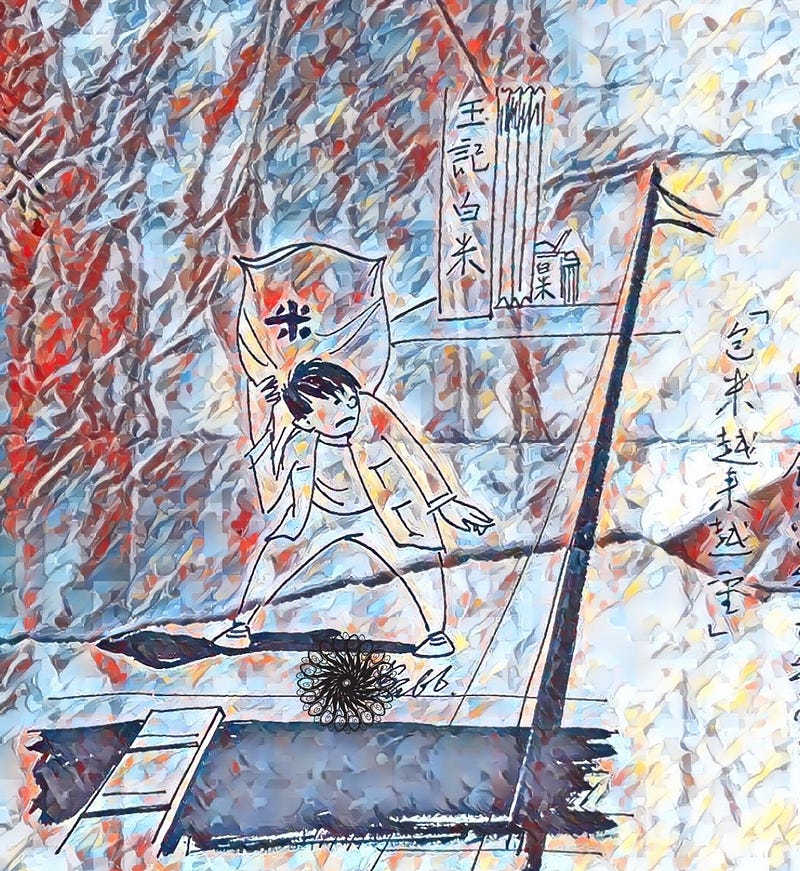
“Artwork by the late Edward Tse Yat Kei 1936 — 2022.”
Ah, the relentless waltz of inflation — an age-old tune that still hums through the alleys of history, echoing the clink of coins and the rustle of banknotes with each spiraling step. Back in the halcyon days of 1966, the dragon of inflation reared its head, and in the narrow streets of Hong Kong, the price of rice — a staple as fundamental as the very air the city breathed — climbed to heights as if trying to meet its sky-bound skyscrapers. The common folk watched, as their pocketbooks thinned, that precious grain transforming into a luxury, an ironic feast for the eyes alone.
Now, fast forward to our modern times. Isn’t it a marvel, a veritable spectacle, how the stage is set yet again? How faces weathered by time observe the rerun of an old show where the cost of living pirouettes out of reach, and rice — a simple sustenance still woven into the fabric of daily life — mocks from its pantry throne. Those with the leanest wallets feel each spike like a needle’s prick, a stinging reminder that while calendars may change, some scripts remain doggedly the same.
So here we are, in today’s grand bazaar of economic shuffle, witnessing the ghost of ‘66 haunting the market aisles. A specter twirling in a slow dance with the price tags of the present, reminding us, with a wry smile, that the more the years change, the more the struggles of the purse strings stay woefully identical._PHYLACTERIES OF FORTUNE, WEAR YOUR GRINS WELL, FOR THE MASQUERADE OF INFLATION IS ONE BALL THAT NEVER ENDS.
And so the masquerade of inflation is one ball that never ends, where the dancers — the rich and the poor — take their turns on the floor, but alas, some find their pockets ever-empty, whilst the golden rice sits just beyond their grasp, as tantalizing and elusive as it did in yesteryears. What a jest history plays on us, with its cyclical jests and jeers!
In this thought-provoking painting, we see a man burdened by a hefty bag of rice slung over his shoulder, depicting a scene that speaks to struggles and economic challenges.
At the center of the canvas stands the man, his figure dominating the foreground. The bag of rice is prominent, showing clear signs of weight and bulk as it presses against the man’s bent back. Its texture might appear rough and sturdy, typical of a sack used to transport grains. The Chinese character for “Rice” (米) is emblazoned on the bag, serving as an immediate visual cue to the contents within and the cultural context of the scene.
The man himself is potentially a laborer or a common citizen — a representation of the working class. His clothing might be simple, possibly worn, and appropriate for labor, suggesting a sense of modesty and hardship. The sunlight over his head casts a severe shadow directly underneath him, highlighting the intense heat of the day and perhaps symbolizing the heavy burden of economic pressure.
On the right side of the painting, there is a jarring reminder of the socio-economic theme: the Chinese words indicating “the rising price of rice”. This phrase adds a layer of meaning to the image, allowing it to serve as a potent symbol of the times, likely commenting on the socio-economic issues of inflation or scarcity affecting the population during the era the painting represents.
Completing the painting, at the bottom, the artist has inscribed a signature, a unique mark of identity and creativity. Accompanying the signature is the year “1966,” providing historical context. This was a time of significant political and social upheaval in China, aligning with the Cultural Revolution period, which drastically impacted every aspect of Chinese life, including the economy.
The painting, with its bold statement on the state of affairs in 1966, serves not only as an artistic expression but also as a historical narrative, capturing the essence of the individual’s plight against the backdrop of broader socio-economic challenges. Through the man’s weary posture and the bag of rice on his shoulder, it encapsulates a powerful story of perseverance amidst adversity and the relentless march of economic forces.